

Clepsydra
Essay on the Plurality of Time in Judaism
Published on 13. April 2016
Book
Hardback
384 pages
978-0-8047-8905-9 (ISBN)
Description
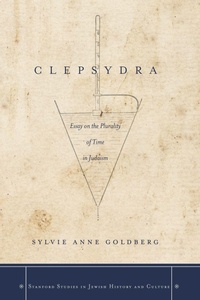
The clepsydra is an ancient water clock and serves as the primary metaphor for this examination of Jewish conceptions of time from antiquity to the present. Just as the flow of water is subject to a number of variables such as temperature and pressure, water clocks mark a time that is shifting and relative. Time is not a uniform phenomenon. It is a social construct made of beliefs, scientific knowledge, and political experiment. It is also a story told by theologians, historians, philosophers, and astrophysicists.
Consequently, Clepsydra is a cultural history divided in two parts: narrated time and measured time, recounted time and counted time, absolute time and ordered time. It is through this dialog that Sylvie Anne Goldberg challenges the idea of a unified Judeo-Christian time and asks, "What is Jewish time?" She consults biblical and rabbinic sources and refers to medieval and modern texts to understand the different sorts of consciousness of time found in Judaism. In Jewish time, Goldberg argues, past, present, and future are intertwined and comprise one perpetual narrative.
Consequently, Clepsydra is a cultural history divided in two parts: narrated time and measured time, recounted time and counted time, absolute time and ordered time. It is through this dialog that Sylvie Anne Goldberg challenges the idea of a unified Judeo-Christian time and asks, "What is Jewish time?" She consults biblical and rabbinic sources and refers to medieval and modern texts to understand the different sorts of consciousness of time found in Judaism. In Jewish time, Goldberg argues, past, present, and future are intertwined and comprise one perpetual narrative.
Reviews / Votes
"Sylvie-Anne Goldberg, a daughter of the Annales school, is truly a pioneer in the cultural history of Jewish time. Having her work available in English will help provide scope, grounding, and coherence to this lively area of current debate. It will at once set to rest some hoary falsehoods about Jewish 'timelessness' and spark new insights into the myriad and unexpected ways that Jewish temporalities are both distinctive and like those of the people amongst whom they live."-Jonathan Boyarin, Cornell University "Goldberg is a perceptive and eloquent observer of Jewish lore and customs, and Clepsydra is a fascinating essay."-Warren Zev Harvey, The Jewish Quarterly Review "An innovative perspective on time and Judaism and a contribution as valuable as its subject is vast. From now on, I will pause to ponder the attitudes towards time expressed by the authors, protagonists, and readers of the Jewish texts I encounter, and my anticipated musings are a greater gift than Sylvie Anne Goldberg could have given me with a fresh block of information."-David Malkiel, Bar-Ilan UniversityMore details
Series
Edition
New edition
Language
English
Place of publication
Palo Alto
United States
Target group
Professional and scholarly
Edition type
New edition
Product notice
Cloth
Dimensions
Height: 229 mm
Width: 152 mm
Thickness: 25 mm
Weight
567 gr
ISBN-13
978-0-8047-8905-9 (9780804789059)
Copyright in bibliographic data and cover images is held by Nielsen Book Services Limited or by the publishers or by their respective licensors: all rights reserved.
Schweitzer Classification
Persons
Sylvie Anne Goldberg teaches at L'Ecole des Hautes Etudes en Sciences Sociales and is the author of several books including Crossing the Jabbok: Illness and Death in Ashkenazi Judaism in Sixteenth- through Ninteenth-Century Prague.
Content
Introduction
1. Ad tempus universal. . . A Time for Everyone?
2. Where Does Time Come From?
3. Where Is Time Going?
4. God's Time, Humanity's Time
5. The Time to Come
6. Temporal Scansions
7. Eschatological Scansions: Jubilees and Apocalypses
8. Historiographical Scansions: Between Adam and the Present Time
9. Mathematical Scansions: In What Era?
10. Directed Time
11. Exercises in Rabbinic Calculation
12. Exercises in Rabbinic Thought
13. A Fleeting Conclusion
1. Ad tempus universal. . . A Time for Everyone?
2. Where Does Time Come From?
3. Where Is Time Going?
4. God's Time, Humanity's Time
5. The Time to Come
6. Temporal Scansions
7. Eschatological Scansions: Jubilees and Apocalypses
8. Historiographical Scansions: Between Adam and the Present Time
9. Mathematical Scansions: In What Era?
10. Directed Time
11. Exercises in Rabbinic Calculation
12. Exercises in Rabbinic Thought
13. A Fleeting Conclusion