

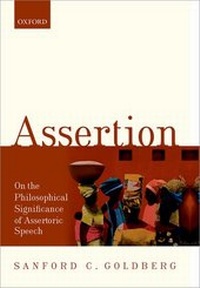
Assertion
On the Philosophical Significance of Assertoric Speech
Published on 19. February 2015
Book
Hardback
330 pages
978-0-19-873248-8 (ISBN)
Description
Sanford C. Goldberg presents a novel account of the speech act of assertion. He defends the view that this type of speech act is answerable to a constitutive norm--the norm of assertion. The hypothesis that assertion is answerable to a robustly epistemic norm is uniquely suited to explain assertion's philosophical significance--its connections to other philosophically interesting topics. These include topics in epistemology (testimony and testimonial knowledge; epistemic authority; disagreement), the philosophy of mind (belief; the theory of mental content), the philosophy of language (norms of language; the method of interpretation; the theory of linguistic content), ethics (the ethics of belief; what we owe to each other as information-seeking creatures), and other matters which transcend any subcategory (anonymity; trust; the division of epistemic labor; Moorean paradoxicality). Goldberg aims to bring out these connections without assuming anything about the precise content of assertion's norm, beyond regarding it as robustly epistemic. In the last section of the book, however, he proposes that we do best to see the norm's epistemic standard as set in a context-sensitive fashion. After motivating this proposal by appeal to Grice's Cooperative Principle and spelling it out in terms of what is mutually believed in the speech context, Goldberg concludes by noting how this sort of context-sensitivity can be made to square with assertion's philosophical significance.
Reviews / Votes
This is an excellent piece of philosophy and an essential contribution to the literature on assertion. Goldberg knows the terrain far better than most do, and his discussion is acute, fair-minded, and enlightening. Even a reader who retains at the end apreference for an alternative position will put the book down less confidently than it was picked up. * David Simpson, Monash University, Australasian Journal of Philosophy * Goldberg's book promises to be an important contribution to the literature: rigorously argued and with a rich source of material for future discussion, anyone with a specialist interest in assertion should read it. * Daniel Brigham, Analysis * This is an outstanding contribution to the growing literature on the speech act...Goldberg's work will surely be read for decades in both epistemology and the philosophy of language. With Assertion Goldberg only cements this legacy, presenting us with views that deserve to be the starting point of future investigations. Goldberg is an exceptionally clear writer, beginning each section with both a summary of the previous material and an explanation Aof its place in the book's larger scheme. It is this sort of clarity which makes it nearly impossible to get lost in the work even when it is at its most technical. This should be essential reading for those working in either the philosophy of language or epistemology. Philosophers of mind and psychology stand to learn much from it too. * Brian Montgomery, Notre Dame Philosophical Reviews Online *More details
Language
English
Place of publication
Oxford
United Kingdom
Target group
College/higher education
Professional and scholarly
Dimensions
Height: 240 mm
Width: 163 mm
Thickness: 24 mm
Weight
656 gr
ISBN-13
978-0-19-873248-8 (9780198732488)
Copyright in bibliographic data and cover images is held by Nielsen Book Services Limited or by the publishers or by their respective licensors: all rights reserved.
Schweitzer Classification
Other editions
Additional editions
E-Book
02/2015
1st Edition
OUP eBook
€20.99
Available for download
E-Book
02/2015
1st Edition
OUP eBook
€19.99
Available for download
Person
Sanford C. Goldberg is Professor and Chair of the Philosophy Department at Northwestern University. He works on topics at the intersection of epistemology, philosophy of mind, and philosophy of language. He is author of Anti-Individualism (CUP, 2007), Relying on Others (OUP, 2010), and numerous other articles on such topics as disagreement, testimony, reliabilism, metaepistemology, the semantics of speech reports, reference, self-knowledge, and attitude externalism.
Content
PART I: INTRODUCTION ; PART II: THE EPISTEMIC SIGNIFICANCE OF ASSERTION ; PART III: OTHER APPLICATIONS: MIND, LANGUAGE, AND MORE ; PART IV: A CASE FOR CONTEXT-SENSITIVITY IN THE NORM OF ASSERTION