

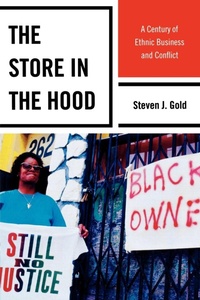
The Store in the Hood
A Century of Ethnic Business and Conflict
Published on 15. November 2011
Book
Paperback/Softback
328 pages
978-1-4422-0624-3 (ISBN)
Description
The Store in the Hood is a comprehensive study of conflicts between immigrant merchants and customers throughout the U.S. during the 20th century. From the lynchings of Sicilian immigrant merchants in the late 1800s, to the riots in L.A. following the acquittal of the police officers who beat Rodney King, to present-day Detroit, recurrent conflicts between immigrant business owners and their customers have disrupted the stability of American life. Devastating human lives, property and public order, these conflicts have been the subject of periodic investigations that are generally limited in scope and emphasize the outlooks and cultural practices of the involved groups as the root of most disputes.
This book develops a more nuanced understanding by exploring merchant/customer conflicts over the past hundred years across a wide range of ethnic groups and settings. Utilizing published research, official statistics, interviews, and ethnographic data collected from diverse locations, the book reveals how powerful groups and institutions have shaped the environments in which merchant/customer conflicts occur. These conflicts must be seen as products of the larger society's values, policies and structures, not solely as a consequence of actions by immigrants, the urban poor, and other marginal groups.
This book develops a more nuanced understanding by exploring merchant/customer conflicts over the past hundred years across a wide range of ethnic groups and settings. Utilizing published research, official statistics, interviews, and ethnographic data collected from diverse locations, the book reveals how powerful groups and institutions have shaped the environments in which merchant/customer conflicts occur. These conflicts must be seen as products of the larger society's values, policies and structures, not solely as a consequence of actions by immigrants, the urban poor, and other marginal groups.
Reviews / Votes
The story of ethnics and enterprise captures both the American dream and the American nightmare, since the same people who seem to be pulling themselves up by their bootstraps, seem to also find themselves in conflict with their neighbors and customers. In The Store in the Hood, Steven Gold revisits this American perennial, taking the long view to tell a surprising story about the conflicts both engendered and avoided by the past century's waves of ethnic entrepreneurs. This deeply researched, well-written book will appeal to students and scholars alike. -- Roger Waldinger, distinguished professor of sociology, UCLA The Store in the Hood offers a nuanced, thoughtful, and thorough account of merchant/customer conflicts in underprivileged racial minority communities over the span of one hundred years in American society. It dispels the myths about ethnic entrepreneurship and compels readers to think critically beyond existing theories and empirical findings. -- Min Zhou, Tan Lark Sye Chair Professor of Sociology at Nanyang Technological University and co-author of The Asian American Achievement Paradox This is a fascinating study, offering fresh insights in a lucid style, from a master sociologist with a keen sense of history. -- Reed Ueda, Tufts University Steven Gold has written an enlightening book, full of rich material, that brings fresh perspectives to a familiar American story: conflicts between immigrant and ethnic merchants and their customers. Providing fascinating case studies that take us from the early 20th century to the present, The Store in the Hood is an important addition to the literature on ethnic entrepreneurs. -- Nancy Foner, distinguished professor of sociology, Hunter College and Graduate Center of the City University of New York The Store in the Hood is a comprehensive study of conflicts between immigrant merchants and customers throughout the U.S. during the 20th century....This book develops a more nuanced understanding by exploring merchant/customer conflicts over the past hundred years across a wide range of ethnic groups and settings. Utilizing published research, official statistics, interviews, and ethnographic data collected from diverse locations, the book reveals how powerful groups and institutions have shaped the environments in which merchant/customer conflicts occur. * Cuss Newsletter: American Sociological Association * The continuing political debates about immigration make clear that race, ethnicity, and economics remain at the forefront of US national discourse. This study offers a historical overview of the relations between ethnic entrepreneurs and their customers. Because the merchant was often racially or ethnically different from the customers where the business was located, conflict was a common part of the relationship. Paradoxically, the business could be viewed as both a problem and a solution. By analyzing the topic in chronological periods, Gold (Michigan State Univ.) illustrates the complexity of American social and economic development and the obstacles that confronted immigrants and native black populations. For example, Italians, Greeks, Jews, Chinese, and others encountered open and frequently violent resistance to their economic ventures during the early 20th century. The Depression and WW II eras were characterized by racial hostility and antagonism, particularly toward entrepreneurs, and the ensuing postwar civil rights movement generated its own unique set of urban economic issues. Those issues are described in a case study of ethnic merchants in Detroit, the largest black majority city in the US. Overall, Gold provides an insightful treatment of minority groups and business opportunity in America. Summing Up: Highly recommended. * Choice Reviews * ...The Store in the Hood offers the most expansive and multi-faceted take on ethnic businesses available to date. Gold has a unique command on the literature of immigrant and minority businesses, a literature he helped construct. This book is strongly recommended for those interested in race relations generally and ethnic entrepreneurship in particular. * Ethnic and Racial Studies * What makes this book unique is its elegant synthesis of historical data and sociological theories on entrepreneurship and ethnic conflict. * Contexts * Gold takes a topic that has been indirectly addressed in several studies of ethnic business and tackles it head-on with a refreshing, unique approach.... Overall, Gold has written an easily accessible, informative book that will appeal to students and faculty in a variety of fields, as well as anyone interested in learning more about the sociological factors that lead to conflict between business owners and those they serve. * Contemporary Sociology * "The Store in the hood is a thorough account of merchant-customer conflicts in under privileged racial minority communities over the span of 100 years in urban America. Gold takes a chronological approach to unfold the phenomenon and explore variations in detail.""One of the key insights of Gold's study is its attention to multiple levels of analyses, different historical periods, and diverse contexts. Gold appreciates the significance of historical and contextual factors, showing how time and space have affected intergroup dynamics and how powerful groups and institutions have shaped the environments in which merchant-customer conflicts occur."
"The Store in the Hood offers a sophisticated understanding of the lives, challenges, and interpersonal relations that the merchants and their underprivileged customers confront on a daily basis in urban America throughout the entire 20th century. It dispels inaccurate assumptions and myths about ethnic entrepreneurship, and compels readers to think critically beyond established theories and empirical findings" * City & Community *
More details
Language
English
Place of publication
United States
Publishing group
Bloomsbury Publishing Plc
Target group
Professional and scholarly
US School Grade: From College Freshman to College Graduate Student, Interest Age: From 18 to 22 years
Dimensions
Height: 229 mm
Width: 152 mm
Thickness: 18 mm
Weight
477 gr
ISBN-13
978-1-4422-0624-3 (9781442206243)
Copyright in bibliographic data and cover images is held by Nielsen Book Services Limited or by the publishers or by their respective licensors: all rights reserved.
Schweitzer Classification
Other editions
Additional editions
E-Book
10/2010
1st Edition
Rowman & Littlefield Publishers
€45.49
Available for download
E-Book
10/2010
1st Edition
Rowman & Littlefield Publishers
€45.49
Available for download
Person
Steven J. Gold is professor and graduate program director in the department of sociology at Michigan State University. The past chair of the International Migration Section of the American Sociological Association, Gold is the author, coauthor or coeditor of six books and the coeditor of The New Americans book series from LFB Publishers.
Content
Preface
Acknowledgments
Chapter 1: Introduction
Chapter 2: Black Entrepreneurship from 1900 until 1935
Chapter 3: Immigrant Entrepreneurs' Relations with Customers in the Early 20th Century
Chapter 4: The Fate of Minority Merchants during Depression and War
Chapter 5: Government Policy, Ghettos, and Merchant-Customer Conflict after World War II
Chapter 6: Demographic Change and Urban Transformation: Interactions between Immigrant Business Owners and Customers, 1970 to 2005
Chapter 7: The Informal Economy as a site of Competition between Disadvantaged Populations and Ethnic Merchants
Chapter 8: Ethnic Merchants in a Black Majority City: The Case of Detroit (with Joe Darden)
Chapter 9:Social Inequality and Merchant-Customer Conflicts
Notes
Bibliography
Index
About the Author
Acknowledgments
Chapter 1: Introduction
Chapter 2: Black Entrepreneurship from 1900 until 1935
Chapter 3: Immigrant Entrepreneurs' Relations with Customers in the Early 20th Century
Chapter 4: The Fate of Minority Merchants during Depression and War
Chapter 5: Government Policy, Ghettos, and Merchant-Customer Conflict after World War II
Chapter 6: Demographic Change and Urban Transformation: Interactions between Immigrant Business Owners and Customers, 1970 to 2005
Chapter 7: The Informal Economy as a site of Competition between Disadvantaged Populations and Ethnic Merchants
Chapter 8: Ethnic Merchants in a Black Majority City: The Case of Detroit (with Joe Darden)
Chapter 9:Social Inequality and Merchant-Customer Conflicts
Notes
Bibliography
Index
About the Author