

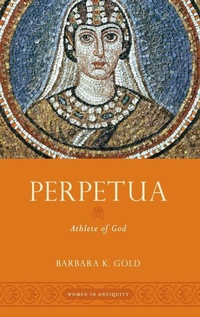
Perpetua
Athlete of God
Published on 8. November 2018
Book
Hardback
278 pages
978-0-19-538545-8 (ISBN)
Description
Perpetua was an early Christian martyr who died in Roman Carthage in 203 CE, along with several fellow martyrs, including one other woman, Felicitas. She has attracted great interest for two main reasons: she was one of the earliest martyrs, especially female martyrs, about whom we have any knowledge, and she left a narrative written in prison just before she went to her death in the amphitheater. Her narrative is embedded in a tripartite telling of the arrest and deaths of these martyrs, the Passio Sanctarum Perpetuae et Felicitatis. The other two parts of her tale were written by Saturus, a fellow martyr and probably her teacher, and a nameless editor or confessor, who introduces her circumstances and group and then tells of her death after she stops writing. Her story is steeped in mystery, and every aspect of her life and death has generated much controversy. Some do not believe that she herself could have written the narrative: the circumstances of her imprisonment and the limitations of her ability to write such a rhetorically complex tale are inconceivable. Some believe that her editor was none other then Tertullian, the famous 2nd-3rd century church father and Perpetua's fellow north African. Some, including Augustine, wonder why the feast day was named only for Perpetua and Felicitas and not for her fellow male martyrs. Some believe that these martyr tales were largely fabricated or constructed in order to generate publicity for the early Christians. This book will investigate and try to make sense of all aspects of Perpetua's life, death, and circumstances: her family and life in Carthage, Christians and Romans in Carthage and in the Roman empire in this period, the comparisons of martyrs to athletes, the influence of these martyr tales upon the Acts of the Apostles and the Greek novel, the reactions of later church fathers like Augustine to her story and her popularity, and the gendering of this text.
Reviews / Votes
The book is well written and it may serve as a good reference for anyone interested in the narrative of Perpetua. * Classical Journal-Online * Barbara Gold's discussion of Perpetua is a comprehensive evaluation of the extensive scholarship. * Raymond Van Dam, University of Michigan, Speculum * Dr. Gold has provided the readers of the Passion with a clearly written, solid and balanced introduction to the Passion which will extend its readership to an even broader audience. Gold's years of judicious study provide the reader with an intelligent reading of masses of scholarship. Her notes are generous as she provides conflicting scholarly points of view and deftly sorts through them allowing the reader to make up his or her mind on an issue. * Thomas J. Heffernan, Analecta Bollandiana * The book is thus a study not just of the historical Perpetua but of the literary one too; of the original woman and of the men who have successively rewritten her. * James Corke-Webster, Kings College London, Greece & Rome *More details
Series
Language
English
Place of publication
New York
United States
Target group
Professional and scholarly
Illustrations
7 halftones, 3 line art
Dimensions
Height: 240 mm
Width: 161 mm
Thickness: 20 mm
Weight
584 gr
ISBN-13
978-0-19-538545-8 (9780195385458)
Copyright in bibliographic data and cover images is held by Nielsen Book Services Limited or by the publishers or by their respective licensors: all rights reserved.
Schweitzer Classification
Other editions
Person
Barbara K. Gold is Edward North Professor and Chair of Classics at Hamilton College. She is the editor of Literary and Artistic Patronage in Ancient Rome, author of Literary Patronage in Greece and Rome, and co-editor of Sex and Gender in Medieval and Renaissance Texts: The Latin Tradition and Roman Dining.
Content
Preface
Acknowledgements
Introduction
Chapter 1: Perpetua's Passio: Text, Authorship, Authenticity
Chapter 2: And I Became Male: Gender and The Athlete
Chapter 3: A Matter of Genre and Influence: The Passio and Greco-Roman Pagan and Christian Narratives
Chapter 4: Carthage: Pagan Culture, Religion, and Society in the Early Empire
Chapter 5: Carthage: The Early Christian Community
Chapter 6: Perpetua's Life: Family (Natal and Christian), Education, and Social Status
Chapter 7: The Conditions of Martyrdom in the Roman Empire
Chapter 8: The Nachleben of Perpetua: Her Unwitting Legacy
Bibliography
Passio Sanctarum Perpetuae Et Felicitatis
Acknowledgements
Introduction
Chapter 1: Perpetua's Passio: Text, Authorship, Authenticity
Chapter 2: And I Became Male: Gender and The Athlete
Chapter 3: A Matter of Genre and Influence: The Passio and Greco-Roman Pagan and Christian Narratives
Chapter 4: Carthage: Pagan Culture, Religion, and Society in the Early Empire
Chapter 5: Carthage: The Early Christian Community
Chapter 6: Perpetua's Life: Family (Natal and Christian), Education, and Social Status
Chapter 7: The Conditions of Martyrdom in the Roman Empire
Chapter 8: The Nachleben of Perpetua: Her Unwitting Legacy
Bibliography
Passio Sanctarum Perpetuae Et Felicitatis