

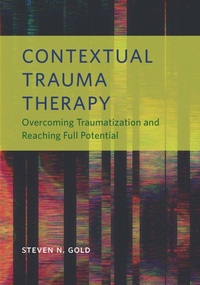
Contextual Trauma Therapy
Overcoming Traumatization and Reaching Full Potential
Will be published approx. on 28. April 2020
Book
Paperback/Softback
319 pages
978-1-4338-3199-7 (ISBN)
Description
This book weaves together clinical insights, research findings, a cohesive theoretical model, and a detailed account of how to implement the components of contextual trauma therapy, a form of treatment specifically designed for survivors of complex traumatization.
Contextual trauma therapy draws on a unique premise: that many survivors suffer not just from multiple traumatic events, but also from the consequences of childhood developmental deprivation. They have not only repeatedly encountered trauma and violence, but also have been denied some of the most fundamental interpersonal resources that all children require. Author Steven Gold guides readers through the process of forming collaborative relationships with patients who may lack confidence in any social connection, fostering sound judgment and reasoning in clients who grew up with capricious and unpredictable caretakers, and transmitting capacities that promote not only resolution to traumatization, but also a foundation for a gratifying and productive adult life.
Contextual trauma therapy draws on a unique premise: that many survivors suffer not just from multiple traumatic events, but also from the consequences of childhood developmental deprivation. They have not only repeatedly encountered trauma and violence, but also have been denied some of the most fundamental interpersonal resources that all children require. Author Steven Gold guides readers through the process of forming collaborative relationships with patients who may lack confidence in any social connection, fostering sound judgment and reasoning in clients who grew up with capricious and unpredictable caretakers, and transmitting capacities that promote not only resolution to traumatization, but also a foundation for a gratifying and productive adult life.
More details
Language
English
Place of publication
Washington DC
United States
Target group
Professional and scholarly
Edition type
Annotated edition
Product notice
Paperback (trade)
Dimensions
Height: 251 mm
Width: 175 mm
Thickness: 15 mm
Weight
590 gr
ISBN-13
978-1-4338-3199-7 (9781433831997)
Copyright in bibliographic data and cover images is held by Nielsen Book Services Limited or by the publishers or by their respective licensors: all rights reserved.
Schweitzer Classification
Person
Steven N. Gold, PhD, is a professor in the College of Psychology at Nova Southeastern University and director of the Trauma Resolution amp amp Integration Program, which he established in 99 . He was a founding coeditor of the Journal of Trauma Practice, inaugural editor of Psychological Trauma, editor-in-chief of the two-volume APA Handbook of Trauma Psychology, and authored the book Not Trauma Alone: Therapy for Child Abuse Survivors in Family and Social Context. Dr. Gold served as president of the American Psychological Association (APA) Division 5 (Trauma Psychology) in 2 9 and has held various other professional leadership roles in addition to lecturing throughout the United States and internationally. A certified traumatologist and consultant in clinical hypnosis, Dr. Gold maintains an independent psychology practice in Plantation, Florida, and has regularly been retained as an expert witness in legal cases.
Content
Acknowledgments
Introduction
Chapter . The Context of Complex Traumatization: Overview and Conceptual Foundations
Chapter 2. In the Foreground: The Presence of Trauma
Chapter 3. In the Background: Inadequate Interpersonal Developmental Resources
Chapter 4. Integrating Figure and Ground: A Major Shift in Perspective
Chapter 5. Initial Contact, Assessment, and Case Formulation: Setting the Stage for Success
Chapter . Forging a Collaborative Relationship: Fostering Connection and Growth
Chapter 7. Collaborative Conceptualization: Jointly Constructing Cognitive Understanding
Chapter 8. Establishing a Sense of Safety and Contentment: Overcoming Chronic Dysphoria
Chapter 9. Learning to Modulate Dissociation: Expanding Focus and Awareness
Chapter . Identifying Complex Dissociation: Annotated Transcript of an Initial Assessment Interview
Chapter . Relinquishing Addictions and Compulsions: Acquiring Adaptive Coping Abilities
Chapter 2. Resolving Trauma: Exorcising the Destabilizing Past
Chapter 3. Enhancing the Life Trajectory: Trauma Integration and Competency Consolidation
Epilogue: Applying Contextual Trauma Therapy to Short-Term Treatment
References
Index
About the Author
Introduction
Chapter . The Context of Complex Traumatization: Overview and Conceptual Foundations
Chapter 2. In the Foreground: The Presence of Trauma
Chapter 3. In the Background: Inadequate Interpersonal Developmental Resources
Chapter 4. Integrating Figure and Ground: A Major Shift in Perspective
Chapter 5. Initial Contact, Assessment, and Case Formulation: Setting the Stage for Success
Chapter . Forging a Collaborative Relationship: Fostering Connection and Growth
Chapter 7. Collaborative Conceptualization: Jointly Constructing Cognitive Understanding
Chapter 8. Establishing a Sense of Safety and Contentment: Overcoming Chronic Dysphoria
Chapter 9. Learning to Modulate Dissociation: Expanding Focus and Awareness
Chapter . Identifying Complex Dissociation: Annotated Transcript of an Initial Assessment Interview
Chapter . Relinquishing Addictions and Compulsions: Acquiring Adaptive Coping Abilities
Chapter 2. Resolving Trauma: Exorcising the Destabilizing Past
Chapter 3. Enhancing the Life Trajectory: Trauma Integration and Competency Consolidation
Epilogue: Applying Contextual Trauma Therapy to Short-Term Treatment
References
Index
About the Author