

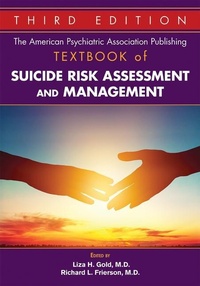
The American Psychiatric Association Publishing Textbook of Suicide Risk Assessment and Management
3rd Edition
Published on 30. January 2020
Book
Hardback
477 pages
978-1-61537-223-2 (ISBN)
Description
Charged with updating the preeminent text on suicide, the new editors of The American Psychiatric Association Publishing Textbook of Suicide Risk Assessment and Management opted not to simply revise existing chapters, but instead to steer a bold course, expanding, reconfiguring, and remaking the third edition to reflect the latest research, nomenclature, and clinical innovations. The editorial team and contributors -- two-thirds of whom are new to this edition -- have taken the intersection of suicide with both mental health and psychosocial issues as their organizing principle, exploring risk assessment and epidemiology in special populations, such as elderly patients, college students, military personnel, and the incarcerated as well as patients with a variety of psychological disorders, including bipolar spectrum, personality, depressive, anxiety, posttraumatic stress, and other disorders and schizophrenia. In addition, the book discusses treatment options (such as cognitive-behavioral therapy, dialectical behavioral therapy, and pharmacotherapy) and settings (such as emergency services, outpatient, inpatient, and civil commitment) in detail, with clinical cases to contextualize the material.
The new and revised content is extensive:
* A chapter on the influence of sleep and sleep disorders on suicide risk has been included that considers possible mechanisms for this link and discusses practical ways of assessing and managing sleep disorders to mitigate suicide risk.
* Nonsuicidal self-injury, the prevalence of which is particularly high among youth, is addressed in detail, differentiating it from and comparing it to suicide attempts, discussing risk assessment, considering safety interventions, examining treatment options, and exploring suicide contagion.
* No text on suicide would be complete without a serious exploration of the role of social media and the internet. The book presents an update on current research as it pertains to social networking and behavior, information access, and artificial intelligence and software, and includes suggestions for clinicians treating patients at risk for suicide.
* Physician-assisted dying (PAD), also referred to as "aid-in-dying," is arguably a form of suicide, and the book includes a thoughtful chapter considering the ethical and practical implications of PAD, the murky professional and legal obligations that may arise, the demographics of these patients, the settings and conditions under which PAD may occur, and the role of the attendant clinicians.
* A number of pedagogical features are included to help the reader learn and remember the material, including key clinical concepts and abundant case examples.
Its diverse range of perspectives, broad relevance to a wide variety of clinicians, and absolutely authoritative coverage makes this new edition of The American Psychiatric Association Publishing Textbook of Suicide Risk Assessment and Management a worthy and indispensable successor.
The new and revised content is extensive:
* A chapter on the influence of sleep and sleep disorders on suicide risk has been included that considers possible mechanisms for this link and discusses practical ways of assessing and managing sleep disorders to mitigate suicide risk.
* Nonsuicidal self-injury, the prevalence of which is particularly high among youth, is addressed in detail, differentiating it from and comparing it to suicide attempts, discussing risk assessment, considering safety interventions, examining treatment options, and exploring suicide contagion.
* No text on suicide would be complete without a serious exploration of the role of social media and the internet. The book presents an update on current research as it pertains to social networking and behavior, information access, and artificial intelligence and software, and includes suggestions for clinicians treating patients at risk for suicide.
* Physician-assisted dying (PAD), also referred to as "aid-in-dying," is arguably a form of suicide, and the book includes a thoughtful chapter considering the ethical and practical implications of PAD, the murky professional and legal obligations that may arise, the demographics of these patients, the settings and conditions under which PAD may occur, and the role of the attendant clinicians.
* A number of pedagogical features are included to help the reader learn and remember the material, including key clinical concepts and abundant case examples.
Its diverse range of perspectives, broad relevance to a wide variety of clinicians, and absolutely authoritative coverage makes this new edition of The American Psychiatric Association Publishing Textbook of Suicide Risk Assessment and Management a worthy and indispensable successor.
Reviews / Votes
This third edition offers updates on many topics and newchapters devoted to sleep and suicide risk, neuromodulation treatments, and
teaching psychiatry residents about suicide. It balances the most high-yield
topics while giving attention to scenarios that need more research but are
immediately clinically relevant. The community pharmacy and telehealth
settings are newer areas for exploring suicide risk and management, which
may be included in future editions. This is critical reading for all
psychiatrists. -- Daniel M Tuinstra, M.D. * Doody's Book Reviews * Even as suicide rates have decreased globally in
recent
years, and despite significant prevention
efforts, US suicide rates have
risen 35% since
2000.1 Some predict that rates will increase
still
further in the wake of the economic stress and
social
isolation brought about by the coronavirus
disease 2019 (COVID-19)
pandemic.2,3 Thus,
publication of the third edition of the
American
Psychiatric Association Publishing Textbook of
Suicide Risk
Assessment and Management is both
welcome and timely.
This edition's
structure parallels that of the previous edition, including sections on risk
assessment
and treatment, major disorders, treatment
settings,
prevention, and special topics. Each chapter provides a useful
conclusion paragraph and summary
bullet points. Notably, this volume is
significantly
smaller than its predecessor (477 vs. 744
pages),
specifics of which are discussed below.
Considering recent
failures to reduce the toll of
suicide in the United States, it is
encouraging that
the scientific field of suicide studies has
recently
begun to see much-needed change, with movement
from the
traditional view of suicide as simply a
symptom of mental illness to
newer models that
approach suicide as a transdiagnostic issue of primary
clinical focus. In this framework, interventions
are designed
specifically around the unique needs of
suicidal individuals, with
similarities in suicidal
processes across diagnoses outweighing the
differences. These processes include such
transdiagnostic
vulnerabilities as cognitive rigidity,
hopelessness,
deficient problem-solving, emotion
dysregulation,
acquired capability, and sleep disturbance.4,5
The
third edition of this textbook commendably
reflects this evolution,
although not to the extent
that one might wish. For example, an
excellent
chapter on depressive disorders contains a lengthy
section
on transdiagnostic considerations, yet the
book continues with separate
chapters on various
disorders, without much discussion of how
suicidal
and nonsuicidal patients with the same diagnosis
differ in
terms of treatment needs. A transdiagnostic approach, on the other hand,
would help
explain why only a small percentage of people with
a
given psychiatric disorder die by suicide and how
they differ from
patients who do not.
The reduced size of the new edition is
especially
noticeable in the area of risk assessment, where
5
chapters are reduced to only 1; largely missing is
guidance beyond
what information one should
gather regarding risk factors and warning
signs to
coverage of how to obtain valid information in such
a
sensitive area. Few details are provided on systems such as the Chronologic
Assessment of Suicide
Events (CASE) approach6 or The
Collaborative
Assessment and Management of Suicidality
(CAMS)
framework,7 both of which provide structured, evidence-based methods for
addressing a
topic that most patients (and many clinicians)
would
prefer to avoid. Similarly, treatment chapters
such as the one on
cognitive-behavior therapy are quite brief and primarily descriptive, with
little in
the way of "how-to's" to guide the clinician.
The
presentation of information improves considerably in later portions of the
book. For example,
the chapter on sleep and suicide not only
presents
an overview of relevant theory and research but
also
provides detailed discussions of the management of insomnia and nightmares.
Likewise, the
chapter on firearms and suicide provides
excellent
guidance for practitioners on navigating the challenging
waters of reducing access to firearms by
people at risk for
suicide.
The chapter, perhaps most likely to show the
reader that
"times have changed" is the updated
chapter on social media and the
internet. In it, we
see the 2-edged sword of the digital world,
which
includes both potentially life-saving resources and
darker
areas where bullying, taunting, and even
"digital self-harm" lurk.
Included in this chapter is
a highly useful list of suggested clinical
interview
questions and prompts regarding internet issues
of
possible relevance to suicide risk.
Despite its reduced size, the
new edition does add
chapters on topics that were not present in
the
previous edition, including chapters on college and
university
students, self-injurious behavior
(including nonsuicidal self-injury),
and physicianassisted dying. The last of these commendably
considers
whether the term "physician-assisted
suicide" should be retired in cases
of terminally ill
individuals who typically do not wish to die but
also
do not want themselves or their families to go
through a
lingering, painful dying process. This
chapter includes an excellent
overview of the status
of assisted dying laws across the United States
and
internationally.
Overall, the American Psychiatric
Association
Publishing Textbook of Suicide Risk Assessment
and
Management, Third Edition, follows in the
footsteps of previous editions
as a quality reference
volume. It is authoritative, digestible, and
applicable to practice in multiple settings, whether
academic,
correctional, inpatient, outpatient, or
emergency care. In areas where
it is lacking in
detail, it provides the reader with ample ideas
on
where one might obtain further information or
training. As such,
it continues to be an important
resource in the libraries of practicing
psychiatrists,
other mental health professionals, and professionals in
training. -- Thomas E. Ellis, PsyD, ABPP * Journal of Psychiatric Practice *
More details
Edition
Third Edition
Language
English
Place of publication
VA
United States
Target group
College/higher education
Professional and scholarly
US School Grade: College Graduate Student and over
Edition type
New edition
Illustrations
1 chart, 7 figures, 67 tables
Dimensions
Height: 259 mm
Width: 182 mm
Thickness: 22 mm
Weight
920 gr
ISBN-13
978-1-61537-223-2 (9781615372232)
Copyright in bibliographic data and cover images is held by Nielsen Book Services Limited or by the publishers or by their respective licensors: all rights reserved.
Schweitzer Classification
Other editions
Additional editions
Liza H. Gold | Richard L. Frierson
The American Psychiatric Association Publishing Textbook of Suicide Risk Assessment and Management
E-Book
03/2020
3rd Edition
American Psychiatric Association Publishing
€93.99
Available for download
Persons
Liza H. Gold, M.D., is a Clinical Professor of Psychiatry at Georgetown University School of Medicine in Washington, D.C.
Richard L. Frierson, M.D. is Vice Chair for Education and Alexander G. Donald Professor in the Department of Neuropsychiatry and Behavioral Science at University of South Carolina School of Medicine in Columbia, South Carolina.
Richard L. Frierson, M.D. is Vice Chair for Education and Alexander G. Donald Professor in the Department of Neuropsychiatry and Behavioral Science at University of South Carolina School of Medicine in Columbia, South Carolina.
Content
Part I. Suicide Risk Assessment and Treatment
Chapter 1. Suicide Risk Assessment
Chapter 2. Pharmacotherapy and Neuromodulation
Chapter 3. Cognitive and Behavioral Therapy
Chapter 4. Psychodynamic Treatment
Chapter 5. Split Treatment
Chapter 6. Cultural Humility and Structural Competence
Part II. Major Mental Disorders
Chapter 7. Depressive Disorders
Chapter 8. Anxiety Disorders, OCD, and PTSD
Chapter 9. Substance-Related Disorders
Chapter 10. Bipolar Spectrum Disorders
Chapter 11. Schizophrenia and Other Psychotic Disorders
Chapter 12. Personality Disorders
Chapter 13. Sleep and Suicide
Part III. Treatment Settings
Chapter 14. Emergency Services
Chapter 15. Outpatient Treatment
Chapter 16. Inpatient Treatment
Chapter 17. Civil Commitment
Part IV. Special Populations
Chapter 18. Children and Adolescents
Chapter 19. College and University Students
Chapter 20. Geriatric Populations
Chapter 21. Jail and Prisons
Chapter 22. Military Personnel and Veterans
Chapter 23. Suicide and Gender
Chapter 24. Self-Injurious Behavior
Part V. Special Topics
Chapter 25. Social Media and Internet
Chapter 26. Physician-Assisted Dying
Chapter 27. Suicide Risk Management
Chapter 28. Psychological Autopsy and Evaluation of Intent
Part VI. Prevention
Chapter 29. Suicide and Firearms
Chapter 30. Suicide Prevention Programs
Chapter 31. Teaching SRA in Psychiatric Residency
Part VII. Aftermath of Suicide
Chapter 32. Reactions to Patient Suicide and Clinician's Role
Index
Chapter 1. Suicide Risk Assessment
Chapter 2. Pharmacotherapy and Neuromodulation
Chapter 3. Cognitive and Behavioral Therapy
Chapter 4. Psychodynamic Treatment
Chapter 5. Split Treatment
Chapter 6. Cultural Humility and Structural Competence
Part II. Major Mental Disorders
Chapter 7. Depressive Disorders
Chapter 8. Anxiety Disorders, OCD, and PTSD
Chapter 9. Substance-Related Disorders
Chapter 10. Bipolar Spectrum Disorders
Chapter 11. Schizophrenia and Other Psychotic Disorders
Chapter 12. Personality Disorders
Chapter 13. Sleep and Suicide
Part III. Treatment Settings
Chapter 14. Emergency Services
Chapter 15. Outpatient Treatment
Chapter 16. Inpatient Treatment
Chapter 17. Civil Commitment
Part IV. Special Populations
Chapter 18. Children and Adolescents
Chapter 19. College and University Students
Chapter 20. Geriatric Populations
Chapter 21. Jail and Prisons
Chapter 22. Military Personnel and Veterans
Chapter 23. Suicide and Gender
Chapter 24. Self-Injurious Behavior
Part V. Special Topics
Chapter 25. Social Media and Internet
Chapter 26. Physician-Assisted Dying
Chapter 27. Suicide Risk Management
Chapter 28. Psychological Autopsy and Evaluation of Intent
Part VI. Prevention
Chapter 29. Suicide and Firearms
Chapter 30. Suicide Prevention Programs
Chapter 31. Teaching SRA in Psychiatric Residency
Part VII. Aftermath of Suicide
Chapter 32. Reactions to Patient Suicide and Clinician's Role
Index