

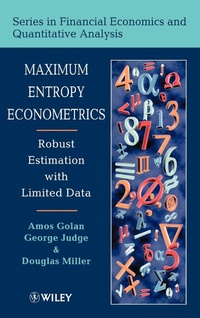
Maximum Entropy Econometrics
Robust Estimation with Limited Data
1st Edition
Published on 13. February 1996
Book
Hardback
336 pages
978-0-471-95311-1 (ISBN)
Description
In the theory and practice of econometrics the model, the methodand the data are all interdependent links in informationrecovery-estimation and inference. Seldom, however, are theeconomic and statistical models correctly specified, the datacomplete or capable of being replicated, the estimation rulesoptimal and the inferences free of distortion. Faced with theseproblems, Maximum Entropy Economeirics provides a new basis forlearning from economic and statistical models that may benon-regular in the sense that they are ill-posed or underdeterminedand the data are partial or incomplete. By extending the maximumentropy formalisms used in the physical sciences, the authorspresent a new set of generalized entropy techniques designed torecover information about economic systems. The authors compare thegeneralized entropy techniques with the performance of the relevanttraditional methods of information recovery and clearly demonstratetheories with applications including
* Pure inverse problems that include first order Markov processes,and input-output, multisectoral or SAM models to
* Inverse problems with noise that include statistical modelssubject to ill-conditioning, non-normal errors, heteroskedasticity,autocorrelation, censored, multinomial and simultaneous responsedata, as well as model selection and non-stationary and dynamiccontrol problems
Maximum Entropy Econometrics will be of interest to econometricianstrying to devise procedures for recovering information from partialor incomplete data, as well as quantitative economists in financeand business, statisticians, and students and applied researchersin econometrics, engineering and the physical sciences.
* Pure inverse problems that include first order Markov processes,and input-output, multisectoral or SAM models to
* Inverse problems with noise that include statistical modelssubject to ill-conditioning, non-normal errors, heteroskedasticity,autocorrelation, censored, multinomial and simultaneous responsedata, as well as model selection and non-stationary and dynamiccontrol problems
Maximum Entropy Econometrics will be of interest to econometricianstrying to devise procedures for recovering information from partialor incomplete data, as well as quantitative economists in financeand business, statisticians, and students and applied researchersin econometrics, engineering and the physical sciences.
More details
Series
Language
English
Place of publication
New York
United States
Target group
College/higher education
Professional and scholarly
Product notice
sewn/stitched
Cloth over boards
Dimensions
Height: 235 mm
Width: 157 mm
Thickness: 24 mm
Weight
680 gr
ISBN-13
978-0-471-95311-1 (9780471953111)
Copyright in bibliographic data and cover images is held by Nielsen Book Services Limited or by the publishers or by their respective licensors: all rights reserved.
Schweitzer Classification
Other editions
Additional editions

Persons
Amos Golan is a professor of economics and directs the Info-Metrics Institute at American University. He is also an External Professor at the Santa Fe Institute and a Senior Associate at Pembroke College, Oxford. His research is primarily in the interdisciplinary field of info-metrics - the science and practice of information processing, modeling, inference, and problem solving with insufficient information. He has published in economics, econometrics, statistics, mathematics, physics and philosophy journals. His books include Maximum Entropy Econometrics: Robust Estimation with Limited Data (coauthored with Judge and Miller) and Information and Entropy Econometrics - A Review and Synthesis.
Content
The Classical Maximum Entropy Formalism: A Review.
PURE INVERSE PROBLEMS.
Basic Maximum Entropy Principle: Formulation and Extensions.
Formulation and Solution of Pure Inverse Problems.
Generalized Pure Inverse Problems.
LINEAR INVERSE PROBLEMS WITH NOISE.
Generalized Maximum Entropy (GME) and Cross-Entropy (GCE)Formulations.
Finite Sample Extensions of GME-GCE.
GENERAL LINEAR MODEL APPLICATIONS OF GME-GCE.
GME-GCE Solutions to Ill-conditioned Problems.
General Linear Statistical Model with a Non-scalar IdentityCovariance Matrix Statistical Model Selection.
A SYSTEM OF ECONOMIC STATISTICAL RELATIONS.
Sets of Linear Statistical Models.
Simultaneous Equations Statistical Model.
LINEAR AND NON-LINEAR DYNAMIC SYSTEMS.
Estimation and Inference of Dynamic Linear Inverse Problems.
Linear and Non-linear Dynamic Systems with Control.
DISCRETE CHOICE-CENSORED PROBLEMS.
Recovering Information from Multinomial Response Data.
Recovering Information from Censored Response Data.
COMPUTATIONAL NOTES.
Computing GME-GCE Solutions.
Epilogue.
Selected Reading.
Index.
PURE INVERSE PROBLEMS.
Basic Maximum Entropy Principle: Formulation and Extensions.
Formulation and Solution of Pure Inverse Problems.
Generalized Pure Inverse Problems.
LINEAR INVERSE PROBLEMS WITH NOISE.
Generalized Maximum Entropy (GME) and Cross-Entropy (GCE)Formulations.
Finite Sample Extensions of GME-GCE.
GENERAL LINEAR MODEL APPLICATIONS OF GME-GCE.
GME-GCE Solutions to Ill-conditioned Problems.
General Linear Statistical Model with a Non-scalar IdentityCovariance Matrix Statistical Model Selection.
A SYSTEM OF ECONOMIC STATISTICAL RELATIONS.
Sets of Linear Statistical Models.
Simultaneous Equations Statistical Model.
LINEAR AND NON-LINEAR DYNAMIC SYSTEMS.
Estimation and Inference of Dynamic Linear Inverse Problems.
Linear and Non-linear Dynamic Systems with Control.
DISCRETE CHOICE-CENSORED PROBLEMS.
Recovering Information from Multinomial Response Data.
Recovering Information from Censored Response Data.
COMPUTATIONAL NOTES.
Computing GME-GCE Solutions.
Epilogue.
Selected Reading.
Index.