

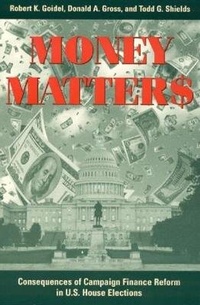
Money Matters
Consequences of Campaign Finance Reform in House Elections
Published on 15. April 1999
Book
Paperback/Softback
228 pages
978-0-8476-8868-5 (ISBN)
Description
Methods of campaign financing have been controversial since George Washington first ran for office, and debates over campaign finance reform have raged just as long. Contemporary critics of reform often contend that it would decrease electoral competition, voter turnout, and the amount of information voters receive about candidates. Money Matters subjects these criticisms to careful, systemic analysis_using simulations, aggregate vote analyses, and individual-level data analyses based on House elections_and concludes that reform, with modest public subsidies and spending limits, would enhance rather than diminish the U.S. system of democratic governance. This timely book helps bridge the gap between quantitative academic research and applied progressive reform efforts. It will be of interest to scholars and students of political parties, the legislative process, campaigns and elections, political institutions, public policy, and political behavior and methodology.
Reviews / Votes
Goidel, Gross, and Shields provide a valuable service to those interested in campaign finance reform in bringing state-of-the-art empirical analysis to proposed reforms. Proponents of reform will find the book a valuable resource. Students in courses on elections and Congress will appreciate the well-organized discussions of reform's history, FECA loopholes, reform alternatives, and pro and con arguments. -- Douglas Rose, Tulane University * Political Science Quarterly * Their analysis of three approaches to campaign finance reform - do little, moderate, and comprehensive - argues for a comprehensive approach with an emphasis on full public financing of congressional elections. -- R. A. Strickland, Appalachian State University * Social and Behavioral Sciences * The book has something for every reader. For the political science novice it provides a thorough look at the role of money in politics and at various reform proposals. For the advanced student or professional it provides a provocative argument for comprehensive reform that challenges many of the conclusions in the contemporary literature. -- Bruce F. Nesmith, Coe College * Perspective On Political Science, Vol. 29, No. 2 * Money Matters is well written, current, fact filled, and, at times, provocative. The scholarship is sound and well grounded in the literature, which is given an extensive review. The authors challenge many of the assumptions that have come to surround proposals for campaign finance reform, especially those proposals designed to reduce expenditures. This is a timely book on a timely topic, unlikely to be rendered passe. -- Charles S. Bullock III, University of GeorgiaMore details
Language
English
Place of publication
United States
Publishing group
Bloomsbury Publishing Plc
Dimensions
Height: 229 mm
Width: 147 mm
Thickness: 13 mm
Weight
308 gr
ISBN-13
978-0-8476-8868-5 (9780847688685)
Copyright in bibliographic data and cover images is held by Nielsen Book Services Limited or by the publishers or by their respective licensors: all rights reserved.
Schweitzer Classification
Persons
Robert K. Goidel is assistant professor of political science at Indiana State University. Donald A. Gross is associate professor of political science at the University of Kentucky. Todd G. Shields is assistant professor of political science at the University of Arkansas.
Content
Chapter 1 Introducing Campaign Finance Reform Chapter 2 A Brief History of Campaign Finance and Campaign Finance Reform Chapter 3 Excessive Spending, Candidate Viability, and Free Speech Chapter 4 Electoral Competition and Campaign Finance Reform Chapter 5 The Question of Voter Turnout, Part I Chapter 6 The Question of Voter Turnout, Part II Chapter 7 Democracy and Citizen Involvement: Campaign Spending and Cognitive Engagement Chapter 8 FECA's Loopholes: Soft Money, Independent Expenditures, and Issue Advocacy Campaigns Chapter 9 Improving the Electoral Process through Campaign Finance Reform