

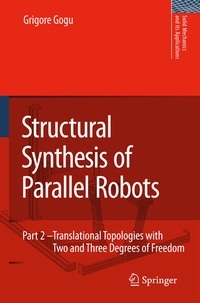
Structural Synthesis of Parallel Robots
Part 2: Translational Topologies with Two and Three Degrees of Freedom
Published on 11. March 2009
Book
Hardback
XVIII, 762 pages
978-1-4020-9793-5 (ISBN)
Description
"The mathematical investigations referred to bring the whole apparatus of a great science to the examination of the properties of a given mechanism, and have accumulated in this direction rich material, of enduring and increasing value. What is left unexamined is however the other, immensely deeper part of the problem, the question: How did the mechanism, or the elements of which it is composed, originate? What laws govern its building up? Is it indeed formed according to any laws whatever? Or have we simply to accept as data what invention gives us, the analysis of what is thus obtained being the only scientific problem left - as in the case of natural history?" Reuleaux, F., Theoretische Kinematik, Braunschweig: Vieweg, 1875 Reuleaux, F., The Kinematics of Machinery, London: Macmillan, 1876 and New York: Dover, 1963 (translated by A.B.W. Kennedy) This book represents the second part of a larger work dedicated to the structural synthesis of parallel robots. Part 1 already published in 2008 (Gogu 2008a) has presented the methodology proposed for structural synthesis. This book focuses on various topologies of translational parallel robots systematically generated by using the structural synthesis approach proposed in Part 1. The originality of this work resides in the fact that it combines the new formulae for mobility connectivity, redundancy and overconstraints, and the evolutionary morphology in a unified approach of structural synthesis giving interesting innovative solutions for parallel mechanisms.
Reviews / Votes
From the reviews: "Part 2 begins with a short summary of developed by the author new formulae for mobility, connectivity, redundancy, and over-constraint. . Parallel robotic manipulators can be considered a well-established . subject of many robotic research studies. . the author has made a significant contribution towards establishing innovative and interesting solutions for parallel mechanisms. . The presentation is at a level of a graduate textbook, and the book will be useful and enjoyed by serious graduate students and by scientists and engineers from academia and industry." (Franz Selig, Zentralblatt MATH, Vol. 1168, 2009)More details
Series
Edition
2009 ed.
Language
English
Place of publication
Dordrecht
Netherlands
Target group
Professional and scholarly
Research
Illustrations
XVIII, 762 p.
Dimensions
Height: 241 mm
Width: 160 mm
Thickness: 47 mm
Weight
1320 gr
ISBN-13
978-1-4020-9793-5 (9781402097935)
DOI
10.1007/978-1-4020-9794-2
Schweitzer Classification
Other editions
Additional editions
Grigore Gogu
Structural Synthesis of Parallel Robots
Part 2: Translational Topologies with Two and Three Degrees of Freedom
Book
10/2010
Springer
€160.49
Shipment within 15-20 days
Grigore Gogu
Structural Synthesis of Parallel Robots
Part 2: Translational Topologies with Two and Three Degrees of Freedom
E-Book
02/2009
1st Edition
Springer
€160.49
Available for download
Content
Preface; Acknowledgements; List of abbreviations and notations; 1 Introduction; 1.1 Terminology; 1.2 Methodology of structural synthesis; 1.2.1 New formulae for mobility, connectivity, redundancy and overconstraint of parallel robots; 1.2.2 Evolutionary morphology approach; 1.2.3 Types of parallel robots with respect to motion coupling; 1.3 Translational parallel robots; 2 Translational parallel robots with two degrees of freedom; 2.1 T2-type translational parallel robots with coupled motions; 2.1.1 Overconstrained solutions; 2.1.2 Non overconstrained solutions; 2.2 T2-type translational parallel robots with decoupled motions; 2.2.1 Overconstrained solutions; 2.2.2 Non overconstrained solutions; 2.3 T2-type translational parallel robots with uncoupled motions; 2.3.1 Overconstrained solutions; 2.3.2 Non overconstrained solutions; 2.4 Maximally regular T2-type translational parallel robots; 2.4.1 Overconstrained solutions; 2.4.2 Non overconstrained solutions; 2.5 Other T2-type translational parallel robots; 2.5.1 Overconstrained solution; 2.5.2 Non overconstrained solutions; 3 Overconstrained T3-type TPMs with coupled motions; 3.1 Basic solutions with linear actuators; 3.2 Derived solutions with linear actuators; 3.3 Basic solutions with rotating actuators; 3.4 Derived solutions with rotating actuators; 4 Non overconstrained T3-type TPMs with coupled motions; 4.1 Basic solutions with linear actuators; 4.2 Derived solutions with linear actuators; 4.3 Basic solutions with rotating actuators; 4.4 Derived solutions with rotating actuators; 5 Overconstrained T3-type TPMs with uncoupled motions; 5.1 Basic solutions with rotating actuators; 5.2 Derived solutions with rotating actuators; 6 Non overconstrained T3-type TPMs with uncoupled motions; 6.1 Basic solutions with rotating actuators; 6.2 Derived solutions with rotating actuators; 7 Maximally regular T3-type translational parallel robots; 7.1 Overconstrained solutions; 7.1.1 Basic solutions with no idle mobilities; 7.1.2 Derived solutions with idle mobilities; 7.2 Non overconstrained solutions; References; Index