

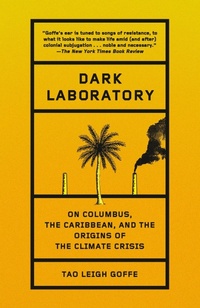
Dark Laboratory
On Columbus, the Caribbean, and the Origins of the Climate Crisis
Will be published approx. on 10. February 2026
Book
Paperback/Softback
384 pages
978-0-593-68491-7 (ISBN)
Description
A groundbreaking investigation of the Caribbean as both an idyll in the American imagination and a dark laboratory of Western experimentation, revealing secrets to racial and environmental progress that impact how we live today.
“Dark Laboratory is a gargantuan, soulful work. It obliterates most of what I thought I knew about the Caribbean’s utility to Western Wealth.”
—Kiese Laymon, New York Times bestselling author of Heavy
In 1492, Christopher Columbus arrived on the Caribbean Island of Guanahaní to find an Edenic scene that was soon mythologized. But behind the myth of paradise, the Caribbean and its people would come to pay the price of relentless Western exploitation and abuse. In Dark Laboratory, Dr. Tao Leigh Goffe embarks on a historical journey to chart the forces that have shaped these islands: the legacy of slavery, indentured labor, and the forced toil of Chinese and enslaved Black people who mined the islands’ bounty—including guano, which, at the time, was more valuable than gold—for the benefit of European powers and at the expense of the islands’ sacred ecologies.
Braiding together family history, cultural reportage, and social studies, Goffe radically transforms how we conceive of Blackness, the natural world, colonialism, and the climate crisis; and, in doing so, she deftly dismantles the many layers of entrenched imperialist thinking that shroud our established understanding of the human and environmental conditions to reveal the cause and effect of a global catastrophe. Dark Laboratory forces a reckoning with the received forms of knowledge that have led us astray.
Through the lens of the Caribbean, both guide and warning of the man-made disasters that continue to plague our world, Goffe closely situates the origins of racism and climate catastrophe within a colonial context. And in redressing these twin apocalypses, Dark Laboratory becomes a record of the violence that continues to shape the Caribbean today. But it is also a declaration of hope, offering solutions toward a better future based on knowledge gleaned from island ecosystems, and an impassioned, urgent testament to the human capacity for change and renewal.
“Dark Laboratory is a gargantuan, soulful work. It obliterates most of what I thought I knew about the Caribbean’s utility to Western Wealth.”
—Kiese Laymon, New York Times bestselling author of Heavy
In 1492, Christopher Columbus arrived on the Caribbean Island of Guanahaní to find an Edenic scene that was soon mythologized. But behind the myth of paradise, the Caribbean and its people would come to pay the price of relentless Western exploitation and abuse. In Dark Laboratory, Dr. Tao Leigh Goffe embarks on a historical journey to chart the forces that have shaped these islands: the legacy of slavery, indentured labor, and the forced toil of Chinese and enslaved Black people who mined the islands’ bounty—including guano, which, at the time, was more valuable than gold—for the benefit of European powers and at the expense of the islands’ sacred ecologies.
Braiding together family history, cultural reportage, and social studies, Goffe radically transforms how we conceive of Blackness, the natural world, colonialism, and the climate crisis; and, in doing so, she deftly dismantles the many layers of entrenched imperialist thinking that shroud our established understanding of the human and environmental conditions to reveal the cause and effect of a global catastrophe. Dark Laboratory forces a reckoning with the received forms of knowledge that have led us astray.
Through the lens of the Caribbean, both guide and warning of the man-made disasters that continue to plague our world, Goffe closely situates the origins of racism and climate catastrophe within a colonial context. And in redressing these twin apocalypses, Dark Laboratory becomes a record of the violence that continues to shape the Caribbean today. But it is also a declaration of hope, offering solutions toward a better future based on knowledge gleaned from island ecosystems, and an impassioned, urgent testament to the human capacity for change and renewal.
More details
Language
English
Place of publication
New York
United States
Publishing group
Random House USA Inc
Product notice
Paperback (trade)
Illustrations
27 ILLUS. AND 1 MAP IN TEXT
Dimensions
Height: 197 mm
Width: 131 mm
Thickness: 25 mm
Weight
316 gr
ISBN-13
978-0-593-68491-7 (9780593684917)
Copyright in bibliographic data and cover images is held by Nielsen Book Services Limited or by the publishers or by their respective licensors: all rights reserved.
Schweitzer Classification
Person
Tao Leigh Goffe
Content
CONTENTS
Prelude 0
BOOK I: EDEN IS NOT LOST
Garden Interlude – Lo Ting & Mami Wata 0
1. ISLAND LABORATORIES 0
In Search of Camouflage Vines
Queen Nanny of the Maroons: Commander, Climate Warrior, Healer
Mining the Red Earth: Jamaica’s Global Bauxite Crisis
British Empire’s Twin Experiments: Hong Kong and Jamaica
2. CLIMATE CRISIS, GENESIS 1492 0
Eden Isles: Black and Native Governance
Columbus’ Crisis
Genres and Genealogies of Eden
Climate Denial, Racial Denial
What is the Dark Laboratory?
3. NATURAL HISTORY MUSEUMS, SHRINES TO EXPLORERS 0
Enshrining Natural History
Environmentalism and the Omission of Race
Digitize the World: Endangered Archives, Endangered Species
The Violence of Knowledge Production and University Museums
BOOK II: GEOLOGICAL TIME AND BLACK WITNESS
4. BREATHING UNDERWATER 0
Afrofuturist Black Freedom beneath the Waves
Coral Coloniality and Collectivity
Corals and the Jagged Taxonomy of Race
Shakespeare’s Tempest as Climate Critique
Darwin’s Pacific Coral and Volcanoes
Capturing Coral
Regeneration Beyond the Future of Bleached Coral
5. GUANO DESTINIES 0
Shithole Countries: From Emerson to Trump
Devil’s Island: A Diamond as Big as Haiti’s Sovereign Debt
Peru: Chinese and Indigenous Labor, Andean Agricultural Science
“I Expect You to Die”: James Bond’s Guano Destiny
Hawai’i: The Refuse and Refusal of Pacific Guano Economies
6. COLONIALISM, THE BIRDER’S COMPANION GUIDE 0
Invisible Branches of the American Family Tree
The Amazon: Birding as Colonial Practice
Four and Twenty Blackbirds: Kerry James Marshall’s Pecking Order
White Flight, Black Mobility, White Fugitivity
Jamaicenesis
Birding Futures
BOOK III: LIFE IN EDEN
7. THE CURIOUS CASE OF THE CALCUTTA MONGOOSE IN JAMAICA 0
The Veil of Ignorance: A Collective Choreography of Mothering
Invasive Species: Chimeras of Empire
Sly Mongoose, the Predator
Rikki, Tikki, Tavi, Indian Natural History, and the Panchatantra
“Massa Espeut’s Ratta”
Indigenous Knowledge Challenging “Invasive” Rhetoric
8. PEDAGOGIES OF SMOKE 0
Ganja, the Ganges, Saddhus, and Rasta Sacrament
Genres of Gardens
The Hothouse Effect: China, Scotland, Nepal, the Caribbean
London Provision Grounds: Beyond the English Country Garden
Legalize It: Marijuana’s Commerce, Criminalization, Climate
9: AFFECTIVE PLATE TECTONICS 0
Decentralized Finance and Island Federation Futures
Mont Pélee, Martinique 1902: Pyroclastic Tragedies
Black Irish Freedom and the Fire This Time in Montserrat
“Not In Our Time”: The Volcano as Island Timekeeper
Ghost Chickens Come Home to Roost in the Caribbean
Coda 0
Acknowledgements 0
Notes 0
Bibliography 0
Index 0
Prelude 0
BOOK I: EDEN IS NOT LOST
Garden Interlude – Lo Ting & Mami Wata 0
1. ISLAND LABORATORIES 0
In Search of Camouflage Vines
Queen Nanny of the Maroons: Commander, Climate Warrior, Healer
Mining the Red Earth: Jamaica’s Global Bauxite Crisis
British Empire’s Twin Experiments: Hong Kong and Jamaica
2. CLIMATE CRISIS, GENESIS 1492 0
Eden Isles: Black and Native Governance
Columbus’ Crisis
Genres and Genealogies of Eden
Climate Denial, Racial Denial
What is the Dark Laboratory?
3. NATURAL HISTORY MUSEUMS, SHRINES TO EXPLORERS 0
Enshrining Natural History
Environmentalism and the Omission of Race
Digitize the World: Endangered Archives, Endangered Species
The Violence of Knowledge Production and University Museums
BOOK II: GEOLOGICAL TIME AND BLACK WITNESS
4. BREATHING UNDERWATER 0
Afrofuturist Black Freedom beneath the Waves
Coral Coloniality and Collectivity
Corals and the Jagged Taxonomy of Race
Shakespeare’s Tempest as Climate Critique
Darwin’s Pacific Coral and Volcanoes
Capturing Coral
Regeneration Beyond the Future of Bleached Coral
5. GUANO DESTINIES 0
Shithole Countries: From Emerson to Trump
Devil’s Island: A Diamond as Big as Haiti’s Sovereign Debt
Peru: Chinese and Indigenous Labor, Andean Agricultural Science
“I Expect You to Die”: James Bond’s Guano Destiny
Hawai’i: The Refuse and Refusal of Pacific Guano Economies
6. COLONIALISM, THE BIRDER’S COMPANION GUIDE 0
Invisible Branches of the American Family Tree
The Amazon: Birding as Colonial Practice
Four and Twenty Blackbirds: Kerry James Marshall’s Pecking Order
White Flight, Black Mobility, White Fugitivity
Jamaicenesis
Birding Futures
BOOK III: LIFE IN EDEN
7. THE CURIOUS CASE OF THE CALCUTTA MONGOOSE IN JAMAICA 0
The Veil of Ignorance: A Collective Choreography of Mothering
Invasive Species: Chimeras of Empire
Sly Mongoose, the Predator
Rikki, Tikki, Tavi, Indian Natural History, and the Panchatantra
“Massa Espeut’s Ratta”
Indigenous Knowledge Challenging “Invasive” Rhetoric
8. PEDAGOGIES OF SMOKE 0
Ganja, the Ganges, Saddhus, and Rasta Sacrament
Genres of Gardens
The Hothouse Effect: China, Scotland, Nepal, the Caribbean
London Provision Grounds: Beyond the English Country Garden
Legalize It: Marijuana’s Commerce, Criminalization, Climate
9: AFFECTIVE PLATE TECTONICS 0
Decentralized Finance and Island Federation Futures
Mont Pélee, Martinique 1902: Pyroclastic Tragedies
Black Irish Freedom and the Fire This Time in Montserrat
“Not In Our Time”: The Volcano as Island Timekeeper
Ghost Chickens Come Home to Roost in the Caribbean
Coda 0
Acknowledgements 0
Notes 0
Bibliography 0
Index 0