

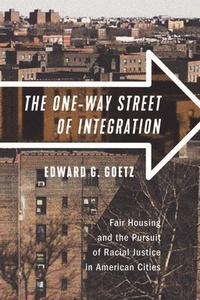
The One-Way Street of Integration
Fair Housing and the Pursuit of Racial Justice in American Cities
Published on 15. March 2020
Book
Paperback/Softback
228 pages
978-1-5017-4847-9 (ISBN)
Description
The One-Way Street of Integration examines two contrasting housing policy approaches to achieving racial justice. Integration initiatives and community development efforts have been for decades contrasting means of achieving racial equity through housing policy. Goetz traces the tensions involved in housing integration and policy to show why he doesn't see the solution to racial injustice as the government moving poor and nonwhite people out of their communities.
The One-Way Street of Integration critiques fair housing integration policies for targeting settlement patterns while ignoring underlying racism and issues of economic and political power. Goetz challenges liberal orthodoxy, determining that the standard efforts toward integration are unlikely to lead to racial equity or racial justice in American cities. In fact, in this pursuit it is the community development movement rather that has the greatest potential for connecting to social change and social justice efforts.
The One-Way Street of Integration critiques fair housing integration policies for targeting settlement patterns while ignoring underlying racism and issues of economic and political power. Goetz challenges liberal orthodoxy, determining that the standard efforts toward integration are unlikely to lead to racial equity or racial justice in American cities. In fact, in this pursuit it is the community development movement rather that has the greatest potential for connecting to social change and social justice efforts.
Reviews / Votes
A courageous work in that Goetz confronts a difficult debate head on. Goetz gives clear guidance about what he believes to be the way forward.(Journal of Planning Education and Research) Should stimulate debate.
(Choice) Professor Goetz's sweeping indictment of the well-intentioned effort to advance racial integration deserves thoughtful consideration; it should inspire wide-ranging debate.
(The Metropole) Goetz has presented compelling arguments for his position on locating subsidized housing, favoring the community development movement.
(Journal of Urban Affairs) Goetz has written an important and timely book. Beyond its substantial contribution to the scholarly literature on American urban policy, infinitely more important is its potential to aid in the ongoing struggle against racial injustice and American white supremacy-something needed now perhaps more than ever.
(Shelterforce)
More details
Language
English
Place of publication
Ithaca
United States
Product notice
Paperback (trade)
Dimensions
Height: 229 mm
Width: 152 mm
Thickness: 13 mm
Weight
340 gr
ISBN-13
978-1-5017-4847-9 (9781501748479)
Copyright in bibliographic data and cover images is held by Nielsen Book Services Limited or by the publishers or by their respective licensors: all rights reserved.
Schweitzer Classification
Other editions
Additional editions
Edward G. Goetz
The One-Way Street of Integration
Fair Housing and the Pursuit of Racial Justice in American Cities
E-Book
03/2018
Cornell University Press
€10.49
Available for download
Person
Edward G. Goetz is Professor of Urban and Regional Planning and Director of the Center for Urban and Regional Affairs at the University of Minnesota. He has published widely, including, most recently, New Deal Ruins.
Content
Introduction: Alternative Approaches to RegionalEquity and Racial Justice
1. The Integration Imperative
2. Affirmatively Furthering Community Development
3. The "Hollow Prospect" of Integration
4. The Three Stations of Fair Housing Spatial Strategy
5. New Issues, Unresolved Questions, and the Widening Debate
Conclusion: Everyone Deserves to Live in anOpportunity Neighborhood
1. The Integration Imperative
2. Affirmatively Furthering Community Development
3. The "Hollow Prospect" of Integration
4. The Three Stations of Fair Housing Spatial Strategy
5. New Issues, Unresolved Questions, and the Widening Debate
Conclusion: Everyone Deserves to Live in anOpportunity Neighborhood