

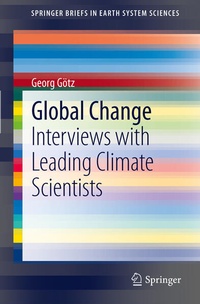
Global Change
Interviews with Leading Climate Scientists
Published on 5. January 2012
Book
Paperback/Softback
VII, 53 pages
978-3-642-23443-9 (ISBN)
Description
Seven interviews with leading climate scientists cover both fundamental research (climate modeling, global warming, sea level change, melting of the ice caps, natural hazards) and impact assessment (adaption, mitigation, economic impacts and costs of climate change). Experts on different aspects of the topic explain their own field and give their opinion on general questions concerning climate change. The goal is to provide the reader with first-hand information on the current state of climate research.
More details
Series
Edition
2012
Language
English
Place of publication
Berlin
Germany
Publishing group
Springer Berlin
Target group
Popular/general
Illustrations
7 farbige Abbildungen
VII, 53 p. 7 illus. in color.
Dimensions
Height: 235 mm
Width: 155 mm
Thickness: 4 mm
Weight
113 gr
ISBN-13
978-3-642-23443-9 (9783642234439)
DOI
10.1007/978-3-642-23444-6
Schweitzer Classification
Other editions
Additional editions
E-Book
01/2012
1st Edition
Springer
€50.28
Available for download
Person
Prof. Dr. Georg Götz ist Inhaber der Professur für Volkswirtschaftslehre (VWL I) mit dem Schwerpunkt Industrieökonomie, Wettbewerbspolitik und Regulierung an der Justus-Liebig-Universität Gießen (JLU). Maximilian Maurice Gail, Phil-Adrian Klotz, Daniel Lüke und Jan Thomas Schäfer sind wissenschaftliche Mitarbeiter an der Professur VWL I und promovieren dort. Dr. Daniel Herold ist Post Doc an der Professur. PD Dr. Johannes Paha ist Vertretungsprofessor an der FAU Erlangen-Nürnberg, Privatdozent an der JLU Gießen und Research Associate an der Stellenbosch University.
Content
Understanding does not imply predictive power.- We always make models for something, not of something.- Time means are more predictable than the instantaneous state.- The large scale dynamics are reasonably well understood, un-certainty lies in the parametrization of small-scale processes.- It is the poor and the marginalized that are hit hardest by climate change.- When deciding about long-term strategies, irreversibility is a key point.- The Montreal Agreement is a good example of how to deal with a global environmental problem.