

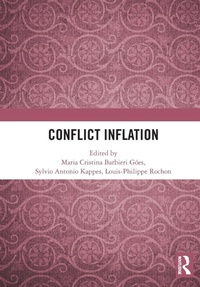
Conflict Inflation
1st Edition
Will be published approx. on 22. June 2026
Book
Paperback/Softback
246 pages
978-1-032-98808-5 (ISBN)
Description
This book brings together distinguished scholars who analyze the recent resurgence of inflation from the point of view of conflict among social classes over the appropriate distribution of income.
For the better part of the past four decades, inflation remained low and stable in most industrialized economies-certainly close to the various inflation targets. As a result, inflation did not pose much of a policy threat, and economists' attention was drawn elsewhere. Since 2020, however, the picture is very different. A pandemic followed by a war has led to a surge in inflation throughout the globe, the result of war, climate change emergencies, supply chain deficiencies, and other cost-related post-COVID problems (so-called greedflation). This surge in inflation has left many economists bewildered. Post-Keynesians, however, have proposed a sound explanation. For them, inflation is 'always and everywhere' a conflict phenomenon, and they have applied this view to the post-pandemic era.
This book is a must-read to understand not only inflation in normal times but also in times of crises. It is an essential read for students, policymakers and scholars in the fields of economics, social sciences, and public policy.
The chapters in this book were originally published as a special issue of Review of Political Economy.
For the better part of the past four decades, inflation remained low and stable in most industrialized economies-certainly close to the various inflation targets. As a result, inflation did not pose much of a policy threat, and economists' attention was drawn elsewhere. Since 2020, however, the picture is very different. A pandemic followed by a war has led to a surge in inflation throughout the globe, the result of war, climate change emergencies, supply chain deficiencies, and other cost-related post-COVID problems (so-called greedflation). This surge in inflation has left many economists bewildered. Post-Keynesians, however, have proposed a sound explanation. For them, inflation is 'always and everywhere' a conflict phenomenon, and they have applied this view to the post-pandemic era.
This book is a must-read to understand not only inflation in normal times but also in times of crises. It is an essential read for students, policymakers and scholars in the fields of economics, social sciences, and public policy.
The chapters in this book were originally published as a special issue of Review of Political Economy.
More details
Language
English
Place of publication
London
United Kingdom
Publishing group
Taylor & Francis Ltd
Target group
College/higher education
Professional and scholarly
Postgraduate, Undergraduate Advanced, and Undergraduate Core
Product notice
Paperback (trade)
Unsewn / adhesive bound
Dimensions
Height: 244 mm
Width: 170 mm
Thickness: 14 mm
Weight
417 gr
ISBN-13
978-1-032-98808-5 (9781032988085)
Copyright in bibliographic data and cover images is held by Nielsen Book Services Limited or by the publishers or by their respective licensors: all rights reserved.
Schweitzer Classification
Other editions
Additional editions
Maria Cristina Barbieri Goes | Sylvio Kappes | Louis-Philippe Rochon
Conflict Inflation
E-Book
03/2025
Routledge
€73.99
Available for download
Maria Cristina Barbieri Goes | Sylvio Kappes | Louis-Philippe Rochon
Conflict Inflation
E-Book
03/2025
Routledge
€73.99
Available for download
Maria Cristina Barbieri Goes | Sylvio Kappes | Louis-Philippe Rochon
Conflict Inflation
Book
03/2025
1st Edition
Routledge
€207.80
Shipment within 10-20 days
Persons
Maria Cristina Barbieri Goes is Assistant Professor at LINK Campus University and co-editor of the Review of Political Economy. Her research activity is focused on post-Keynesian economics, growth theory, fiscal and monetary policies, income distribution, macroeconomics and regional economics. Her scientific contributions were published in various journals.
Sylvio Antonio Kappes is Professor of Macroeconomics at the Federal University of Alagoas, Brazil. His main areas of research are Stock-flow Consistent models, Monetary Economics and Post-Keynesian Economics. He is co-editor of the Review of Political Economy.
Louis-Philippe Rochon is Full Professor of Economics at Laurentian University, Canada, where he has been teaching since 2004. He is the editor-in-chief of the Review of Political Economy. He is the Founding Editor (now Emeritus) of the Review of Keynesian Economics. He has widely published in post-Keynesian economics, and monetary theory and policy. He has been a visiting professor in over a dozen universities around the world.
Sylvio Antonio Kappes is Professor of Macroeconomics at the Federal University of Alagoas, Brazil. His main areas of research are Stock-flow Consistent models, Monetary Economics and Post-Keynesian Economics. He is co-editor of the Review of Political Economy.
Louis-Philippe Rochon is Full Professor of Economics at Laurentian University, Canada, where he has been teaching since 2004. He is the editor-in-chief of the Review of Political Economy. He is the Founding Editor (now Emeritus) of the Review of Keynesian Economics. He has widely published in post-Keynesian economics, and monetary theory and policy. He has been a visiting professor in over a dozen universities around the world.
Content
Introduction: Conflict Inflation 1. The Conflict Theory of Inflation Revisited 2. Conflictual Distributional Struggles and Inflation 3. Sellers' Inflation and Distributive Conflict: Lessons from the Post-COVID Recovery 4. Cost-Push and Conflict Inflation: A Discussion of the Italian Case 5. Inflation, Unemployment, and Inequality: Beyond the Traditional Phillips Curve 6. Conflictual Inflation and the Phillips Curve 7. Which Policies Against Inflation After Covid-19 and the War in Ukraine: The Italian Case 8. Kaleckian Models of Conflict Inflation, Distribution and Employment: A Comparative Analysis 9. 'Sellers' Inflation' and Monetary Policy Interventions: A Critical Analysis 10. Conflict Inflation and the Role of Monetary Policy 11. Conflict, Inertia, and Phillips Curve from a Sraffian Standpoint