

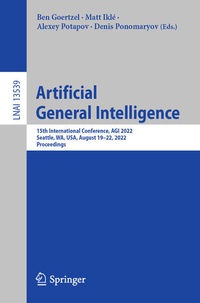
Artificial General Intelligence
15th International Conference, AGI 2022, Seattle, WA, USA, August 19-22, 2022, Proceedings
Published on 14. January 2023
Book
Paperback/Softback
XIV, 472 pages
978-3-031-19906-6 (ISBN)
Description
This book constitutes the refereed proceedings of the 15th International Conference on Artificial General Intelligence, AGI 2022, held as a hybrid event in Seattle, WA, USA, in August 2022.
The 31 full papers presented in this book were carefully reviewed and selected from 61 submissions. The papers cover topics from foundations of AGI, to AGI approaches and AGI ethics, to the roles of systems biology, goal generation, and learning systems, and so much more. Additionally, this volume contains 13 posters.
More details
Series
Edition
1st ed. 2023
Language
English
Place of publication
Cham
Switzerland
Publishing group
Springer International Publishing
Target group
Professional and scholarly
Illustrations
100 s/w Abbildungen, 79 farbige Abbildungen
XIV, 472 p. 179 illus., 79 illus. in color.
Dimensions
Height: 235 mm
Width: 155 mm
Thickness: 27 mm
Weight
733 gr
ISBN-13
978-3-031-19906-6 (9783031199066)
DOI
10.1007/978-3-031-19907-3
Schweitzer Classification
Other editions
Additional editions
Ben Goertzel | Matt Iklé | Alexey Potapov
Artificial General Intelligence
15th International Conference, AGI 2022, Seattle, WA, USA, August 19-22, 2022, Proceedings
E-Book
01/2023
Springer
€90.94
Available for download
Content
Accepted for poster presentation.-
A General Purpose Machine Reasoning Engine.- COMFO: Multilingual Corpus for Opinion Mining.- Information as Entanglement-A Framework for Artificial General Intelligence.- Causal Analysis of Generic Time Series Data Applied for Market Prediction.- Dynamic and Evolving Neural Network for event discrimination.- Hierarchical temporal DNN and Associative knowledge representation.- MARTI: new model of human brain, considering neocortex and basal ganglia - learns to play Atari game by reinforcement learning on a single CPU.- General-Purpose Minecraft Agents and Hybrid AGI.- Graph Strategy for Interpretable Visual Question Answering.- Analogical Problem Solving in the Causal Cognitive Architecture.- A Biologically Plausible Graph Structure for AGI.- The Delta Normal AGI.- Purely Symbolic Induction of Structure.-
Accepted for full oral presentation.-
Extended subdomains: a solution to a problem of Hernández-Orallo and Dowe.- Versatility-Efficiency Index (VEI): Towards a Comprehensive Definition of Intelligence Quotient (IQ) for Artificial General Intelligence (AGI) Agents.- Moral Space for Paraconsistent AGI.- PERI.2 Goes to PreSchool and Beyond, in Search of AGI.- Reinforcement Learning with Information-Theoretic Actuation.- Homomorphisms Between Transfer, Multi-Task, and Meta-Learning Systems.- Core and Periphery as Closed-System Precepts for Engineering General Intelligence.- Toward Generating Natural-Language Explanations of Modal Logic Proofs.- ONA for autonomous ROS-based robots.- Generalized Identity Matching in NARS.- Adaptive Multi-Strategy Market-Making Agent For Volatile Markets.- Toward a Comprehensive List of Necessary Abilities for Human Intelligence, Part 2: Using Knowledge.- What can nonhuman animals, children, and g tell us about human-level artificial general intelligence (AGI)?.- Toward a Comprehensive List of Necessary Abilities for Human Intelligence, Part 1: Constructing Knowledge.- Cognitive Architecturefor Co-Evolutionary Hybrid Intelligence.- An approach to generation triggers for parrying backdoor in neural networks.- The Learning Agent Triangle: Towards a unified disambiguation of the AGI challenge..- Maze Learning using a Hyperdimensional Predictive Processing Cognitive Architecture.- Market Prediction as a Task for AGI Agents.- Monte Carlo Bias Correction in Q-learning.- Free Will Belief as a Consequence of Model-based Reinforcement Learning.- Thoughts on Architecture.- On the possibility of regulation of human emotions via multimodal social interaction with an embodied agent controlled by eBICA-based emotional interaction model.- QKSA: Quantum Knowledge Seeking Agent.- Elements of Active Continuous Learning and Uncertainty Self-Awareness: a Narrow Implementation for Face and Facial Expression Recognition.- Thrill-K Architecture: Towards a Solution to the Problem of Knowledge Based Understanding.- Grammar Induction - Experimental Results.- Brain Principles Programming.- A meta-probabilistic-programming language for bisimulation of probabilistic and non-well-founded type systems.- Artificial Open World for Evaluating AGI: a Conceptual Design.- Ownability of AGI.