

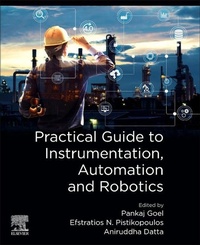
Practical Guide to Instrumentation, Automation and Robotics
Will be published approx. on 1. June 2029
Book
Paperback/Softback
612 pages
978-0-12-822140-2 (ISBN)
Description
Practical Guide to Instrumentation, Automation and Robotics discusses in detail the concepts of instrumentation, process control, automation, robotics design and their applications in industry, and provides practical examples. The book adopts a life-cycle approach for discussing the different aspects of selection, process design, installation and commissioning of modern measurement and process control systems. The examples are taken from real-life scenarios under real-life conditions. Topics covered in the book include sensor technologies, process control theory and process control, automation systems and their applications, project-lifecycles for measurement and process control systems, applications in process safety, robotic systems and future technologies including data analysis, machine learning, and Industrial Internet of Things (IIoT).The book is dedicated to understanding the major process technology and process design requirements for the operation of a facility and the interaction of such systems with human operators. It is an indispensable practical guide for early career process engineers who enter the workforce and need to understand the fundamentals of measurement, process control, automation and robotics for designing efficient systems, secure and safer process controls, and maintaining integrity of the operating plant.
More details
Language
English
Place of publication
United States
Target group
Professional and scholarly
Early career engineers/scientists and senior/graduate students in process, chemical or petroleum engineering
Professionals working in the process, chemical, petroleum, oil & gas, energy, power, pharmaceutical, or manufacturing industry
Product notice
Paperback (trade)
Unsewn / adhesive bound
Illustrations
Approx. 100 illustrations
Dimensions
Height: 235 mm
Width: 191 mm
ISBN-13
978-0-12-822140-2 (9780128221402)
Copyright in bibliographic data and cover images is held by Nielsen Book Services Limited or by the publishers or by their respective licensors: all rights reserved.
Schweitzer Classification
Persons
Pankaj Goel holds a PhD degree from Texas A&M University, College Station in Electrical Engineering. His research focusses on Process Control, Automation and Abnormal situation management. He has published several journal papers, presented his research at conferences and is currently writing two book chapters. He has received a Process Safety Engineering Certificate from MKOPSC. Pankaj has served as teaching assistant at Texas A&M University. Pankaj has 11 years of professional experience. He has worked with Reliance Industries Limited (RIL) for six years, where he worked as Maintenance Engineer and Project Engineer for a Greenfield project. Efstratios N. Pistikopoulos is a distinguished chemical engineer and academic leader, currently serving as Director of the Texas A&M Energy Institute and holding the Dow Chemical Chair Professorship in the Artie McFerrin Department of Chemical Engineering at Texas A&M University. He holds a PhD in Chemical Engineering from Carnegie Mellon University in the USA. He has been working at Shell Chemicals in Amsterdam. He has served as Professor of Chemical Engineering at Imperial College London, directing the Centre for Process Systems Engineering. His research focuses on process systems engineering, particularly multi-parametric programming, model predictive control, and integrated frameworks for designing, optimizing, and scheduling complex systems with applications in energy, manufacturing, and biomedical engineering.
Dr. Pistikopoulos is the lead developer of the PAROC framework and has authored hundreds of publications and several books. Professor Pistikopoulos is a Fellow of the Royal Academy of Engineering, IChemE, and AIChE, and has received numerous honors, including the AIChE Computing in Chemical Engineering Award, the IChemE Sargent Medal, and the Royal Academy of Engineering's MacRobert Award. He also serves as Editor-in-Chief of Computers & Chemical Engineering, underscoring his global leadership in advancing process systems engineering. Aniruddha Datta received the B. Tech degree from the Indian Institute of Technology, Kharagpur in 1985, the M.S.E.E. degree from Southern Illinois University, Carbondale in 1987 and the M.S. (Applied Mathematics) and Ph.D. degrees from the University of Southern California in 1991. In 1991, he joined Texas A&M University where he is currently the J. W. Runyon, Jr. '35 Professor II and Director of the Center for Bioinformatics and Genomic Systems Engineering (CBGSE). His areas of interest include adaptive control, robust control, PID control and Genomic Signal Processing. He has authored or co-authored 5 books and over 200 journal and conference papers on these topics.
Dr. Pistikopoulos is the lead developer of the PAROC framework and has authored hundreds of publications and several books. Professor Pistikopoulos is a Fellow of the Royal Academy of Engineering, IChemE, and AIChE, and has received numerous honors, including the AIChE Computing in Chemical Engineering Award, the IChemE Sargent Medal, and the Royal Academy of Engineering's MacRobert Award. He also serves as Editor-in-Chief of Computers & Chemical Engineering, underscoring his global leadership in advancing process systems engineering. Aniruddha Datta received the B. Tech degree from the Indian Institute of Technology, Kharagpur in 1985, the M.S.E.E. degree from Southern Illinois University, Carbondale in 1987 and the M.S. (Applied Mathematics) and Ph.D. degrees from the University of Southern California in 1991. In 1991, he joined Texas A&M University where he is currently the J. W. Runyon, Jr. '35 Professor II and Director of the Center for Bioinformatics and Genomic Systems Engineering (CBGSE). His areas of interest include adaptive control, robust control, PID control and Genomic Signal Processing. He has authored or co-authored 5 books and over 200 journal and conference papers on these topics.
Editor
Department of Electrical and Computer Engineering, Texas A&M University, Coleage Station, TX, United States
Texas A&M Energy Institute, Texas A&M University, College Station, Texas, United StatesArtie McFerrin Department of Chemical Engineering, Texas A&M University, College Station, Texas, United States
Department of Electrical and Computer Engineering, Texas A&M University, College Station, TX, USA
Content
1. Introduction
2. Instrumentation
3. Control Theory and Process Controls
4. Automation
5. Process Design and Project Management
6. Process Safety and Human Factors
7. Regulations and Standards
8. New Technologies and Future Vision
Appendix
A: Abbreviations
B: Definitions
C: Units
D: Performance Terms
E: References and Standards
2. Instrumentation
3. Control Theory and Process Controls
4. Automation
5. Process Design and Project Management
6. Process Safety and Human Factors
7. Regulations and Standards
8. New Technologies and Future Vision
Appendix
A: Abbreviations
B: Definitions
C: Units
D: Performance Terms
E: References and Standards