

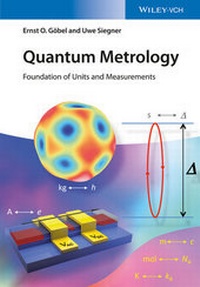
Quantum Metrology
Foundation of Units and Measurements
Published on 5. August 2015
Book
Hardback
XVI, 212 pages
978-3-527-41265-5 (ISBN)
Description
The International System of Units (SI) is the world's most widely used system of measurement, used every day in commerce and science, and is the modern form of the metric system. It currently comprises the meter (m), the kilogram (kg), the second (s), the ampere (A), the kelvin (K), the candela (cd) and the mole (mol)). The system is changing though, units and unit definitions are modified through international agreements as the technology of measurement progresses, and as the precision of measurements improves. The SI is now being redefined based on constants of nature and their realization by quantum standards. Therefore, the underlying physics and technologies will receive increasing interest, and not only in the metrology community but in all fields of science.
This book introduces and explains the applications of modern physics concepts to metrology, the science and the applications of measurements. A special focus is made on the use of quantum standards for the realization of the forthcoming new SI (the international system of units). The basic physical phenomena are introduced on a level which provides comprehensive information for the experienced reader but also provides a guide for a more intense study of these phenomena for students.
This book introduces and explains the applications of modern physics concepts to metrology, the science and the applications of measurements. A special focus is made on the use of quantum standards for the realization of the forthcoming new SI (the international system of units). The basic physical phenomena are introduced on a level which provides comprehensive information for the experienced reader but also provides a guide for a more intense study of these phenomena for students.
Reviews / Votes
The book "Quantum Metrology: Foundation of Units and Measurements" offers a unique introduction to the planned modifications of our system of units and is recommended for students, scientists and lecturers who are interested in questions of quantum physics and its practical applications in metrology.Prof. Dr. Klaus von Klitzing, Max-Planck-Institut fuer Festkoerperforschung, Stuttgart Seit zehn Jahren gibt es intensive UEberlegungen, das internationale Einheitensystem zu renovieren. Ausschlaggebend waren Fortschritte in der Praezisionsmesstechnik, welche die Moeglichkeit eroeffneten, Masseinheiten festzulegen, die nicht von Raum und Zeit abhaengen. Bei der Laengeneinheit Meter ist diese Entwicklung schon seit 1983 durch Rueckfuehrung auf eine Naturkonstante - die Lichtgeschwindigkeit ? zum Abschluss gekommen. Nicht nur das Meter, sondern auch die anderen Basiseinheiten unseres internationalen Einheitensystems sollen entsprechend einer Empfehlung der Generalkonferenz fuer Masse und Gewichte durch festgelegte Naturgroessen ersetzt werden. Ein entsprechender Beschluss koennte 2018 gefaellt werden. Der Umschlag des vorliegenden Buches verdeutlicht die geplanten AEnderungen: Insbesondere soll das Kilogramm ueber einen festgelegten Wert fuer die Planck-Konstante h, das Ampere ueber einen festgelegten Wert fuer die Elementarladung e und das Kelvin ueber einen festgelegten Wert fuer die Boltzmann-Konstante kB definiert werden.
Die Autoren dieses Buches sind bestens geeignet, die geplanten AEnderungen unseres SI-Einheitensystems und die entsprechenden physikalischen Grundlagen zu erlaeutern. Ernst Goebel war mehr als 16 Jahre Praesident der Physikalisch-Technischen Bundesanstalt (PTB) und hat als langjaehriges Mitglied des Komitees fuer Masse und Gewichte die geplanten Umwaelzungen von Beginn an miterlebt und gestaltet. Uwe Siegner als Leiter der Abteilung Elektrizitaet in der PTB ist in besonderem Masse von der geplanten AEnderung im SI-Einheitensystem betroffen, da sich die elektrischen Einheiten durch international vereinbarte konventionelle Werte fuer die Josephson- und von-Klitzing-Konstanten von den offiziellen SI-Einheiten abgekoppelt haben und sich erst durch die geplante Neufestlegung der SI-Basiseinheiten in dieses Einheitensystem integrieren lassen.
Nach einer Einfuehrung in die Grundlagen der Metrologie und in unser jetziges Einheitensystem werden in getrennten Kapiteln die experimentellen Methoden erlaeutert, die fuer die Neufestlegung der jeweiligen SI-Basiseinheit von Bedeutung sind. Das fuehrt dem Leser die gesamte Breite der modernen Quantenoptik, Thermodynamik, Supraleitungs- und Festkoerper-Nanophysik und deren Anwendung in der Metrologie vor Augen. Mit mehr als 500 Referenzen hat der Leser die Moeglichkeit, sich in das jeweilige Fachgebiet zu vertiefen.
Das Buch "Quantum Metrology: Foundation of Units and Measurements" bietet einen hervorragenden Einstieg zum Verstaendnis der geplanten AEnderungen in unserem Einheitensystem und ist Studierenden, Wissenschaftlern und Lehrenden zu empfehlen, die sich fuer moderne Fragen der Quantenphysik und deren praktischer Anwendung in der Metrologie interessieren.
Prof. Dr. Klaus von Klitzing, Max-Planck-Institut fuer Festkoerperforschung, Stuttgart
More details
Other editions
Additional editions
E-Book
06/2015
1st Edition
Wiley
€111.99
Available for download
E-Book
06/2015
1st Edition
Wiley
€111.99
Available for download
Persons
Prof. Ernst O. Göbel was president of the PTB, the German national metrology institute from 1995 until the end of 2011. He obtained his degrees from the Johann-Wolfgang Goethe University Frankfurt (diploma) and University Stuttgart (PhD), Germany. After a postdoctoral stay at Bell Laboratories in Holmdel, USA, he continued his scientific career at Stuttgart University, and subsequently at the Max-Planck-Institut for Solid State Physics in Stuttgart, Germany. In 1985 he was appointed full professor at the Philipps-University in Marburg, Germany. His main areas of expertise are solid state physics, in particular semiconductor physics, laser physics and metrology. He has published more than 350 scientific articles and received several scientific awards such as the Leibnitz-prize of the German Research Ass. (DFG) and the Max-Born Award jointly provided by the Institute of Physics (London) and the German Physical Society (DPG). He is member of several academies, e.g. the Berlin-Brandenburgische Academy of Science, Acatech - the German Academy of Engineering, the National Academy of Science Ukraine, and the Metrology Academy of Russia.
Content
Foreword
Preface
List of Abbreviations
INTRODUCTION
BASICS
Measurement
The SI (Système International d'Unités)
LASER COOLING, ATOMIC CLOCKS, AND THE SECOND
Techniques for Laser Cooling
The Cs-Fountain Clock
Optical Clocks
SUPERCONDUCTIVITY, JOSEPHSON EFFECT, AND FLUX QUANTA
Josephson Effect and Quantum Voltage Standards
Flux Quanta and Superconducting Quantum Interference Devices
QUANTUM HALL EFFECT
Basic Physics of Three- and Two Dimensional Semiconductors
Two-Dimensional Electron Systems in Real Semiconductors
The Hall Effect
Quantum Hall Resistance Standards
SINGLE-CHARGE TRANSFER DEVICES AND THE NEW AMPERE
Basic Physics of Single-Electron Transport
Quantized Current Sources
Consistency Tests: Quantum Metrology Triangle
PLANCK CONSTANT, THE NEW KILOGRAM, AND THE MOLE
The Avogadro Experiment
The Watt Balance Experiment
The Mole, Unit of Amount of Susbstance
BOLTZMAN CONSTANT AND THE NEW KELVIN
Primary Thermometers
Realization and Disseminiation of the New Kelvin
SINGLE-PHOTON METROLOGY AND QUANTUM RADIOMETRY
Single-Photon Sources
Single-Photon Detectors
Metrological Challenge
OUTLOOK
Preface
List of Abbreviations
INTRODUCTION
BASICS
Measurement
The SI (Système International d'Unités)
LASER COOLING, ATOMIC CLOCKS, AND THE SECOND
Techniques for Laser Cooling
The Cs-Fountain Clock
Optical Clocks
SUPERCONDUCTIVITY, JOSEPHSON EFFECT, AND FLUX QUANTA
Josephson Effect and Quantum Voltage Standards
Flux Quanta and Superconducting Quantum Interference Devices
QUANTUM HALL EFFECT
Basic Physics of Three- and Two Dimensional Semiconductors
Two-Dimensional Electron Systems in Real Semiconductors
The Hall Effect
Quantum Hall Resistance Standards
SINGLE-CHARGE TRANSFER DEVICES AND THE NEW AMPERE
Basic Physics of Single-Electron Transport
Quantized Current Sources
Consistency Tests: Quantum Metrology Triangle
PLANCK CONSTANT, THE NEW KILOGRAM, AND THE MOLE
The Avogadro Experiment
The Watt Balance Experiment
The Mole, Unit of Amount of Susbstance
BOLTZMAN CONSTANT AND THE NEW KELVIN
Primary Thermometers
Realization and Disseminiation of the New Kelvin
SINGLE-PHOTON METROLOGY AND QUANTUM RADIOMETRY
Single-Photon Sources
Single-Photon Detectors
Metrological Challenge
OUTLOOK