


Contact Talk
The Discursive Organization of Contact and Boundaries
1st Edition
Published on 26. November 2019
Book
Hardback
204 pages
978-1-138-37074-6 (ISBN)
Description
Written by a wide range of highly regarded scholars and exciting junior ones, this book critiques and operationalizes contemporary thinking in the rapidly expanding field of linguistic anthropology. It does so using case studies of actual everyday language practices from an extremely understudied yet incredibly important area of the Global South: Indonesia. In doing so, it provides a rich set of studies that model and explain complex linguistic anthropological analysis in engaging and easily understood ways.
As a book that is both accessible for undergraduate students and enlightening for graduate students through to senior professors, this book problematizes a wide range of assumptions. The diversity of settings and methodologies used in this book surpass many recent collections that attempt to address issues surrounding contemporary processes of diversification given rapid ongoing social change. In focusing on the trees, so to speak, the collection as a whole also enables readers to see the forest. This approach provides a rare insight into relationships between everyday language practices, social change, and the ever-present and ongoing processes of nation-building.
As a book that is both accessible for undergraduate students and enlightening for graduate students through to senior professors, this book problematizes a wide range of assumptions. The diversity of settings and methodologies used in this book surpass many recent collections that attempt to address issues surrounding contemporary processes of diversification given rapid ongoing social change. In focusing on the trees, so to speak, the collection as a whole also enables readers to see the forest. This approach provides a rare insight into relationships between everyday language practices, social change, and the ever-present and ongoing processes of nation-building.
Reviews / Votes
"This is an immensely important volume in which a synthesis is achieved of decades of theoretical debate, now integrated in an original and innovative framework for a sociolinguistics of complexity. Offering a range of richly documented studies within a coherent framework, this book is compelling reading for anyone interested in the contemporary dynamics of language and society." - Professor Jan Blommaert, Director of Babylon, Department of Culture Studies, Tilburg School of Humanities and Digital Sciences, Tilburg University, Tilburg, the Netherlands"This book shows that although Indonesia has arguably the world's most successful national language in one of the world's most linguistically diverse countries, the problem of contact languages has not been 'solved'. With ethnographically rich examples and introducing the concepts of 'scalar shifter' and 'contact register', the authors show beautifully how language remains a pivotal resource for the construction of difference and sameness in the midst of massive decentralization and globalization." - Joel Kuipers, Professor of Anthropology and International Affairs, George Washington University, USA "This is an immensely important volume in which a synthesis is achieved of decades of theoretical debate, now integrated in an original and innovative framework for a sociolinguistics of complexity. Offering a range of richly documented studies within a coherent framework, this book is compelling reading for anyone interested in the contemporary dynamics of language and society." - Professor Jan Blommaert, Director of Babylon, Department of Culture Studies, Tilburg School of Humanities and Digital Sciences, Tilburg University, Tilburg, the Netherlands
"This book shows that although Indonesia has arguably the world's most successful national language in one of the world's most linguistically diverse countries, the problem of contact languages has not been 'solved'. With ethnographically rich examples and introducing the concepts of 'scalar shifter' and 'contact register', the authors show beautifully how language remains a pivotal resource for the construction of difference and sameness in the midst of massive decentralization and globalization." - Joel Kuipers, Professor of Anthropology and International Affairs, George Washington University, USA
More details
Language
English
Place of publication
London
United Kingdom
Publishing group
Taylor & Francis Ltd
Target group
College/higher education
Illustrations
21 s/w Abbildungen, 21 s/w Photographien bzw. Rasterbilder, 6 s/w Tabellen
6 Tables, black and white; 21 Halftones, black and white; 21 Illustrations, black and white
Dimensions
Height: 234 mm
Width: 156 mm
Weight
560 gr
ISBN-13
978-1-138-37074-6 (9781138370746)
Copyright in bibliographic data and cover images is held by Nielsen Book Services Limited or by the publishers or by their respective licensors: all rights reserved.
Schweitzer Classification
Other editions
Additional editions
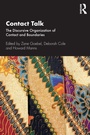
Zane Goebel | Deborah Cole | Howard Manns
Contact Talk
The Discursive Organization of Contact and Boundaries
Book
11/2019
1st Edition
Routledge
€61.10
Shipment within 10-20 days
Zane Goebel | Deborah Cole | Howard Manns
Contact Talk
The Discursive Organization of Contact and Boundaries
E-Book
11/2019
1st Edition
Routledge
€53.99
Available for download
Zane Goebel | Deborah Cole | Howard Manns
Contact Talk
The Discursive Organization of Contact and Boundaries
E-Book
11/2019
1st Edition
Routledge
€53.99
Available for download
Persons
Zane Goebel is Associate Professor in Indonesian and Applied Linguistics in the School of Languages and Cultures, Faculty of Humanities and Social Sciences, University of Queensland, Australia.
Deborah Cole is Associate Professor in the Department of Language, Literature and Communication, College of Humanities at Utrecht University, the Netherlands.
Howard Manns is Lecturer in Linguistics in the School of Languages, Literature, Cultures and Linguistics at Monash University, Australia.
Deborah Cole is Associate Professor in the Department of Language, Literature and Communication, College of Humanities at Utrecht University, the Netherlands.
Howard Manns is Lecturer in Linguistics in the School of Languages, Literature, Cultures and Linguistics at Monash University, Australia.
Content
1. Theorizing the Semiotic Complexity of Contact Talk: Contact Registers and Scalar Shifters
Zane Goebel, Deborah Cole and Howard Manns
2. Indonesia and Indonesian
Howard Manns, Deborah Cole and Zane Goebel
3. Reentering the Margins? The Scale of "Local Language" in a Decentralizing Indonesia
Adam Harr
4. Moving Languages: Bivalency and Scalar Shifters in Central Javanese Language Ecologies
Lauren Zentz
5. From "Top-down" to "Bottom-up": The New Order's Vertical Synchronicity and the Vintage Aesthetics of the Margins in Post-Suharto Political Oratory
Aurora Donzelli
6. Revaluing and Rescaling National and Ethnic Language Boundaries in Online Discourse
Howard Manns and Simon Musgrave
7. Adolescent Interaction, Local Languages and Peripherality in Teen Fiction
Dwi Noverini Djenar
8. Modeling Contact Talk on Television
Zane Goebel
9. Localizing Person Reference among Indonesian Youth
Michael C. Ewing
10. Revaluing Papuan Malay
Izak Morin and Zane Goebel
11. The Emergent Selectivity of Semiotically Playful Utterances
Deborah Cole
12. Coda
Zane Goebel
Zane Goebel, Deborah Cole and Howard Manns
2. Indonesia and Indonesian
Howard Manns, Deborah Cole and Zane Goebel
3. Reentering the Margins? The Scale of "Local Language" in a Decentralizing Indonesia
Adam Harr
4. Moving Languages: Bivalency and Scalar Shifters in Central Javanese Language Ecologies
Lauren Zentz
5. From "Top-down" to "Bottom-up": The New Order's Vertical Synchronicity and the Vintage Aesthetics of the Margins in Post-Suharto Political Oratory
Aurora Donzelli
6. Revaluing and Rescaling National and Ethnic Language Boundaries in Online Discourse
Howard Manns and Simon Musgrave
7. Adolescent Interaction, Local Languages and Peripherality in Teen Fiction
Dwi Noverini Djenar
8. Modeling Contact Talk on Television
Zane Goebel
9. Localizing Person Reference among Indonesian Youth
Michael C. Ewing
10. Revaluing Papuan Malay
Izak Morin and Zane Goebel
11. The Emergent Selectivity of Semiotically Playful Utterances
Deborah Cole
12. Coda
Zane Goebel