

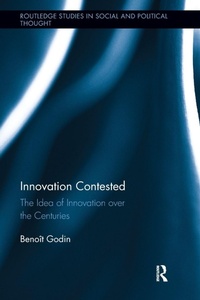
Innovation Contested
The Idea of Innovation Over the Centuries
1st Edition
Published on 14. October 2024
Book
Paperback/Softback
370 pages
978-1-032-92127-3 (ISBN)
Description
Innovation is everywhere. In the world of goods (technology), but also in the world of words: innovation is discussed in the scientific and technical literature, but also in the social sciences and humanities. Innovation is also a central idea in the popular imaginary, in the media and in public policy. Innovation has become the emblem of the modern society and a panacea for resolving many problems.
Today, innovation is spontaneously understood as technological innovation because of its contribution to economic "progress". Yet for 2,500 years, innovation had nothing to do with economics in a positive sense. Innovation was pejorative and political. It was a contested idea in philosophy, religion, politics and social affairs. Innovation only got de-contested in the last century. This occurred gradually beginning after the French revolution. Innovation shifted from a vice to a virtue. Innovation became an instrument for achieving political and social goals.
In this book, Benoit Godin lucidly examines the representations and meaning(s) of innovation over time, its diverse uses, and the contexts in which the concept emerged and changed. This history is organized around three periods or episteme: the prohibition episteme, the instrument episteme, and the value episteme.
Today, innovation is spontaneously understood as technological innovation because of its contribution to economic "progress". Yet for 2,500 years, innovation had nothing to do with economics in a positive sense. Innovation was pejorative and political. It was a contested idea in philosophy, religion, politics and social affairs. Innovation only got de-contested in the last century. This occurred gradually beginning after the French revolution. Innovation shifted from a vice to a virtue. Innovation became an instrument for achieving political and social goals.
In this book, Benoit Godin lucidly examines the representations and meaning(s) of innovation over time, its diverse uses, and the contexts in which the concept emerged and changed. This history is organized around three periods or episteme: the prohibition episteme, the instrument episteme, and the value episteme.
More details
Series
Language
English
Place of publication
London
United Kingdom
Publishing group
Taylor & Francis Ltd
Target group
College/higher education
Academic and Postgraduate
Illustrations
7 s/w Abbildungen
7 Illustrations, black and white
Dimensions
Height: 229 mm
Width: 152 mm
Weight
860 gr
ISBN-13
978-1-032-92127-3 (9781032921273)
Copyright in bibliographic data and cover images is held by Nielsen Book Services Limited or by the publishers or by their respective licensors: all rights reserved.
Schweitzer Classification
Other editions
Additional editions

Book
01/2015
1st Edition
Routledge
€188.10
Shipment within 15-20 days
E-Book
01/2015
1st Edition
Routledge
€54.99
Available for download
E-Book
01/2015
1st Edition
Routledge
€55.49
Available for download
Person
Benoit Godin is a professor at INRS in Montreal, Canada. He holds a Dphil in science policy from Sussex (UK) University and has written extensively on science policy, research evaluation and science indicators.
Content
Selected Contents: Introduction Part 1: The Emergence of a Concept 1. Kainotomia and Conceptual Innovation in Ancient Greece 2. Innovo: On the Vicissitudes and Varieties of a Concept 3. Innovation, or, How to Stabilize a Changing World Part 2. Use of the Concept: The Prohibition Episteme 4. 'Meddle Not With Them That Are Given to Change': Innovation as Evil 5. Republicanism as Innovation ... or Not Innovation 6. Social Innovation: From Scheme to Utopia Part 3. Transformation of the Concept: The Instrument Episteme 7. Re-imagining Innovation: A Semantic Rehabilitation 8. Innovation Transformed: From Word to Concept 9. When Science Had Nothing to Do with Innovation, and Vice-Versa Part 4. Diffusion of the Concept: The Value Episteme 10. The Vocabulary of Innovation: A Lexicon 11. Appropriating Innovation: For What Purpose? 12. "Innovation Studies": The Invention of a Specialty. Conclusion. Appendices. Sources and References. Index