

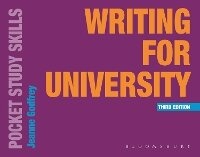
Writing for University
3rd Edition
Published on 10. March 2022
Book
Paperback/Softback
144 pages
978-1-350-93367-5 (ISBN)
Description
This indispensable guide shows students what successful academic writing involves and gives them the tools they will need to write successfully themselves. It separates fact from fiction and takes students through the five essential elements of academic writing: writing critically; using sources; developing your own voice; having a clear structure and style; and editing and polishing drafts. Chapters include annotated extracts of real students' academic writing from a range of subject areas. This third edition has been revised throughout, and contains three new sections on originality, argument and synthesising sources.
Writing for University is an essential resource for students making the transition to university-level study and a valuable reference point for all students doing academic study in English. It is suitable for students of all disciplines, from education and business through to social work and psychology.
Writing for University is an essential resource for students making the transition to university-level study and a valuable reference point for all students doing academic study in English. It is suitable for students of all disciplines, from education and business through to social work and psychology.
More details
Series
Edition
3rd edition
Language
English
Place of publication
London
United Kingdom
Publishing group
Bloomsbury Publishing PLC
Target group
College/higher education
Illustrations
Approx. 20 line drawings
Dimensions
Height: 139 mm
Width: 109 mm
Thickness: 10 mm
Weight
95 gr
ISBN-13
978-1-350-93367-5 (9781350933675)
Copyright in bibliographic data and cover images is held by Nielsen Book Services Limited or by the publishers or by their respective licensors: all rights reserved.
Schweitzer Classification
Other editions
Additional editions

Jeanne Godfrey
Writing for University
E-Book
03/2022
3rd Edition
Bloomsbury Academic
€9.99
Available for download

Jeanne Godfrey
Writing for University
E-Book
03/2022
3rd Edition
Bloomsbury Academic
€9.99
Available for download
Previous edition

Jeanne Godfrey
Writing for University
Book
03/2016
2nd Edition
Red Globe Press
€10.69
Article exhausted; check for reprint
Person
Jeanne Godfrey lectures at the University of Leeds UK. She has been Chair of the British Association of Lecturers in English for Academic Purposes and set up one of the first academic writing centres in a UK university.
Content
PART 1: INTRODUCTION
1. Myths and Realities
2. What Academic Writing Looks Like
3. Understanding Your Context and Purpose
4. What Your Tutors Mean by 'Originality'
Summary
PART 2: WRITE CRITICALLY
5. What Critical Writing Is
6. What Critical Writing Looks Like
7. Common Errors in Critical Writing
8. Forming an Argument
Summary
PART 3: USE YOUR SOURCES CORRECTLY
9. Using Their Words - Quotation
10. Using Your Words - Paraphrase and Source Summary
11. Using Verbs to Show You Understand Your Sources
12. Referencing Styles and Techniques
13. Avoiding Accidental Plagiarism
Summary
PART 4: LET YOUR OWN VOICE SHINE THROUGH
14. Synthesizing Sources to Create Your Own Insights
15. Making Sure Your Own Arguments Stand Out
16. Using Verbs to Show Your Position
17. Using I and We
18. Expressing Levels of Certainty and Caution
Summary
PART 5: WRITE FOR YOUR READER
19. Creating a Clear Assignment Structure
20. Structure of Different Assignment Types
21. Creating a Clear Paragraph Structure
22. Developing a Clear Writing Style
23. Using Words Precisely
Summary
PART 6: EDIT AND POLISH YOUR ASSIGNMENT
24. The Process of Writing and Rewriting
25. Common Language Errors
26. A Checklist
1. Myths and Realities
2. What Academic Writing Looks Like
3. Understanding Your Context and Purpose
4. What Your Tutors Mean by 'Originality'
Summary
PART 2: WRITE CRITICALLY
5. What Critical Writing Is
6. What Critical Writing Looks Like
7. Common Errors in Critical Writing
8. Forming an Argument
Summary
PART 3: USE YOUR SOURCES CORRECTLY
9. Using Their Words - Quotation
10. Using Your Words - Paraphrase and Source Summary
11. Using Verbs to Show You Understand Your Sources
12. Referencing Styles and Techniques
13. Avoiding Accidental Plagiarism
Summary
PART 4: LET YOUR OWN VOICE SHINE THROUGH
14. Synthesizing Sources to Create Your Own Insights
15. Making Sure Your Own Arguments Stand Out
16. Using Verbs to Show Your Position
17. Using I and We
18. Expressing Levels of Certainty and Caution
Summary
PART 5: WRITE FOR YOUR READER
19. Creating a Clear Assignment Structure
20. Structure of Different Assignment Types
21. Creating a Clear Paragraph Structure
22. Developing a Clear Writing Style
23. Using Words Precisely
Summary
PART 6: EDIT AND POLISH YOUR ASSIGNMENT
24. The Process of Writing and Rewriting
25. Common Language Errors
26. A Checklist