

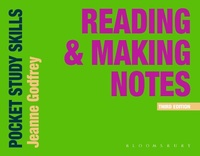
Reading and Making Notes
3rd Edition
Published on 9. February 2023
Book
Paperback/Softback
160 pages
978-1-350-32185-4 (ISBN)
Description
University students are typically exposed to a much wider variety of academic sources at university - including monographs, textbooks, journals, reports - and, crucially, a much larger proportion of their time is spent on independent academic reading, relative to their time in school.
There are lots of study skills texts which deal with academic writing in some form or other, but there are far fewer resources which provide helpful guidance about how to manage the early stages of an assignment. The quality of a student's written work reflects the quality of their reading and note-making skills. If students don't understand what their assignment is asking; if students don't take control of their reading list and consult the most appropriate sources; and if students don't end the process of reading with meaningful notes it's very unlikely that they will score high marks for their assignment.
This book helps readers to take charge of their reading at university and provides succinct and practical guidance at key stages of the assignment. It helps students to understand what their assignment title means and how to identify useful, reliable academic sources. It helps students to apply different reading strategies, depending on the task at hand, and to approach texts actively so that they are questioning and evaluating materials as they go. In addition to reading strategies, the Pocket introduces readers to useful strategies and tips for note-making. The final part helps readers to make the most of their notes by engaging with and reviewing the material they've created.
New for this edition:
- A science-based example for STEM students
- New section which helps readers think about what type of information and evidence they need to find
- New tips on managing large volumes of reading
- Updated material on note-making software and online tools to reflect latest technology
There are lots of study skills texts which deal with academic writing in some form or other, but there are far fewer resources which provide helpful guidance about how to manage the early stages of an assignment. The quality of a student's written work reflects the quality of their reading and note-making skills. If students don't understand what their assignment is asking; if students don't take control of their reading list and consult the most appropriate sources; and if students don't end the process of reading with meaningful notes it's very unlikely that they will score high marks for their assignment.
This book helps readers to take charge of their reading at university and provides succinct and practical guidance at key stages of the assignment. It helps students to understand what their assignment title means and how to identify useful, reliable academic sources. It helps students to apply different reading strategies, depending on the task at hand, and to approach texts actively so that they are questioning and evaluating materials as they go. In addition to reading strategies, the Pocket introduces readers to useful strategies and tips for note-making. The final part helps readers to make the most of their notes by engaging with and reviewing the material they've created.
New for this edition:
- A science-based example for STEM students
- New section which helps readers think about what type of information and evidence they need to find
- New tips on managing large volumes of reading
- Updated material on note-making software and online tools to reflect latest technology
More details
Series
Edition
3rd edition
Language
English
Place of publication
London
United Kingdom
Publishing group
Bloomsbury Publishing PLC
Target group
College/higher education
Dimensions
Height: 138 mm
Width: 108 mm
Thickness: 11 mm
Weight
104 gr
ISBN-13
978-1-350-32185-4 (9781350321854)
Copyright in bibliographic data and cover images is held by Nielsen Book Services Limited or by the publishers or by their respective licensors: all rights reserved.
Schweitzer Classification
Other editions
Additional editions

Jeanne Godfrey
Reading and Making Notes
E-Book
02/2023
3rd Edition
Bloomsbury Academic
€9.99
Available for download

Jeanne Godfrey
Reading and Making Notes
E-Book
02/2023
3rd Edition
Bloomsbury Academic
€9.99
Available for download
Person
Jeanne Godfrey has been teaching and managing in the field of English language and academic writing for over twenty years and currently lectures at the University of Leeds UK. She has been Chair of the British Association of Lecturers in English for Academic Purposes and set up one of the first academic writing centres in a UK university. Jeanne is author of The Student Phrase Book, The Business Student's Phrase Book, How to Use Your Reading in Your Essays, and Writing for University.
Content
Acknowledgements
Introduction
1. Active reading and note making
PART I: DECIDE WHAT YOU ARE GOING TO READ
2. What your lecturers are looking for
3. Understand your assignment title
4. Take control of your reading list...
5. ...and go beyond it?
6. Reliable and academic sources
7. Fine-tune your selection
PART II: DECIDE HOW YOU ARE GOING TO READ
8. Ways to read
9. Finding time to read
PART III: UNDERSTAND, QUESTION AND EVALUATE
10. Understand the text accurately
11. What to do if you get stuck
12. Make up your own mind
13. Get the wider picture
PART IV: THE ESSENTIALS
14. Active and purposeful notes
15. Key features of effective notes
PART V: DECIDE HOW YOU WILL MAKE NOTES
16. Different note-making formats
17. Making notes in lectures and seminars
18. Tools and technology
PART VI: MAKE THE MOST OF YOUR NOTES
19. Review and rework your notes
20. Using your notes in assignments
Appendix 1: Examples of common abbreviations for note making
Appendix 2: Definitions of words used in this guide
References
Useful resources
Index
Introduction
1. Active reading and note making
PART I: DECIDE WHAT YOU ARE GOING TO READ
2. What your lecturers are looking for
3. Understand your assignment title
4. Take control of your reading list...
5. ...and go beyond it?
6. Reliable and academic sources
7. Fine-tune your selection
PART II: DECIDE HOW YOU ARE GOING TO READ
8. Ways to read
9. Finding time to read
PART III: UNDERSTAND, QUESTION AND EVALUATE
10. Understand the text accurately
11. What to do if you get stuck
12. Make up your own mind
13. Get the wider picture
PART IV: THE ESSENTIALS
14. Active and purposeful notes
15. Key features of effective notes
PART V: DECIDE HOW YOU WILL MAKE NOTES
16. Different note-making formats
17. Making notes in lectures and seminars
18. Tools and technology
PART VI: MAKE THE MOST OF YOUR NOTES
19. Review and rework your notes
20. Using your notes in assignments
Appendix 1: Examples of common abbreviations for note making
Appendix 2: Definitions of words used in this guide
References
Useful resources
Index