

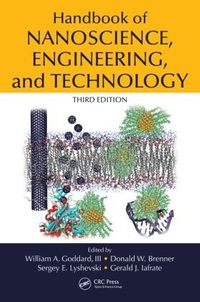
Handbook of Nanoscience, Engineering, and Technology
3rd Edition
Published on 12. June 2012
Book
Hardback
1094 pages
978-1-4398-6015-1 (ISBN)
Description
In his 1959 address, "There is Plenty of Room at the Bottom," Richard P. Feynman speculated about manipulating materials atom by atom and challenged the technical community "to find ways of manipulating and controlling things on a small scale." This visionary challenge has now become a reality, with recent advances enabling atomistic-level tailoring and control of materials.
Exemplifying Feynman's vision, Handbook of Nanoscience, Engineering, and Technology, Third Edition continues to explore innovative nanoscience, engineering, and technology areas. Along with updating all chapters, this third edition extends the coverage of emerging nano areas even further. Two entirely new sections on energy and biology cover nanomaterials for energy storage devices, photovoltaics, DNA devices and assembly, digital microfluidic lab-on-a-chip, and much more. This edition also includes new chapters on nanomagnet logic, quantum transport at the nanoscale, terahertz emission from Bloch oscillator systems, molecular logic, electronic optics in graphene, and electromagnetic metamaterials.
With contributions from top scientists and researchers from around the globe, this color handbook presents a unified, up-to-date account of the most promising technologies and developments in the nano field. It sets the stage for the next revolution of nanoscale manufacturing-where scalable technologies are used to manufacture large numbers of devices with complex functionalities.
Exemplifying Feynman's vision, Handbook of Nanoscience, Engineering, and Technology, Third Edition continues to explore innovative nanoscience, engineering, and technology areas. Along with updating all chapters, this third edition extends the coverage of emerging nano areas even further. Two entirely new sections on energy and biology cover nanomaterials for energy storage devices, photovoltaics, DNA devices and assembly, digital microfluidic lab-on-a-chip, and much more. This edition also includes new chapters on nanomagnet logic, quantum transport at the nanoscale, terahertz emission from Bloch oscillator systems, molecular logic, electronic optics in graphene, and electromagnetic metamaterials.
With contributions from top scientists and researchers from around the globe, this color handbook presents a unified, up-to-date account of the most promising technologies and developments in the nano field. It sets the stage for the next revolution of nanoscale manufacturing-where scalable technologies are used to manufacture large numbers of devices with complex functionalities.
Reviews / Votes
Praise for the First Edition:There is quite a wide array of topics in this handbook, and it can certainly be interesting and useful to read about what others are doing in nanotechnology to get your own ideas. This book gives the reader access to a huge wealth of ideas that may spur new ideas in the area of nanotechnology they are working in.-IEEE Electrical Insulation Magazine, July/August 2008
More details
Series
Edition
3rd edition
Language
English
Place of publication
Bosa Roca
United States
Publishing group
Taylor & Francis Inc
Target group
Professional and scholarly
Professional
Illustrations
530 s/w Abbildungen, 20 s/w Tabellen
20 Tables, black and white; 530 Illustrations, black and white
Dimensions
Height: 254 mm
Width: 178 mm
Weight
2414 gr
ISBN-13
978-1-4398-6015-1 (9781439860151)
Copyright in bibliographic data and cover images is held by Nielsen Book Services Limited or by the publishers or by their respective licensors: all rights reserved.
Schweitzer Classification
Other editions
Additional editions
William A. Goddard III | Donald Brenner | Sergey Edward Lyshevski
Handbook of Nanoscience, Engineering, and Technology
E-Book
09/2018
3rd Edition
CRC Press
€180.99
Available for download
William A. Goddard III | Donald Brenner | Sergey Edward Lyshevski
Handbook of Nanoscience, Engineering, and Technology
E-Book
09/2018
3rd Edition
CRC Press
€311.99
Available for download
William A. Goddard III | Donald Brenner | Sergey Edward Lyshevski
Handbook of Nanoscience, Engineering, and Technology, Third Edition
Book
10/2017
3rd Edition
CRC Press
€94.22
Article exhausted; check different version
Previous edition
William A. Goddard III | Donald Brenner | Sergey Edward Lyshevski
Handbook of Nanoscience, Engineering, and Technology, Second Edition
Book
05/2007
2nd Edition
CRC Press
€152.27
Article exhausted; check for reprint
Persons
William A. Goddard III is the Charles and Mary Ferkel Professor in chemistry, materials science, and applied physics at the California Institute of Technology, where he serves as the director of the Materials and Process Simulation Center. He is also a World Class University professor and director of the Center for Materials Simulation and Design at the Korea Advanced Institute of Science and Technology.
Professor Goddard is a member of the U.S. National Academy of Sciences and fellow of the American Physical Society, the American Association for the Advancement of Science, the American Academy of Arts and Science, and the U.K. Royal Society of Chemistry. He has published over 964 scientific articles and has developed first-principles-based multiscale, multiparadigm methods to solve critical problems in nanotechnology, catalysis, energy storage, and pharma. Professor Goddard has received numerous honors from societies and organizations, including the American Chemical Society, the Institute for Molecular Manufacturing, and NASA.
Donald W. Brenner is a Kobe Steel distinguished professor and associate head of the Department of Materials Science and Engineering at North Carolina State University. He is also a member of the Scientific Advisory Committee of the Center for Nanoscale Materials at Argonne National Laboratory. Dr. Brenner has received several awards from North Carolina State University, the American Chemical Society, the U.S. National Science Foundation, and the U.S. Naval Research Laboratory. His research focuses on using atomic and mesoscale simulation and theory to understand technologically important processes and materials.
Sergey E. Lyshevski is a professor of electrical engineering at Rochester Institute of Technology. Dr. Lyshevski has been a professor at Kiev Polytechnic Institute, the Academy of Sciences of Ukraine, and Purdue School of Engineering. He also has been a senior summer faculty member at the U.S. Air Force Research Laboratory and the U.S. Surface and Undersea Naval Warfare Centers. He has authored/co-authored 16 books and over 300 papers and handbook chapters. His research encompasses the areas of molecular engineering, microsystems, MEMS, nanotechnology, molecular processing, and systems informatics.
Gerald J. Iafrate is a research professor of electrical and computer engineering at North Carolina State University. He is a fellow of the American Physical Society, the American Association for the Advancement of Science, and the Institute of Electrical and Electronics Engineers. Dr. Iafrate was a professor at the University of Notre Dame, director of the U.S. Army Research Office, and director of electronic devices research at the U.S. Army Electronics Technology and Devices Laboratory. His research interests include quantum transport in nanostructures, spontaneous emission from Bloch electron radiators, and molecular-scale electronics.
Professor Goddard is a member of the U.S. National Academy of Sciences and fellow of the American Physical Society, the American Association for the Advancement of Science, the American Academy of Arts and Science, and the U.K. Royal Society of Chemistry. He has published over 964 scientific articles and has developed first-principles-based multiscale, multiparadigm methods to solve critical problems in nanotechnology, catalysis, energy storage, and pharma. Professor Goddard has received numerous honors from societies and organizations, including the American Chemical Society, the Institute for Molecular Manufacturing, and NASA.
Donald W. Brenner is a Kobe Steel distinguished professor and associate head of the Department of Materials Science and Engineering at North Carolina State University. He is also a member of the Scientific Advisory Committee of the Center for Nanoscale Materials at Argonne National Laboratory. Dr. Brenner has received several awards from North Carolina State University, the American Chemical Society, the U.S. National Science Foundation, and the U.S. Naval Research Laboratory. His research focuses on using atomic and mesoscale simulation and theory to understand technologically important processes and materials.
Sergey E. Lyshevski is a professor of electrical engineering at Rochester Institute of Technology. Dr. Lyshevski has been a professor at Kiev Polytechnic Institute, the Academy of Sciences of Ukraine, and Purdue School of Engineering. He also has been a senior summer faculty member at the U.S. Air Force Research Laboratory and the U.S. Surface and Undersea Naval Warfare Centers. He has authored/co-authored 16 books and over 300 papers and handbook chapters. His research encompasses the areas of molecular engineering, microsystems, MEMS, nanotechnology, molecular processing, and systems informatics.
Gerald J. Iafrate is a research professor of electrical and computer engineering at North Carolina State University. He is a fellow of the American Physical Society, the American Association for the Advancement of Science, and the Institute of Electrical and Electronics Engineers. Dr. Iafrate was a professor at the University of Notre Dame, director of the U.S. Army Research Office, and director of electronic devices research at the U.S. Army Electronics Technology and Devices Laboratory. His research interests include quantum transport in nanostructures, spontaneous emission from Bloch electron radiators, and molecular-scale electronics.
Content
Nanotechnology Overview. Molecular and Nanoelectronics. Manipulation and Assembly. Functional Structures. Nano Energy. NanoBio, Medicine, and Life Sciences. Index.