

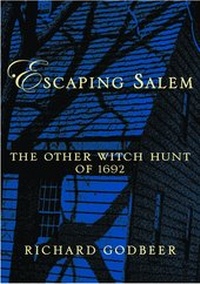
Escaping Salem
The Other Witch Hunt of 1692
Published on 1. October 2004
Book
Hardback
208 pages
978-0-19-516129-8 (ISBN)
Description
Few events in American history are as well remembered as the Salem Witch Trials of 1692. But there was another witch hunt that year, in Stamford, Connecticut, that has never been examined in depth. Now Richard Godbeer describes this "other witch hunt" in a concise, fascinating narrative that illuminates the colonial world and shatters the stereotype of early New Englanders as quick to accuse and condemn. That stereotype originates with Salem, which was in many ways unlike other outbreaks of witch-hunting in the region. Drawing on eye-witness testimony, Godbeer tells the story of Kate Branch, a seventeen-year-old afflicted by strange visions and given to blood-chilling wails of pain and fright. Branch accused several women of bewitching her, two of whom were put on trial for witchcraft. The book takes us inside the courtroom - and inside the minds of the surprisingly skeptical Stamford townfolk. Was the pain and screaming due to natural causes, or to supernatural causes? Was Branch simply faking the symptoms? And if she was telling the truth, why believe the demonic sources of the information, who might well be lying? For the judges, Godbeer shows, the trial was a legal thicket.
All agreed that witches posed a real and serious threat, but proving witchcraft (an invisible crime) in court was another matter. The court in Salem had become mired in controversy over its use of dubious evidence. In an intriguing passage, Godbeer examines Magistrate Jonathan Selleck's notes on how to determine the guilt of someone accused of witchcraft - an illuminating look at what constituted proof of witchcraft at the time. The stakes were high - if found guilty, the two accused women would be hanged. In the afterword, Godbeer explains how he used the trial evidence to build his narrative, an inside look at the historian's craft that enhances this wonderful account of life in colonial New England.
All agreed that witches posed a real and serious threat, but proving witchcraft (an invisible crime) in court was another matter. The court in Salem had become mired in controversy over its use of dubious evidence. In an intriguing passage, Godbeer examines Magistrate Jonathan Selleck's notes on how to determine the guilt of someone accused of witchcraft - an illuminating look at what constituted proof of witchcraft at the time. The stakes were high - if found guilty, the two accused women would be hanged. In the afterword, Godbeer explains how he used the trial evidence to build his narrative, an inside look at the historian's craft that enhances this wonderful account of life in colonial New England.
Reviews / Votes
[Godbeer] is especially successful in evoking the world of village tensions and long-remembered squabbles which so often udnerlay witchcraft accusations Times Literary SupplementMore details
Series
Language
English
Place of publication
New York
United States
Target group
Professional and scholarly
Students and scholars of Colonial history
Illustrations
6 Fotos bzw. Rasterbilder, 2 Karten, 2 Abbildungen
6 halftones, 2 maps, 2 line illus.
Weight
259 gr
ISBN-13
978-0-19-516129-8 (9780195161298)
Copyright in bibliographic data and cover images is held by Nielsen Book Services Limited or by the publishers or by their respective licensors: all rights reserved.
Schweitzer Classification
Other editions
Additional editions
E-Book
10/2004
1st Edition
OUP eBook
€8.99
Available for download
Person
Richard Godbeer, Associate Professor of History, University of California at Riverside