

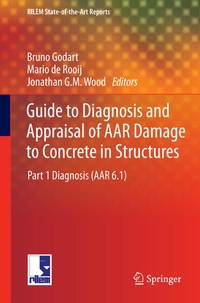
Guide to Diagnosis and Appraisal of AAR Damage to Concrete in Structures
Part 1 Diagnosis (AAR 6.1)
Published on 20. April 2013
Book
Hardback
X, 91 pages
978-94-007-6566-5 (ISBN)
Description
This book describes procedures and methodologies used predominantly to obtain a diagnosis of damaged concrete possibly caused by Alkali-Aggregate Reaction (AAR). It has two primary objectives, namely firstly to identify the presence of AAR reaction, and whether or not the reaction is the primary or contributory cause of damage in the concrete; and secondly, to establish its intensity (severity) in various members of a structure. It includes aspects such as field inspection of the structure, sampling, petrographic examination of core samples, and supplementary tests and analyses on cores, such as mechanical tests and chemical analysis. Evaluation of test data for prognosis, consequences and appraisal will be more fully set out in AAR-6.2.
More details
Series
Edition
2013 ed.
Language
English
Place of publication
Dordrecht
Netherlands
Target group
Professional and scholarly
Research
Product notice
sewn/stitched
Cloth over boards
Illustrations
28 s/w Abbildungen
X, 91 p. 28 illus.
Dimensions
Height: 241 mm
Width: 160 mm
Thickness: 10 mm
Weight
330 gr
ISBN-13
978-94-007-6566-5 (9789400765665)
DOI
10.1007/978-94-007-6567-2
Schweitzer Classification
Other editions
Additional editions
Bruno Godart | Mario de Rooij | Jonathan G.M. Wood
Guide to Diagnosis and Appraisal of AAR Damage to Concrete in Structures
Part 1 Diagnosis (AAR 6.1)
Book
05/2015
Springer
€106.99
Shipment within 15-20 days
Bruno Godart | Mario de Rooij | Jonathan G.M. Wood
Guide to Diagnosis and Appraisal of AAR Damage to Concrete in Structures
Part 1 Diagnosis (AAR 6.1)
E-Book
04/2013
1st Edition
Springer
€96.29
Available for download
Content
1. Introduction: 1.1 Why the need for a diagnosis document.- 1.2 Scope.- 1.3 Definitions.- 2 Alkali-Aggregate Reaction: 2.1 Introduction.- 2.2 Alkali.- 2.3 Aggregates.- 2.4 Water.- 2.5 Pessimum behaviour.- 2.6 Summary.- 3 Symptoms of an expansive reaction during routine inspection: 3.1 General inspection remarks.- 3.2 Review of existing records.- 3.3 Planning of a comprehensive on-site inspection.- 3.4 The routine on-site inspection.- 3.5 Concrete surface features suggestive of AAR.- 3.6 First assessment of field observations.- 4 Confirmation investigation: 4.1 Introduction.- 4.2 Available methods, personnel and expertise.- 4.3 Approach for diagnosis of AAR in structures.- 4.4 On-site sampling for AAR confirmation.- 4.5 Visual examination of cores.- 4.6 Petrographic examination.- 4.7 Additional tests.- 5 Severity investigation: 5.1 Introduction.- 5.2 Field investigation.- 5.3 Laboratory tests.- 5.4 Summary of diagnosis.- 6 Reporting: 6.1 Purpose.- 6.2 Scope.- 6.3 Objectives of the investigation.- 6.4 Information concerning the structures.- 6.5 Methods and techniques used.- 6.6 Interpretation of results.- 6.7 Conclusions.- 6.8 Author.- References.- Appendix 1. Proceedings of ICAAR.- Appendix 2. Diagnosis of AAR within an overall investigation.