

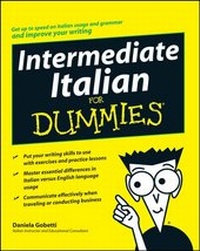
Intermediate Italian For Dummies
1st Edition
Published on 31. October 2008
Book
Paperback/Softback
336 pages
978-0-470-24794-5 (ISBN)
Description
Plenty of room to practice skills with exercises right in the workbook
From e-mails to personal letters and correspondence, write in Italian with confidence
Looking to enhance your Italian writing skills? This friendly, hands-on workbook gives you practical examples and useful exercises so you can practice writing the language like a native. From vocabulary and numbers to juggling tenses, you'll get a clear understanding of the nuances of Italian style and usage that will have you writing in no time. Plus, you'll find an appendix of verb charts that provides conjugations of regular and irregular Italian verbs.
Discover how to:
* Use fundamental Italian grammar -- from nouns, adjectives, and adverbs to pronouns, prepositions, and conjunctions
* Select the correct Italian verbs
* Understand the importance of grammatical gender in Italian
* Avoid the most common writing mistakes in Italian
From e-mails to personal letters and correspondence, write in Italian with confidence
Looking to enhance your Italian writing skills? This friendly, hands-on workbook gives you practical examples and useful exercises so you can practice writing the language like a native. From vocabulary and numbers to juggling tenses, you'll get a clear understanding of the nuances of Italian style and usage that will have you writing in no time. Plus, you'll find an appendix of verb charts that provides conjugations of regular and irregular Italian verbs.
Discover how to:
* Use fundamental Italian grammar -- from nouns, adjectives, and adverbs to pronouns, prepositions, and conjunctions
* Select the correct Italian verbs
* Understand the importance of grammatical gender in Italian
* Avoid the most common writing mistakes in Italian
More details
Other editions
New editions
T Picarazzi
Italian Workbook For Dummies
Book
01/2023
2nd Edition
Wiley
€20.00
Shipment within 15-20 days
Additional editions
Person
Daniela Gobetti has taught political theory in undergraduate and graduate courses in Italy and the United States. She has written several books of instruction for learners of Italian, and taught private language courses and cultural training classes. She is the principal and managing director of PROXIMA-INTERCULTURAL, a consulting firm working on the internationalization of higher education.
Content
Introduction 1
About This Book 1
Conventions Used in This Book 2
Foolish Assumptions 2
How This Book Is Organized 3
Part I: Getting Your Bearings: Reviewing the Basics 3
Part II: A Close Look at Parts of Speech 3
Part III: What Would You Do without Verbs and Tenses? 3
Part IV: Adding Nuances to Moods and Tenses 4
Part V: The Part of Tens 4
Part VI: Appendixes 4
Icons Used in This Book 4
Where to Go from Here 5
Part I: Getting Your Bearings: Reviewing the Basics 7
Chapter 1: What Do You Know? Parts of Speech and Then Some 9
Getting a Grip on Italian Grammar Terms and Nuances 9
Phonology: Saying and spelling words correctly 10
Morphology: Word structure and variations in word forms 11
Syntax: Putting words in order 17
Getting the Most Out of Dictionaries 19
Navigating a monolingual Italian dictionary 20
Navigating a bilingual Italian-English/English-Italian dictionary 20
Answer Key 23
Chapter 2: Noun and Article Basics: Gender and Number 25
A Primer on Articles 25
Dealing with the definite article "the" 26
Saying "a" or "an" in Italian: Indefinite articles 27
Distinguishing between Masculine and Feminine Nouns 27
Recognizing common noun endings 28
Sorting nouns into three classes 29
Moving from Singular to Plural: Basic Rules 31
Exceptions to the Basic Rules on Number 32
Changing more than just the ending 32
Changing only the article 34
Using nouns only in the singular or the plural 34
Deciding When to Include an Article 35
When (and when not) to use a definite article 35
When (and when not) to use an indefinite article 36
Answer Key 38
Chapter 3: Numbers, Dates, and Time 41
Counting Items with Cardinal Numbers 41
Putting Items in Order with Ordinal Numbers 44
Managing Your Calendar and Your Time 45
Il calendario: The calendar 45
L'ora: The time 46
Answer Key 49
Part II: A Close Look at Parts of Speech 51
Chapter 4: All About Pronouns 53
Reader, Meet the Subject Pronouns 54
Knowing when to use them 55
Adapting subject pronouns for formal and informal usage 55
Stressed Pronouns 56
Direct Object Pronouns 57
Indirect Object Pronouns 60
Combining Direct and Indirect Object Pronouns to Form Double Pronouns 62
But Wait - There's More! Special Italian Pronouns 64
The adverbial pronoun ci 64
The pronoun ne 66
When the Subject Is Also the Object: Reflexive Pronouns 67
Answer Key 69
Chapter 5: Adjectives, Adverbs, and Comparisons 73
Matching Adjectives to Nouns in Gender and Number 74
Regular adjectives 75
Irregular adjectives 75
Invariable adjectives 76
When You Need to Match One Adjective to More than One Noun 77
Putting Adjectives in Their Place 78
Recognizing the adjectives that come before nouns 78
Using placement to change an adjective's meaning 78
Forming Adverbs the Italian Way 80
Original adverbs 80
Derived adverbs 81
Finding a Place for Adverbs in a Sentence 82
Making Comparisons 84
Designating the best and the worst: The superlatives 85
Migliore and peggiore, meglio and peggio: Better and worse 86
Answer Key 88
Chapter 6: Prepositions: The Big Challenge 91
Combining Prepositions with Articles 91
Forming Complements (Preposition + Noun, Name, or Pronoun) 92
Possession and specification 93
Qualities and functions 93
Place 94
Place and function 96
Time 96
Purpose and agent of action 99
Tools, reasons, and causes 100
Answer Key 102
Chapter 7: Demonstrative, Indefinite, and Possessive Qualifiers 105
Pointing to Something with Questo (This) and Quello (That) 105
Conveying Something Indefinite 107
Indefinite words used as adjectives or pronouns 107
Indefinite words used solely as pronouns 111
Indefinite words that express a part of a set:
Partitive articles, indefinites, and the pronoun ne 113
Assigning Ownership with Possessive Qualifiers 115
Answer Key 117
Chapter 8: Linking Sentences with Conjunctions and Relative Pronouns 119
Linking Words and Clauses with Conjunctions and Prepositions 120
Connecting words or sentences with coordinating conjunctions 120
Joining a dependent clause with an independent one 122
Joining Clauses That Belong Together 125
Dealing just with your average relative pronouns 126
Economy of speech: Combined pronouns 129
Answer Key 131
Part III: What Would You Do without Verbs and Tenses? 133
Chapter 9:Writing in the Present 135
The Reliable Guys: Regular Verbs 135
Finding Surprises at Every Turn: Irregular Verbs 137
Auxiliary verbs and modal auxiliaries 137
Irregular verbs of the first conjugation: -are 139
Irregular verbs of the second conjugation: -ere 140
Irregular verbs of the third conjugation: -ire 142
More irregular verbs: Those that end in -arre, -urre, and -orre 144
Having to Do without a Subject: Impersonal Verbs 145
What's Happening Right Now: The Present Progressive Tense 146
Using Pronouns with Verbs in the Infinitive or the Gerund 147
Answer Key 150
Chapter 10: Glancing Back at the Past: The Present Perfect and Preterit 153
Step 1: Turning a Verb into a Past Participle 154
Forming the past participle of regular verbs 154
Forming the past participle of irregular verbs 154
Step 2: Figuring Out Which Auxiliary to Use 157
Step 3: Coordinating the Past Participle with the Subject or Object 159
Adding a Modal Auxiliary to a Verbal Form in the Present Perfect 160
Writing and Reading about the Distant Past: The Preterit 162
The preterit of regular verbs 163
The preterit of irregular verbs 164
Answer Key 167
Chapter 11: When Things Lasted (In the Past): The Imperfect 171
Forming the Imperfect 172
Adding endings to regular verbs 172
A few scoundrels: Irregular verbs 173
Crafting the Imperfect Progressive 175
When the Going Gets Tricky: Comparing the Imperfect and Present Perfect 176
Choosing one over the other: Imperfect or present perfect? 176
Using different tenses in different sentences 177
Conveying Two Past Actions in Sequence: The Past Perfect 178
Practicing Your Navigation Among the Three Past Tenses 179
Answer Key 183
Chapter 12: The Future Tense 185
Knowing When to Use the Present to Talk about the Future 185
Forming the Future Tense 186
Regular verbs 186
Irregular verbs 187
Forming the Future Perfect Tense 193
Answer Key 195
Part IV: Adding Nuances to Moods and Tenses 197
Chapter 13: The Imperative 199
The Imperative Form of Regular Verbs 200
Informal usage 200
Formal usage 200
The Imperative Form of Irregular Verbs 201
Verbs that are irregular in the informal imperative 201
Verbs that are irregular in the formal imperative 202
Negative Commands 203
Adding Pronouns to Commands 205
When the pronoun follows the imperative 205
When the pronoun precedes the imperative 206
Answer Key 208
Chapter 14: Forming Conditional and Subjunctive Verbs 209
Shaping Verbs into the Present Conditional 209
Regular verbs 210
Irregular verbs (well, sort of) 211
It's Over Now! Forming the Past Conditional 213
Putting Verbs in the Present Subjunctive 214
Regular verbs 214
Irregular verbs 215
Creating the Imperfect Subjunctive 216
Regular verbs 216
Irregular verbs 217
Constructing the Subjunctive Mood of the Present Perfect and Past Perfect 219
Answer Key 221
Chapter 15: The Conditional and the Subjunctive in Action 223
Using the Conditional by Itself 224
Constructing Declarative Clauses 225
Managing Time in Declarative Clauses 227
Setting Conditions: Building If . . . Then Clauses 230
Real, possible, and unreal if . . . then clauses 231
Handling variations of temporal sequences of if . . . then clauses 232
Answer Key 234
Chapter 16: Satisfying Your Curiosity with Questions and Answers 237
The Three Ways of Asking a Question 238
Adding a question mark to a sentence 238
Employing the obvious: Question words 239
Using interrogative pronouns to ask about specifics 240
The Nuances of Negative Adjectives and Pronouns: Q & A 243
Responding to Questions 244
Simple responses 245
Using a pronoun in a response 245
Answer Key 248
Chapter 17: The Reflexive, Passive, and Impersonal Constructions 249
Turning Yourself into the Object of Your Own Actions 249
Forming reflexive verbs 250
Transforming a transitive verb into a reflexive verb 251
Verbs that are pretty much purely reflexive 253
Acting on the body (or parts of it): Reflexive pronoun + transitive verb + direct object 253
Engaging in reciprocal actions 255
Moving from the Active to the Passive Form 256
Referring to the Anonymous "Someone" 258
Answer Key 260
Part V: The Part of Tens 263
Chapter 18: Ten Facts to Remember about Italian Grammar 265
False Friends: Similar Italian and English Words Don't Necessarily Share Meanings 265
Italian Verbs Can Have Multiple Functions 267
Some Verbs Turn the Object into the Subject 268
Some Verbs Can't Live Without Pronouns 269
Fare is the Jack of All Trades 269
da + Verb = Four Possible Meanings 270
Convey the Passive Voice in More than One Way 270
Convey Strong Emotion with Exclamatory Words 271
Lasciare Grants (or Requests) Permission 271
If You Want Someone to Agree with You, Add Non e vero? 272
Chapter 19: Ten Subtle Verb Distinctions 273
Abitare (To Live, To Reside) versus Vivere (To Live, To Reside) 273
Andare (To Go) versus Partire (To Leave) 273
Sapere (To Know) versus Conoscere (To Be Acquainted With) 274
Fare (To Do) versus Essere (To Be) 274
Essere (To Be) versus Stare (To Stay) 274
Suonare (To Play an Instrument) versus Giocare (To Play a Game or a Sport) 275
Partire (To Leave) versus Uscire (To Go Out) or Lasciare (To Leave) 275
Prendere (To Take, To Have) versus Bere (To Drink) or Mangiare (To Eat) 275
Potere (Can, May) Versus Riuscire (Can, To Be Able To) 275
Udire/Sentire (To Hear) versus Ascoltare (To Listen To) 276
Part VI: Appendixes 277
Appendix A: Verb Charts 279
Regular Verbs 279
Regular Verbs with a Twist: Simple Spelling Changes 281
-care/-gare verbs 281
-ciare /-giare verbs 281
-gliare verbs 282
-iare verbs 282
-iare verbs 282
-ire verbs that add -sc- 282
Irregular Verbs 282
Auxiliaries and modal auxiliaries 283
First conjugation in -are 284
Second conjugation in -ere 285
Third conjugation in -ire 290
Combining Irregularities: Verbs that Use an Older Stem 292
Appendix B: English-Italian Dictionary 295
Appendix C: Italian-English Dictionary 299
Index 303
About This Book 1
Conventions Used in This Book 2
Foolish Assumptions 2
How This Book Is Organized 3
Part I: Getting Your Bearings: Reviewing the Basics 3
Part II: A Close Look at Parts of Speech 3
Part III: What Would You Do without Verbs and Tenses? 3
Part IV: Adding Nuances to Moods and Tenses 4
Part V: The Part of Tens 4
Part VI: Appendixes 4
Icons Used in This Book 4
Where to Go from Here 5
Part I: Getting Your Bearings: Reviewing the Basics 7
Chapter 1: What Do You Know? Parts of Speech and Then Some 9
Getting a Grip on Italian Grammar Terms and Nuances 9
Phonology: Saying and spelling words correctly 10
Morphology: Word structure and variations in word forms 11
Syntax: Putting words in order 17
Getting the Most Out of Dictionaries 19
Navigating a monolingual Italian dictionary 20
Navigating a bilingual Italian-English/English-Italian dictionary 20
Answer Key 23
Chapter 2: Noun and Article Basics: Gender and Number 25
A Primer on Articles 25
Dealing with the definite article "the" 26
Saying "a" or "an" in Italian: Indefinite articles 27
Distinguishing between Masculine and Feminine Nouns 27
Recognizing common noun endings 28
Sorting nouns into three classes 29
Moving from Singular to Plural: Basic Rules 31
Exceptions to the Basic Rules on Number 32
Changing more than just the ending 32
Changing only the article 34
Using nouns only in the singular or the plural 34
Deciding When to Include an Article 35
When (and when not) to use a definite article 35
When (and when not) to use an indefinite article 36
Answer Key 38
Chapter 3: Numbers, Dates, and Time 41
Counting Items with Cardinal Numbers 41
Putting Items in Order with Ordinal Numbers 44
Managing Your Calendar and Your Time 45
Il calendario: The calendar 45
L'ora: The time 46
Answer Key 49
Part II: A Close Look at Parts of Speech 51
Chapter 4: All About Pronouns 53
Reader, Meet the Subject Pronouns 54
Knowing when to use them 55
Adapting subject pronouns for formal and informal usage 55
Stressed Pronouns 56
Direct Object Pronouns 57
Indirect Object Pronouns 60
Combining Direct and Indirect Object Pronouns to Form Double Pronouns 62
But Wait - There's More! Special Italian Pronouns 64
The adverbial pronoun ci 64
The pronoun ne 66
When the Subject Is Also the Object: Reflexive Pronouns 67
Answer Key 69
Chapter 5: Adjectives, Adverbs, and Comparisons 73
Matching Adjectives to Nouns in Gender and Number 74
Regular adjectives 75
Irregular adjectives 75
Invariable adjectives 76
When You Need to Match One Adjective to More than One Noun 77
Putting Adjectives in Their Place 78
Recognizing the adjectives that come before nouns 78
Using placement to change an adjective's meaning 78
Forming Adverbs the Italian Way 80
Original adverbs 80
Derived adverbs 81
Finding a Place for Adverbs in a Sentence 82
Making Comparisons 84
Designating the best and the worst: The superlatives 85
Migliore and peggiore, meglio and peggio: Better and worse 86
Answer Key 88
Chapter 6: Prepositions: The Big Challenge 91
Combining Prepositions with Articles 91
Forming Complements (Preposition + Noun, Name, or Pronoun) 92
Possession and specification 93
Qualities and functions 93
Place 94
Place and function 96
Time 96
Purpose and agent of action 99
Tools, reasons, and causes 100
Answer Key 102
Chapter 7: Demonstrative, Indefinite, and Possessive Qualifiers 105
Pointing to Something with Questo (This) and Quello (That) 105
Conveying Something Indefinite 107
Indefinite words used as adjectives or pronouns 107
Indefinite words used solely as pronouns 111
Indefinite words that express a part of a set:
Partitive articles, indefinites, and the pronoun ne 113
Assigning Ownership with Possessive Qualifiers 115
Answer Key 117
Chapter 8: Linking Sentences with Conjunctions and Relative Pronouns 119
Linking Words and Clauses with Conjunctions and Prepositions 120
Connecting words or sentences with coordinating conjunctions 120
Joining a dependent clause with an independent one 122
Joining Clauses That Belong Together 125
Dealing just with your average relative pronouns 126
Economy of speech: Combined pronouns 129
Answer Key 131
Part III: What Would You Do without Verbs and Tenses? 133
Chapter 9:Writing in the Present 135
The Reliable Guys: Regular Verbs 135
Finding Surprises at Every Turn: Irregular Verbs 137
Auxiliary verbs and modal auxiliaries 137
Irregular verbs of the first conjugation: -are 139
Irregular verbs of the second conjugation: -ere 140
Irregular verbs of the third conjugation: -ire 142
More irregular verbs: Those that end in -arre, -urre, and -orre 144
Having to Do without a Subject: Impersonal Verbs 145
What's Happening Right Now: The Present Progressive Tense 146
Using Pronouns with Verbs in the Infinitive or the Gerund 147
Answer Key 150
Chapter 10: Glancing Back at the Past: The Present Perfect and Preterit 153
Step 1: Turning a Verb into a Past Participle 154
Forming the past participle of regular verbs 154
Forming the past participle of irregular verbs 154
Step 2: Figuring Out Which Auxiliary to Use 157
Step 3: Coordinating the Past Participle with the Subject or Object 159
Adding a Modal Auxiliary to a Verbal Form in the Present Perfect 160
Writing and Reading about the Distant Past: The Preterit 162
The preterit of regular verbs 163
The preterit of irregular verbs 164
Answer Key 167
Chapter 11: When Things Lasted (In the Past): The Imperfect 171
Forming the Imperfect 172
Adding endings to regular verbs 172
A few scoundrels: Irregular verbs 173
Crafting the Imperfect Progressive 175
When the Going Gets Tricky: Comparing the Imperfect and Present Perfect 176
Choosing one over the other: Imperfect or present perfect? 176
Using different tenses in different sentences 177
Conveying Two Past Actions in Sequence: The Past Perfect 178
Practicing Your Navigation Among the Three Past Tenses 179
Answer Key 183
Chapter 12: The Future Tense 185
Knowing When to Use the Present to Talk about the Future 185
Forming the Future Tense 186
Regular verbs 186
Irregular verbs 187
Forming the Future Perfect Tense 193
Answer Key 195
Part IV: Adding Nuances to Moods and Tenses 197
Chapter 13: The Imperative 199
The Imperative Form of Regular Verbs 200
Informal usage 200
Formal usage 200
The Imperative Form of Irregular Verbs 201
Verbs that are irregular in the informal imperative 201
Verbs that are irregular in the formal imperative 202
Negative Commands 203
Adding Pronouns to Commands 205
When the pronoun follows the imperative 205
When the pronoun precedes the imperative 206
Answer Key 208
Chapter 14: Forming Conditional and Subjunctive Verbs 209
Shaping Verbs into the Present Conditional 209
Regular verbs 210
Irregular verbs (well, sort of) 211
It's Over Now! Forming the Past Conditional 213
Putting Verbs in the Present Subjunctive 214
Regular verbs 214
Irregular verbs 215
Creating the Imperfect Subjunctive 216
Regular verbs 216
Irregular verbs 217
Constructing the Subjunctive Mood of the Present Perfect and Past Perfect 219
Answer Key 221
Chapter 15: The Conditional and the Subjunctive in Action 223
Using the Conditional by Itself 224
Constructing Declarative Clauses 225
Managing Time in Declarative Clauses 227
Setting Conditions: Building If . . . Then Clauses 230
Real, possible, and unreal if . . . then clauses 231
Handling variations of temporal sequences of if . . . then clauses 232
Answer Key 234
Chapter 16: Satisfying Your Curiosity with Questions and Answers 237
The Three Ways of Asking a Question 238
Adding a question mark to a sentence 238
Employing the obvious: Question words 239
Using interrogative pronouns to ask about specifics 240
The Nuances of Negative Adjectives and Pronouns: Q & A 243
Responding to Questions 244
Simple responses 245
Using a pronoun in a response 245
Answer Key 248
Chapter 17: The Reflexive, Passive, and Impersonal Constructions 249
Turning Yourself into the Object of Your Own Actions 249
Forming reflexive verbs 250
Transforming a transitive verb into a reflexive verb 251
Verbs that are pretty much purely reflexive 253
Acting on the body (or parts of it): Reflexive pronoun + transitive verb + direct object 253
Engaging in reciprocal actions 255
Moving from the Active to the Passive Form 256
Referring to the Anonymous "Someone" 258
Answer Key 260
Part V: The Part of Tens 263
Chapter 18: Ten Facts to Remember about Italian Grammar 265
False Friends: Similar Italian and English Words Don't Necessarily Share Meanings 265
Italian Verbs Can Have Multiple Functions 267
Some Verbs Turn the Object into the Subject 268
Some Verbs Can't Live Without Pronouns 269
Fare is the Jack of All Trades 269
da + Verb = Four Possible Meanings 270
Convey the Passive Voice in More than One Way 270
Convey Strong Emotion with Exclamatory Words 271
Lasciare Grants (or Requests) Permission 271
If You Want Someone to Agree with You, Add Non e vero? 272
Chapter 19: Ten Subtle Verb Distinctions 273
Abitare (To Live, To Reside) versus Vivere (To Live, To Reside) 273
Andare (To Go) versus Partire (To Leave) 273
Sapere (To Know) versus Conoscere (To Be Acquainted With) 274
Fare (To Do) versus Essere (To Be) 274
Essere (To Be) versus Stare (To Stay) 274
Suonare (To Play an Instrument) versus Giocare (To Play a Game or a Sport) 275
Partire (To Leave) versus Uscire (To Go Out) or Lasciare (To Leave) 275
Prendere (To Take, To Have) versus Bere (To Drink) or Mangiare (To Eat) 275
Potere (Can, May) Versus Riuscire (Can, To Be Able To) 275
Udire/Sentire (To Hear) versus Ascoltare (To Listen To) 276
Part VI: Appendixes 277
Appendix A: Verb Charts 279
Regular Verbs 279
Regular Verbs with a Twist: Simple Spelling Changes 281
-care/-gare verbs 281
-ciare /-giare verbs 281
-gliare verbs 282
-iare verbs 282
-iare verbs 282
-ire verbs that add -sc- 282
Irregular Verbs 282
Auxiliaries and modal auxiliaries 283
First conjugation in -are 284
Second conjugation in -ere 285
Third conjugation in -ire 290
Combining Irregularities: Verbs that Use an Older Stem 292
Appendix B: English-Italian Dictionary 295
Appendix C: Italian-English Dictionary 299
Index 303