

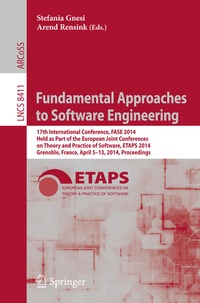
Fundamental Approaches to Software Engineering
17th International Conference, FASE 2014, Held as Part of the European Joint Conferences on Theory and Practice of Software, ETAPS 2014, Grenoble, France, April 5-13, 2014, Proceedings
Published on 17. March 2014
Book
Paperback/Softback
XVI, 432 pages
978-3-642-54803-1 (ISBN)
Description
This book constitutes the proceedings of the 17th International Conference on Fundamental Approaches to Software Engineering, FASE 2014, held as part of the European Joint Conferences on Theory and Practice of Software, ETAPS 2014, which took place in Grenoble, France, in April 2014. The 28 papers included in this volume, together with one invited talk, were carefully reviewed and selected from 125 submissions. They have been organized in topical sections on: modeling and model transformation; time and performance; static analysis; scenario-based specification; software verification; analysis and repair; verification and validation; graph transformation and debugging and testing.
More details
Series
Edition
2014 ed.
Language
English
Place of publication
Berlin
Germany
Publishing group
Springer Berlin
Target group
Professional and scholarly
Research
Illustrations
103 s/w Abbildungen
XVI, 432 p. 103 illus.
Dimensions
Height: 235 mm
Width: 155 mm
Thickness: 25 mm
Weight
674 gr
ISBN-13
978-3-642-54803-1 (9783642548031)
DOI
10.1007/978-3-642-54804-8
Schweitzer Classification
Other editions
Additional editions
Stefania Gnesi | Arend Rensink
Fundamental Approaches to Software Engineering
17th International Conference, FASE 2014, Held as Part of the European Joint Conferences on Theory and Practice of Software, ETAPS 2014, Grenoble, France, April 5-13, 2014, Proceedings
E-Book
03/2014
Springer
€53.49
Available for download
Content
Probabilistic Model Checking and Non-standard Multi-objective Reasoning.- Target Oriented Relational Model Finding.- Splitting Models Using Information Retrieval and Model Crawling Techniques.- Sound Merging and Differencing for Class Diagrams.- Heterogeneous and Asynchronous Networks of Timed Systems.- Family-Based Performance Analysis of Variant-Rich Software Systems.- Touch Cost: Cost Analysis of Touch Develop Scripts.- Efficient Incremental Static Analysis Using Path Abstraction.- Type-Based Taint Analysis for Java Web Applications.- Mining the Categorized Software Repositories to Improve the Analysis of Security Vulnerabilities.- Modularizing Early Architectural Assumptions in Scenario-Based Requirements.- Semantically Configurable Analysis of Scenario-Based Specifications.- Formal Verification of Medical Device User Interfaces Using PVS.- Sound Control Flow Graph Extraction from Incomplete Java Bytecode Programs.- Verifying Class Invariants in Concurrent Programs.- Automatic Program Repair by Fixing Contracts.- Dynamic Package Interfaces.- SMT-Based Checking of SOLOIST over Sparse Traces.- An Online Validator for Provenance: Algorithmic Design, Testing and API.- Comparator: A Tool for Quantifying Behavioural Compatibility.- Transformation of Attributed Structures with Cloning.- Implementing Graph Transformations in the Bulk Synchronous Parallel Model.- Modularizing Triple Graph Grammars Using Rule Refinement.- Polymorphic Single-Pushout Graph Transformation.- Causal-Consistent Reversible Debugging.- An Expressive Semantics of Mocking.- Integration Testing in the Test Template Framework.- Data Flow Coverage for Circus-Based Testing.