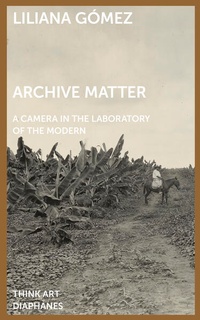
The establishment of the United Fruit Company as a global political agent with its banana plantations met with considerable resistance. The Company's resurgent photographic archive is at the center of this book's considerations on the historical and political agency of photography as a field. By exploring a set of practices, institutions, and relationships, as well as the aesthetic and epistemic contexts of the images in botany, archaeology and tropical medicine, this book argues that the overlooked but important photographic archive made the expansion of corporate capitalism into the Caribbean possible. "Since photographic archives tend to suspend meaning and use; within the archive meaning exists in a state that is both residual and potential,"
Allan Sekula maintains.
Reading the photographic archive against the grain, this book examines the images from within their "optical unconscious" and via the archive's silences and omissions; as residues they attest to the (in)visibility and cultural implications of the violence of the radical man-made environmental alterations. The archive's powerful imaginaries, envisaged as a chronotope of the eternal transition towards modernity, a promise of modernization itself, have effectively brought the Caribbean into modernity. Yet, the aftermath of the photographs helps scrutinize this modernity and recognize the violence embodied as the foundational act of the archive.
Series
Language
Place of publication
Target group
Professional and scholarly
Illustrations
85
60 farb. Abb., 25 sw. Abb.
Dimensions
Height: 22.5 cm
Width: 14 cm
Weight
ISBN-13
978-3-0358-0396-9 (9783035803969)
Schweitzer Classification
Author
Liliana Gómez Liliana Gómez ist Professorin an der
Kunsthochschule Kassel und dem documenta Institut. Sie leitet das Forschungsprojekt "Contested Amnesia and Dissonant Narratives in the
Global South: Post-Conflict in Literature, Art, and Emergent Archives", für das sie Förderung und die SNF-Förderungsprofessur vom Schweizerischen Nationalfond erhielt. Sie schreibt über Literatur-, Kultur- und Medientheorie der Gegenwart, Theorie und Geschichte der Moderne im besonderen mit Blick auf die Kunst, die Stadt und Botanik, Ästhetik und postkoloniale Studien, Memory Studies, Literatur, Kunst und Menschenrechte, die Visuellen Kulturen und environmental humanities. Kürzlich hat sie Performing Human Rights: Contested Amnesia and
Aesthetic Practices in the Global South (diaphanes, 2021) herausgegeben und ist Mitherausgeberin von
Liquid Ecologies in Latin American and Caribbean Art (Routledge, 2020). Zudem ist sie Autorin von Archive Matter: A Camera in the Laboratory
of the Modern (diaphanes, 2023) Chefredakteurin des Magazins Latin
American and Latinx Visual Culture.
7
-
14
Preface
(Jens Andermann)
19
-
52
Introduction
(Liliana Gómez)
53
-
132
Camera and Capitalism: the United Fruit Company
(Liliana Gómez)
133
-
198
The Crossroads of Science and Discourse Networks
(Liliana Gómez)
199
-
266
"The World Was My Garden"
(Liliana Gómez)
267
-
324
Ethnographic Eyes and Archaeological Views
(Liliana Gómez)
325
-
378
Epilogue. Upheavals and the Resurgent Photographic Archive
(Liliana Gómez)
379
-
400
Bibliography
(Liliana Gómez)