

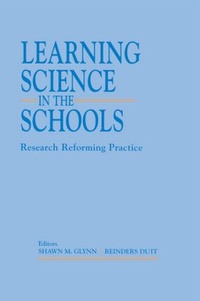
Learning Science in the Schools
Research Reforming Practice
Published on 1. September 1995
Book
Hardback
392 pages
978-0-8058-1807-9 (ISBN)
Description
Science -- and the technology derived from it -- is having a dramatic impact on the quality of our personal lives and the environment around us. Science will have an even greater impact on the lives of our students. The lives of scientifically literate students will be enriched by their understanding, appreciation, and enjoyment of the natural world. To prosper in the near future, all students must become scientifically literate and embrace the notion of life-long learning in science. Without scientific literacy, it will become impossible for students to make informed decisions about the interrelated educational, scientific, and social issues that will confront them in the future.
Intended for science teachers, teacher educators, researchers, and administrators, this volume is concerned with the innovative research that is reforming how science is learned in schools. The chapters provide overviews of current research and illustrate how the findings of this research are being applied in schools. This research-based knowledge is essential for effective science instruction. The contributors are leading authorities in science education and their chapters draw clear connections among research, theory, and classroom practice. They provide excellent examples from science classes in which their research has reformed practice.
This book will help educators develop the scientific literacy of students. It bridges the gap between cutting-edge research and classroom practice to provide educators with the knowledge they need to foster students' scientific literacy.
Intended for science teachers, teacher educators, researchers, and administrators, this volume is concerned with the innovative research that is reforming how science is learned in schools. The chapters provide overviews of current research and illustrate how the findings of this research are being applied in schools. This research-based knowledge is essential for effective science instruction. The contributors are leading authorities in science education and their chapters draw clear connections among research, theory, and classroom practice. They provide excellent examples from science classes in which their research has reformed practice.
This book will help educators develop the scientific literacy of students. It bridges the gap between cutting-edge research and classroom practice to provide educators with the knowledge they need to foster students' scientific literacy.
Reviews / Votes
"We recommend this edited volume as covering a wide range of topics of current interest to researchers, science teachers, and teacher educators. Many chapters are relevant to all these groups as well as to mathematics educators. The book would be a valuable resource or text for undergraduate or postgraduate teacher education."-Science Education
"The book is very well written and illustrated and understandably quite academic, since it is a collection of research papers. ...the book is a valuable contribution to the knowledge base of science teacher educators and professional developers".
-Horizon Research, Inc.
More details
Language
English
Place of publication
New York
United States
Publishing group
Taylor & Francis Inc
Target group
College/higher education
Professional and scholarly
Dimensions
Height: 234 mm
Width: 156 mm
Weight
890 gr
ISBN-13
978-0-8058-1807-9 (9780805818079)
Copyright in bibliographic data and cover images is held by Nielsen Book Services Limited or by the publishers or by their respective licensors: all rights reserved.
Schweitzer Classification
Other editions
Additional editions
Book
05/2016
1st Edition
Routledge
€80.65
Shipment within 10-20 days
E-Book
10/2012
1st Edition
Routledge
€68.49
Available for download
E-Book
10/2012
1st Edition
Routledge
€68.49
Available for download
Persons
Shawn M. Glynn, Reinders Duit
Content
Contents: Preface. Part I: Learning Science Meaningfully.S.M Glynn, R. Duit, Learning Science Meaningfully: Constructing Conceptual Models. R.E. Yager, Constructivism and the Learning of Science. T.R. Koballa, Jr., Children's Attitudes Toward Learning Science. K. Tobin, D.J. Tippins, K.S. Hook, Students' Beliefs About Epistemology, Science, and Classroom Learning: A Question of Fit. Part II: Conceptual Development in Science Domains.C. Wood-Robinson, Children's Biological Ideas: Knowledge About Ecology, Inheritance, and Evolution. R. Stavy, Conceptual Development of Basic Ideas in Chemistry. J. Baxter, Children's Understanding of Astronomy and the Earth Sciences. S. Kesidou, R. Duit, S.M. Glynn, Conceptual Development in Physics: Students' Understanding of Heat. Part III: Conceptual Tools for Learning.B.Y. White, The ThinkerTools Project: Computer Microworlds as Conceptual Tools for Facilitating Scientific Inquiry. J.D. Novak, Concept Mapping: A Strategy for Organizing Knowledge. S.M. Glynn, R. Duit, R.B. Thiele, Teaching Science with Analogies: A Strategy for Constructing Knowledge. A. Stinner, Science Textbooks: Their Present Role and Future Form. Part IV: Assessing Learners' Science Knowledge.D.H. Gitomer, R.A. Duschl, Moving Toward a Portfolio Culture in Science Education. D.F. Treagust, Diagnostic Assessment of Students' Science Concepts. B. Bell, Interviewing: A Technique for Assessing Science Knowledge.