

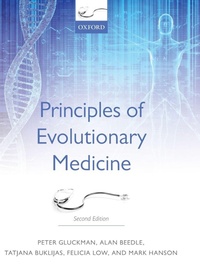
Principles of Evolutionary Medicine
2nd Edition
Published in December 2016
Book
Hardback
400 pages
978-0-19-966392-7 (ISBN)
Description
Evolutionary science is critical to an understanding of integrated human biology and is increasingly recognised as a core discipline by medical and public health professionals. Advances in the field of genomics, epigenetics, developmental biology, and epidemiology have led to the growing realisation that incorporating evolutionary thinking is essential for medicine to achieve its full potential. This revised and updated second edition of the first comprehensive
textbook of evolutionary medicine explains the principles of evolutionary biology from a medical perspective and focuses on how medicine and public health might utilise evolutionary thinking. It is written to be accessible to a broad range of readers, whether or not they have had formal exposure to
evolutionary science.
The general structure of the second edition remains unchanged, with the initial six chapters providing a summary of the evolutionary theory relevant to understanding human health and disease, using examples specifically relevant to medicine. The second part of the book describes the application of evolutionary principles to understanding particular aspects of human medicine: in addition to updated chapters on reproduction, metabolism, and behaviour, there is an expanded chapter on our
coexistence with micro-organisms and an entirely new chapter on cancer. The two parts are bridged by a chapter that details pathways by which evolutionary processes affect disease risk and symptoms, and how hypotheses in evolutionary medicine can be tested. The final two chapters of the volume are
considerably expanded; they illustrate the application of evolutionary biology to medicine and public health, and consider the ethical and societal issues of an evolutionary perspective. A number of new clinical examples and historical illustrations are included.
This second edition of a novel and popular textbook provides an updated resource for doctors and other health professionals, medical students and biomedical scientists, as well as anthropologists interested in human health, to gain a better understanding of the evolutionary processes underlying human health and disease.
textbook of evolutionary medicine explains the principles of evolutionary biology from a medical perspective and focuses on how medicine and public health might utilise evolutionary thinking. It is written to be accessible to a broad range of readers, whether or not they have had formal exposure to
evolutionary science.
The general structure of the second edition remains unchanged, with the initial six chapters providing a summary of the evolutionary theory relevant to understanding human health and disease, using examples specifically relevant to medicine. The second part of the book describes the application of evolutionary principles to understanding particular aspects of human medicine: in addition to updated chapters on reproduction, metabolism, and behaviour, there is an expanded chapter on our
coexistence with micro-organisms and an entirely new chapter on cancer. The two parts are bridged by a chapter that details pathways by which evolutionary processes affect disease risk and symptoms, and how hypotheses in evolutionary medicine can be tested. The final two chapters of the volume are
considerably expanded; they illustrate the application of evolutionary biology to medicine and public health, and consider the ethical and societal issues of an evolutionary perspective. A number of new clinical examples and historical illustrations are included.
This second edition of a novel and popular textbook provides an updated resource for doctors and other health professionals, medical students and biomedical scientists, as well as anthropologists interested in human health, to gain a better understanding of the evolutionary processes underlying human health and disease.
Reviews / Votes
This volume will appeal to a broad readership of students and faculty in a variety of disciplines ... I recommend this book highly as a clear and accessible introduction to the growing field of evolution, medicine, and public health. * Robert Perlman, The Quarterly Review of Biology *More details
Other editions
Additional editions
Peter Gluckman | Alan Beedle | Tatjana Buklijas
Principles of Evolutionary Medicine
Book
03/2016
2nd Edition
Oxford University Press
€56.50
Shipment within 15-20 days
Peter Gluckman | Alan Beedle | Tatjana Buklijas
Principles of Evolutionary Medicine
E-Book
03/2016
2nd Edition
OUP eBook
€40.99
Available for download
Peter Gluckman | Alan Beedle | Tatjana Buklijas
Principles of Evolutionary Medicine
E-Book
03/2016
2nd Edition
OUP eBook
€40.99
Available for download
Persons
Professor Sir Peter Gluckman is a well-known biomedical scientist. Author of over 650 scientific papers and reviews, and of technical and popular science books, his contributions to developmental, endocrine and evolutionary sciences have won him numerous awards and recognition - including Fellowship of the Royal Society (London) and the Order of New Zealand, the country's highest civic honour. He is the only New Zealander elected to the Institute of Medicine of the
National Academies of Science (USA) and the Academy of Medical Sciences of Great Britain. Since 2009 Sir Peter has also held the position of Chief Science Advisor to the Prime Minister of New Zealand.
Dr Alan Beedle BSc, PhD, is a biochemist who became a professional science editor and writer. He has held senior positions in scientific and medical publishing in the UK, Europe and New Zealand, and has been editor of several high-impact journals in the biomedical sciences. Alan has research interests in the application of evolutionary and developmental biology to human health and disease.
Dr Buklijas was trained as a physician in her hometown of Zagreb, Croatia, but then changed career to first study (M.Phil. and PhD) and then work, as a Wellcome Research Fellow, in the Department of History and Philosophy of Science, University of Cambridge. In 2008 she took up a research fellowship at the Liggins Institute where she works on projects related to evolutionary medicine and developmental origins of health and disease, especially from the perspective of the history and philosophy
of evolution and development.
Dr Felicia Low obtained her PhD in Pathology from the University of Otago, Christchurch, New Zealand. Since taking up a research fellowship with the Office of the Prime Minister's Science Advisory Committee, based at the Liggins Institute, in 2009, her research has focused on the molecular aspects of evolutionary developmental biology. Her other research interests include the effects of early-life factors on later-life risk of non-communicable disease; the utility of developmental epigenetics
as a prognostic marker of disease risk, and in informing maternal/early postnatal nutritional advice; and the dissemination and translation of scientific research.
Professor Mark Hanson is one of the UK's leading researchers on developmental pathways to disease. He is current President of the International Society for the Developmental Origins of Health and Disease and was a founder member of the Society. He has served on a range of committees in government, charitable and NGOs focusing on the importance of adopting a life course perspective to new ways of reducing the burden of obesity and non-communicable disease globally. He directs the University of
Southampton Institute of Developmental Sciences and is British Heart Foundation Professor of Cardiovascular Science there. He holds visiting appointments in several universities overseas. His research concerns several aspects of development and health, ranging from how the environment before and after
birth affects the risk of chronic disease to population studies aimed at the early identification of risk, so that timely preventative interventions can be made.
National Academies of Science (USA) and the Academy of Medical Sciences of Great Britain. Since 2009 Sir Peter has also held the position of Chief Science Advisor to the Prime Minister of New Zealand.
Dr Alan Beedle BSc, PhD, is a biochemist who became a professional science editor and writer. He has held senior positions in scientific and medical publishing in the UK, Europe and New Zealand, and has been editor of several high-impact journals in the biomedical sciences. Alan has research interests in the application of evolutionary and developmental biology to human health and disease.
Dr Buklijas was trained as a physician in her hometown of Zagreb, Croatia, but then changed career to first study (M.Phil. and PhD) and then work, as a Wellcome Research Fellow, in the Department of History and Philosophy of Science, University of Cambridge. In 2008 she took up a research fellowship at the Liggins Institute where she works on projects related to evolutionary medicine and developmental origins of health and disease, especially from the perspective of the history and philosophy
of evolution and development.
Dr Felicia Low obtained her PhD in Pathology from the University of Otago, Christchurch, New Zealand. Since taking up a research fellowship with the Office of the Prime Minister's Science Advisory Committee, based at the Liggins Institute, in 2009, her research has focused on the molecular aspects of evolutionary developmental biology. Her other research interests include the effects of early-life factors on later-life risk of non-communicable disease; the utility of developmental epigenetics
as a prognostic marker of disease risk, and in informing maternal/early postnatal nutritional advice; and the dissemination and translation of scientific research.
Professor Mark Hanson is one of the UK's leading researchers on developmental pathways to disease. He is current President of the International Society for the Developmental Origins of Health and Disease and was a founder member of the Society. He has served on a range of committees in government, charitable and NGOs focusing on the importance of adopting a life course perspective to new ways of reducing the burden of obesity and non-communicable disease globally. He directs the University of
Southampton Institute of Developmental Sciences and is British Heart Foundation Professor of Cardiovascular Science there. He holds visiting appointments in several universities overseas. His research concerns several aspects of development and health, ranging from how the environment before and after
birth affects the risk of chronic disease to population studies aimed at the early identification of risk, so that timely preventative interventions can be made.
Author
Centre for Human Evolution, Adaptation and Disease, Liggins Institute, The University of Auckland, New Zealand
Centre for Human Evolution, Adaptation and Disease, Liggins Institute, The University of Auckland, New Zealand
Centre for Human Evolution, Adaptation and Disease, Liggins Institute, The University of Auckland, New Zealand
Centre for Human Evolution, Adaptation and Disease, Liggins Institute, The University of Auckland, New Zealand
Institute of Developmental Sciences and NIHR Nutrition Biomedical Research Centre, University of Southampton and University Hospital Southampton, UK
Content
PART 1: FUNDAMENTALS OF EVOLUTIONARY BIOLOGY; PART 2: EVOLUTION IN HEALTH AND DISEASE