

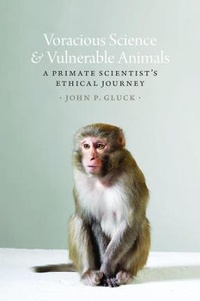
Voracious Science and Vulnerable Animals
A Primate Scientist's Ethical Journey
Will be published approx. on 26. October 2016
Book
Hardback
360 pages
978-0-226-37565-6 (ISBN)
Description
The National Institute of Health recently announced its plan to retire the fifty remaining chimpanzees held in national research facilities and place them in sanctuaries. This significant decision comes after a lengthy process of examination and debate about the ethics of animal research. For decades, proponents of such research have argued that the discoveries and benefits for humans far outweigh the costs of the traumatic effects on the animals; but today, even the researchers themselves have come to question the practice. John P. Gluck has been one of the scientists at the forefront of the movement to end research on primates, and in Voracious Science and Vulnerable Animals he tells a vivid, heart-rending, personal story of how he became a vocal activist for animal protection. Gluck begins by taking us inside the laboratory of Harry F. Harlow at the University of Wisconsin, where Gluck worked as a graduate student in the 1960s. Harlow's primate lab became famous for his behavioral experiments in maternal-deprivation and social isolation of rhesus macaques.
Though trained as a behavioral scientist, Gluck finds himself unable to overlook the intense psychological and physical damage these experiments wrought on the macaques. Gluck's sobering and moving account reveals how in this and other labs, including his own, he came to grapple with the uncomfortable justifications that many researchers were offering for their work. As his sense of conflict grows, we're right alongside him, developing a deep empathy for the often smart and always vulnerable animals used for these experiments. At a time of unprecedented recognition of the intellectual cognition and emotional intelligence of animals, Voracious Science and Vulnerable Animals is a powerful appeal for our respect and compassion for those creatures who have unwillingly dedicated their lives to science. Through the words of someone who has inflicted pain in the name of science and come to abhor it, it's important to know what has led this far to progress and where further inroads in animal research ethics are needed.
Though trained as a behavioral scientist, Gluck finds himself unable to overlook the intense psychological and physical damage these experiments wrought on the macaques. Gluck's sobering and moving account reveals how in this and other labs, including his own, he came to grapple with the uncomfortable justifications that many researchers were offering for their work. As his sense of conflict grows, we're right alongside him, developing a deep empathy for the often smart and always vulnerable animals used for these experiments. At a time of unprecedented recognition of the intellectual cognition and emotional intelligence of animals, Voracious Science and Vulnerable Animals is a powerful appeal for our respect and compassion for those creatures who have unwillingly dedicated their lives to science. Through the words of someone who has inflicted pain in the name of science and come to abhor it, it's important to know what has led this far to progress and where further inroads in animal research ethics are needed.
More details
Series
Language
English
Place of publication
Chicago
United States
Publishing group
The University of Chicago Press
Target group
College/higher education
Dimensions
Height: 23 mm
Width: 16 mm
Thickness: 3 mm
Weight
595 gr
ISBN-13
978-0-226-37565-6 (9780226375656)
Copyright in bibliographic data and cover images is held by Nielsen Book Services Limited or by the publishers or by their respective licensors: all rights reserved.
Schweitzer Classification
Other editions
Additional editions
E-Book
10/2016
1st Edition
University of Chicago Press
€35.49
Available for download
Person
John P. Gluck is professor emeritus of psychology and a senior advisor to the president on animal research ethics and welfare at the University of New Mexico. He is also research professor of the Kennedy Institute of Ethics at Georgetown University and the coauthor of The Human Use of Animals.