

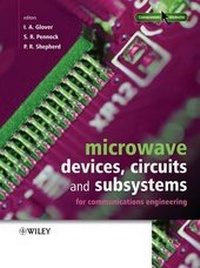
Microwave Devices, Circuits and Subsystems for Communications Engineering
Devices, Circuits and Subsystems
1st Edition
Published on 24. March 2005
Book
Hardback
550 pages
978-0-471-89964-8 (ISBN)
Description
Microwave Devices, Circuits and Subsystems for Communications Engineering provides a detailed treatment of the common microwave elements found in modern microwave communications systems. The treatment is thorough without being unnecessarily mathematical. The emphasis is on acquiring a conceptual understanding of the techniques and technologies discussed and the practical design criteria required to apply these in real engineering situations.
Key topics addressed include:
* Microwave diode and transistor equivalent circuits
* Microwave transmission line technologies and microstrip design
* Network methods and s-parameter measurements
* Smith chart and related design techniques
* Broadband and low-noise amplifier design
* Mixer theory and design
* Microwave filter design
* Oscillators, synthesisers and phase locked loops
Each chapter is written by specialists in their field and the whole is edited by experience authors whose expertise spans the fields of communications systems engineering and microwave circuit design.
Microwave Devices, Circuits and Subsystems for Communications Engineering is suitable for senior electrical, electronic or telecommunications engineering undergraduate students, first year postgraduate students and experienced engineers seeking a conversion or refresher text.
* Includes a companion website featuring:
* Solutions to selected problems
* Electronic versions of the figures
* Sample chapter
Reviews / Votes
"...this book is a good reference for [the] microwave engineering community." (IEEE Circuits & Devices Magazine, November/December 2006)More details
Product info
GB
Edition
1., Auflage
Language
English
Place of publication
New York
United States
Target group
Professional and scholarly
Product notice
sewn/stitched
Cloth over boards
Dimensions
Height: 252 mm
Width: 174 mm
Thickness: 37 mm
Weight
1168 gr
ISBN-13
978-0-471-89964-8 (9780471899648)
Schweitzer Classification
Other editions
Additional editions
Ian A. Glover | Steve Pennock | Peter Shepherd
Microwave Devices, Circuits and Subsystems for Communications Engineering
E-Book
05/2006
Wiley
€168.99
Available for download
Persons
Dr. Ian A Glover is a Senior Lecturer. Research interests: radio science, microwave radio propagation, channel measure ments and modelling, and digital communications coding and modulation. He is co-author of the successful book Digital Communications.
Dr. Steve R. Pennock is a Senior Lecturer. Research interests: microwave engineering and communications, inset dielectric guide antennas and subsystems, monolithic microwave integrated circuits, flared slot antennas, discontinuities and non-uniformities in transmission lines and millimetre wave propagation effects.
Dr. Peter R. Shepherd is a Senior Lecturer and First Year Course Director. Research interests: microwave engineering and communications, inset dielectric guide antennas and subsystems, monolithic microwave integrated circuits, flared slot antennas, discontinuities and non-uniformities in transmission lines, millimetre wave propagation effects, and mixed signal integrated circuits
Content
List of contributors.
Preface.
1. Overview of the Book (I.A. Glover, S.R. Pennock and P.R. Shepherd).
1.1 Introduction.
1.2 RF Devices.
1.3 Signal Transmission and Network Methods.
1.4 Amplifiers.
1.5 Mixers.
1.6 Filters.
1.7 Oscillators and Frequency Synthesisers.
2. RF Devices: Characteristics and Modelling (A. Suarez and T. Fernandez).
2.1 Introduction
2.2 Semiconductor Properties
2.3 P-N Junction.
2.4 The Schottky Diode.
2.5 PIN Diodes.
2.6 Step-Recovery Diodes.
2.7 Gunn Diodes.
2.8 IMPATT Diodes.
2.9 Transistors.
References.
3. Signal Transmission, Network Methods and Impedance Matching (N.J. McEwan, T.C. Edwards, D. Dernikas and I.A. Glover).
3.1 Introduction.
3.2 Transmission Lines: General Considerations.
3.3 The Two-Conductor Transmission Line: Revision of Distributed Circuit Theory.
3.4 Loss, Dispersion, Phase and Group Velocity.
3.5 Field Theory Method for Ideal TEM Case.
3.6 Microstrip.
3.7 Coupled Microstrip Lines.
3.8 Network Methods.
3.9 Impedance Matching.
3.10 Network Analysers.
3.11 Summary.
References.
4. Amplifier Design (N.J. McEwan and D. Dernikas).
4.1 Introduction.
4.2 Amplifier Gain Definitions.
4.3 Stability.
4.4. Broadband Amplifier Design.
4.5 Low Noise Amplifier Design.
4.6 Practical Circuit Considerations.
4.7 Computer-Aided Design (CAD).
References.
5. Mixers: Theory and Design (A. Tazon and L. de la Fuente).
5.1 Introduction.
5.2 General Properties.
5.3 Devices for Mixers.
5.4 Non-Linear Analysis.
5.5 Diode Mixer Theory.
5.6 FET Mixers.
5.7 IF Amplifier.
5.8 Single-Balanced FET Mixers.
5.9 Double-Balanced FET Mixers.
5.10 Harmonic Mixers.
5.11 Monolithic Mixers.
References.
6. Filters (A Mediavilla).
6.1 Introduction.
6.2 Filter Fundamentals.
6.3 Mathematical Filter Responses.
6.4 Low Pass Prototype Filter Design.
6.5 Filter Impedance and Frequency Scaling.
6.6 Elliptic Filter Transformation.
6.7 Filter Normalisation.
7. Oscillators, Frequency Synthesisers and PLL Techniques (E. Artal, J.P. Pascal and J. Portilla).
7.1 Introduction.
7.2 Solid State Microwave Oscillators.
7.3 Negative Resistance Diode Oscillators.
7.4 Transistor Oscillators.
7.5 Voltage-Controlled Oscillators.
7.6 Oscillator Characterisation and Testing,
7.7 Microwave Phase Locked Oscillators.
7.8 Subsystems for Microwave Phase Locked Oscillators (PLOs).
7.9 Phase Noise.
7.10 Examples of PLOs.
References.
Index.