

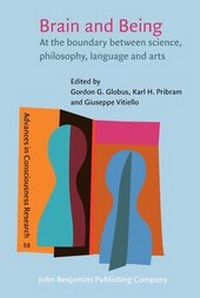
Brain and Being
At the boundary between science, philosophy, language and arts
Published on 17. September 2004
Book
Hardback
354 pages
978-90-272-5194-7 (ISBN)
Description
This book results from a group meeting held at the Institute for Scientific Exchange in Torino, Italy. The central aim was for scientists to "think together" in new ways with those in the humanities inspired by quantum theory and especially quantum brain theory. These fields of inquiry have suffered conceptual estrangement but now are ripe for rapprochement, if academic parochialism is put aside. A prevalent theme of the book is a moving away from individual elements and individual actors acting upon each other, toward a coordinate hermeneutic dynamics that manifests as a coherent totality. Among the topics covered are image in photography and in neuroscience; language; time; brain and mathematics; quantum brain dynamics and quantum communication.
Reviews / Votes
Brain and Being illustrates both the promise and the perils of the interface between NeuroQuantology and the humanities. -- NeuroQuantology, Vol. 3:1 (2005)More details
Series
Language
English
Place of publication
Amsterdam
Netherlands
Target group
Professional and scholarly
Dimensions
Height: 225 mm
Width: 154 mm
Weight
665 gr
ISBN-13
978-90-272-5194-7 (9789027251947)
Copyright in bibliographic data and cover images is held by Nielsen Book Services Limited or by the publishers or by their respective licensors: all rights reserved.
Schweitzer Classification
Other editions
Additional editions
Gordon G. Globus | Karl H. Pribram | Giuseppe Vitiello
Brain and Being
At the boundary between science, philosophy, language and arts
E-Book
09/2004
1st Edition
John Benjamins Publishing Company
€144.99
Available for download
Persons
Content
1. Foreword; 2. 1. Doubling image to face the obscenity of photography (by Prete, Nadia); 3. 2. The self-transcendence of consciousness towards its models: Consciousness as noumenal emergence. Some philosophical remarks on the Quantum Field Theory model of Giuseppe Vitiello (by Desideri, Fabrizio); 4. 3. The unthinkable: Nonclassical theory, the unconscious mind and the quantum brain (by Plotnitsky, Arkady); 5. 4. Mental presence and the temporal present (by Franck, Georg); 6. 5. The psycho-emotional-physical unity of living organisms as an outcome of quantum physics (by Giudice, Emilio Del); 7. 6. Dual mode ontology and its application to the Riemann Hypothesis (by Globus, Gordon G.); 8. 7. Quantum monadology and consciousness (by Nakagomi, Teruaki); 9. 8. Quantum connectionism and the emergence of cognition (by Pessa, Eliano); 10. 9. The rheomode of language of David Bohm as a way to re-construct the access to physical reality (by Stamenov, Maxim I.); 11. 10. Can quantum analogies help us to understand the process of thought? (by Pylkkanen, Paavo); 12. 11. Information, quantum theory and the brain (by Hiley, B.J.); 13. 12. Brain and mathematics (by Pribram, Karl H.); 14. 13. Searching for the biophysics of an elementary system (by Fleischmann, Martin); 15. 14. Brain and physics of many-body problems (by Ricciardi, Luigi Maria); 16. 15. Quantum Brain Dynamics and Quantum Field Theory (by Jibu, Mari); 17. 16. Brain and Quantum Field Theory: Notes on monumental discussions presenting Quantum Field Models of brain (by Takahashi, Yasushi); 18. 17. The dissipative brain (by Vitiello, Giuseppe); 19. Name index; 20. Subject index