

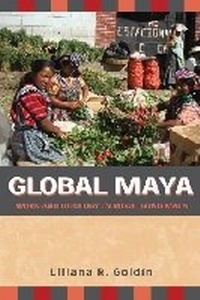
Global Maya
Work and Ideology in Rural Guatemala
University of Arizona Press
Will be published approx. on 30. January 2009
Book
Hardback
264 pages
978-0-8165-2688-8 (ISBN)
Description
In the central highland Maya communities of Guatemala, the demands ofthe global economy have become a way of life. This book explores how ruralpeoples experience economic and cultural change as their country joins theglobal market, focusing on their thoughts about work and sustenance as a way oflearning about Guatemala's changing economy. For more than a decade, Liliana Goldin observed in highland towns boththe intensification of various forms of production and their growing links towider markets. In this first book to compare economic ideology across a rangeof production systems, she examines how people make a living and how theythink about their options, practices, and constraints. Drawing on interviews andsurveyseven retellings of traditional narratives'she reveals how contemporaryMaya respond to the increasingly globalized yet locally circumscribed conditionsin which they work. Goldin presents four case studies: cottage industries devoted to garmentproduction, vegetable growing for internal and border markets reached throughdirect commerce, crops grown for export, and wage labor in garment assemblyfactories.
By comparing generational and gendered differences among workers,she reveals not only complexities of change but also how these complexities arereflected in changing attitudes, understandings, and aspirations that characterizepeople's economic ideology. Further, she shows that as rural people take ondiverse economic activities, they also reinterpret their views on such mattersas accumulation, cooperation, competition, division of labor, and communitysolidarity. Global Maya explores global processes in local terms, revealing the interplayof traditional values, household economics, and the inescapable conditions ofdemographic growth, a shrinking land base, and a global economy always lookingfor cheap labor. It offers a wealth of new insights not only for Maya scholarsbut also for anyone concerned with the effects of globalization on the Third World.
By comparing generational and gendered differences among workers,she reveals not only complexities of change but also how these complexities arereflected in changing attitudes, understandings, and aspirations that characterizepeople's economic ideology. Further, she shows that as rural people take ondiverse economic activities, they also reinterpret their views on such mattersas accumulation, cooperation, competition, division of labor, and communitysolidarity. Global Maya explores global processes in local terms, revealing the interplayof traditional values, household economics, and the inescapable conditions ofdemographic growth, a shrinking land base, and a global economy always lookingfor cheap labor. It offers a wealth of new insights not only for Maya scholarsbut also for anyone concerned with the effects of globalization on the Third World.
More details
Language
English
Place of publication
Tucson
United States
Target group
College/higher education
Illustrations
illustrations
Dimensions
Height: 231 mm
Width: 154 mm
Thickness: 25 mm
Weight
497 gr
ISBN-13
978-0-8165-2688-8 (9780816526888)
Copyright in bibliographic data and cover images is held by Nielsen Book Services Limited or by the publishers or by their respective licensors: all rights reserved.
Schweitzer Classification