

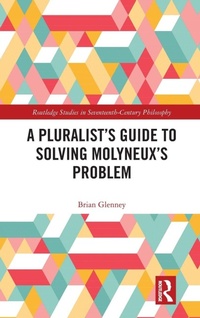
A Pluralist's Guide to Solving Molyneux's Problem
1st Edition
Published on 31. December 2024
Book
Hardback
232 pages
978-1-032-18571-2 (ISBN)
Description
This book presents a novel pluralist strategy for answering Molyneux's 300+-year-old conundrum: Would a person, born blind but given sight, identify a shape previously known only by their touch? The author interweaves historical scholarship with contemporary philosophical work and empirical research on animal, infant, and adult human perception.
The author argues that we need a new approach to Molyneux's problem because we do not know what the problem is really about, and it is untestable because a Molyneux subject cannot be physically realized. He criticizes Molyneux's question for its simplistic taxonomy of "the blind" that groups significant individual differences into a singular ontology. Research in the cognitive sciences confirms that various kinds of blindness can co-occur, such as ocular, cortical, and psychological blindness. Therefore, the author adopts an explanatory pluralism for answering Molyneux's problem, which includes no, yes, and "no answer" answers according to the domain of inquiry being used. This account provides a research-based answer to a long-standing problem using previously unheeded insights particularly from animal crossmodal perception studies to retell a more complex story of perception: its levels of explanation and integration.
A Pluralist's Guide to Solving Molyneux's Problem will be of interest to researchers and advanced students working in comparative psychology, epistemology, history of philosophy, philosophy of perception.
The author argues that we need a new approach to Molyneux's problem because we do not know what the problem is really about, and it is untestable because a Molyneux subject cannot be physically realized. He criticizes Molyneux's question for its simplistic taxonomy of "the blind" that groups significant individual differences into a singular ontology. Research in the cognitive sciences confirms that various kinds of blindness can co-occur, such as ocular, cortical, and psychological blindness. Therefore, the author adopts an explanatory pluralism for answering Molyneux's problem, which includes no, yes, and "no answer" answers according to the domain of inquiry being used. This account provides a research-based answer to a long-standing problem using previously unheeded insights particularly from animal crossmodal perception studies to retell a more complex story of perception: its levels of explanation and integration.
A Pluralist's Guide to Solving Molyneux's Problem will be of interest to researchers and advanced students working in comparative psychology, epistemology, history of philosophy, philosophy of perception.
More details
Series
Language
English
Place of publication
London
United Kingdom
Publishing group
Taylor & Francis Ltd
Target group
College/higher education
Postgraduate and Undergraduate Advanced
Illustrations
19 s/w Abbildungen, 7 s/w Photographien bzw. Rasterbilder, 12 s/w Zeichnungen, 4 s/w Tabellen
4 Tables, black and white; 12 Line drawings, black and white; 7 Halftones, black and white; 19 Illustrations, black and white
Dimensions
Height: 235 mm
Width: 157 mm
Thickness: 18 mm
Weight
515 gr
ISBN-13
978-1-032-18571-2 (9781032185712)
Copyright in bibliographic data and cover images is held by Nielsen Book Services Limited or by the publishers or by their respective licensors: all rights reserved.
Schweitzer Classification
Other editions
Additional editions
Brian Glenney
A Pluralist's Guide to Solving Molyneux's Problem
Book
05/2026
1st Edition
Routledge
€57.00
Shipment within 10-20 days
Brian Glenney
A Pluralist's Guide to Solving Molyneux's Problem
E-Book
12/2024
1st Edition
Routledge
€60.49
Available for download
Brian Glenney
A Pluralist's Guide to Solving Molyneux's Problem
E-Book
12/2024
1st Edition
Routledge
€60.49
Available for download
Person
Brian Glenney is Associate Professor of Philosophy at Norwich University. He has wide interests in the history of philosophy and sensory perception. He focuses on Molyneux's problem and co-edited the book Molyneux's Question and the History of Philosophy (2020), the special issue "Molyneux's Question Today," (2024) and has authored encyclopedia entries and journal articles.
Content
Plan of the Book 1. Seven Problems for the Two-Choice Approach to Molyneux's Problem 2. Molyneux's Tool and the Philosophy of Perception 3. Puzzle Pluralism: A Broad Explanatory Account for Molyneux's Problem 4. A Pluralist Resolution to Molyneux's Problem 5. Locke's Answer and a Plug and Play History of Molyneux's Problem 6. The New Molyneux Problem 7. Molyneux's Animals: Promises and Problems 8. Meaningful Movements of Molyneux's Animals 9. Molyneux's Underwater Animals and the Possibility of a Supramodal Sense 10. A New Skill-Based Experimental Paradigm for Testing Molyneux's Problem Epilogue