

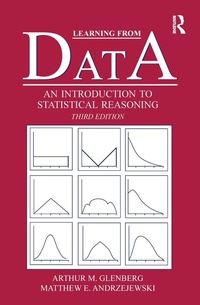
Learning From Data
An Introduction To Statistical Reasoning
3rd Edition
Published on 9. August 2007
Book
Hardback
580 pages
978-0-8058-4921-9 (ISBN)
Description
Learning from Data focuses on how to interpret psychological data and statistical results. The authors review the basics of statistical reasoning to helpstudents better understand relevant data that affecttheir everyday lives.
Numerous examples based on current research and events are featured throughout.To facilitate learning, authors Glenberg and Andrzejewski:
Devote extra attention to explaining the more difficult concepts and the logic behind them
Use repetition to enhance students' memories with multiple examples, reintroductions of the major concepts, and a focus on these concepts in the problems
Employ a six-step procedure for describing all statistical tests from the simplest to the most complex
Provide end-of-chapter tables to summarize the hypothesis testing procedures introduced
Emphasizes how to choose the best procedure in the examples, problems and endpapers
Focus on power with a separate chapter and power analyses procedures in each chapter
Provide detailed explanations of factorial designs, interactions, and ANOVA to help students understand the statistics used in professional journal articles.
The third edition has a user-friendly approach:
Designed to be used seamlessly with Excel, all of the in-text analyses are conducted in Excel, while the book's downloadable resources contain files for conducting analyses in Excel, as well as text files that can be analyzed in SPSS, SAS, and Systat
Two large, real data sets integrated throughout illustrate important concepts
Many new end-of-chapter problems (definitions, computational, and reasoning) and many more on the companion CD
Online Instructor's Resources includes answers to all the exercises in the book and multiple-choice test questions with answers
Boxed media reports illustrate key concepts and their relevance to realworld issues
The inclusion of effect size in all discussions of power accurately reflects the contemporary issues of power, effect size, and significance.
Learning From Data, Third Edition is intended as a text for undergraduate or beginning graduate statistics courses in psychology, education, and other applied social and health sciences.
Numerous examples based on current research and events are featured throughout.To facilitate learning, authors Glenberg and Andrzejewski:
Devote extra attention to explaining the more difficult concepts and the logic behind them
Use repetition to enhance students' memories with multiple examples, reintroductions of the major concepts, and a focus on these concepts in the problems
Employ a six-step procedure for describing all statistical tests from the simplest to the most complex
Provide end-of-chapter tables to summarize the hypothesis testing procedures introduced
Emphasizes how to choose the best procedure in the examples, problems and endpapers
Focus on power with a separate chapter and power analyses procedures in each chapter
Provide detailed explanations of factorial designs, interactions, and ANOVA to help students understand the statistics used in professional journal articles.
The third edition has a user-friendly approach:
Designed to be used seamlessly with Excel, all of the in-text analyses are conducted in Excel, while the book's downloadable resources contain files for conducting analyses in Excel, as well as text files that can be analyzed in SPSS, SAS, and Systat
Two large, real data sets integrated throughout illustrate important concepts
Many new end-of-chapter problems (definitions, computational, and reasoning) and many more on the companion CD
Online Instructor's Resources includes answers to all the exercises in the book and multiple-choice test questions with answers
Boxed media reports illustrate key concepts and their relevance to realworld issues
The inclusion of effect size in all discussions of power accurately reflects the contemporary issues of power, effect size, and significance.
Learning From Data, Third Edition is intended as a text for undergraduate or beginning graduate statistics courses in psychology, education, and other applied social and health sciences.
Reviews / Votes
"My teaching assistants and students, as well as other statistics instructors in my department, regard it as the best introductory statistics book available...The connection of the dialogue with the real world ... is the book's greatest strength. It keeps ... many of the students engaged in a subject where they often expect to be bored." -Daniel S. Levine, PhD, University of Texas at Arlington"...it is a rigorous yet clear text with an emphasis on power that ...is lacking in many other introductory texts... I love the idea of focusing on Excel...I ... have been using Glenberg for the past 4 or 5 years....I will seriously consider its adoption (and almost certainly will adopt it)." -Richard E. Zinbarg, PhD, Northwestern University
Praise for the first edition:
"...an unusually attractive new entry in the introductory statistics sweepstakes....Chapters are well organized....Examples seem to be clear and easy to follow, with a six part scheme used consistently to outline statistical tests."
-Contemporary Psychology "It is a rigorous yet clear text with an emphasis on power. ... I love the idea of focusing on Excel. ... I ... have been using Glenberg for the past four or five years. ... I will seriously consider its adoption (and almost certainly will adopt it)." - Richard E. Zinbarg, Northwestern University
More details
Edition
3rd edition
Language
English
Place of publication
New York
United States
Publishing group
Taylor & Francis Inc
Target group
Professional and scholarly
Professional
Dimensions
Height: 254 mm
Width: 178 mm
Weight
1156 gr
ISBN-13
978-0-8058-4921-9 (9780805849219)
Copyright in bibliographic data and cover images is held by Nielsen Book Services Limited or by the publishers or by their respective licensors: all rights reserved.
Schweitzer Classification
Other editions
New editions
Arthur M. Glenberg | Matthew E. Andrzejewski
Learning From Data
An Introduction to Statistical Reasoning using JASP
Book
07/2024
4th Edition
Routledge
€276.30
Shipment within 15-20 days
Additional editions
Book
05/2014
3rd Edition
Routledge
€57.14
Article exhausted; check for reprint
E-Book
08/2007
3rd Edition
Routledge
€47.49
Available for download
E-Book
08/2007
3rd Edition
Routledge
€47.49
Available for download

Software
08/2007
3rd Edition
Lawrence Erlbaum Associates Inc
€20.01
Article exhausted; check different version
Previous edition
Book
04/1996
2nd Edition
Lawrence Erlbaum Associates Inc
€85.00
Article exhausted; check for reprint
Persons
Arthur M. Glenberg is a Professor of Psychology and Educational Psychology at the University of Wisconsin-Madison in the area of cognitive/perceptual sciences. He received his Ph.D. in 1974 from the University of Michigan. Matthew E. Andrzejewski is a Research Scientist in the Department of Psychiatry, studying behavioral neuroscience, and a lecturer in the Department of Psychology at the University of Wisconsin-Madison. He received his Ph.D. in 2001 from Temple University.
Content
Contents: Preface. Why Statistics? Part I:Descriptive Statistics. Frequency Distributions and Percentiles. Central Tendency and Variability. z Scores and Normal Distributions. Part II: Introduction to Inferential Statistics. Overview of Inferential Statistics. Probability. Sampling Distributions. Logic of Hypothesis Testing. Power. Logic of Parameter Estimation. Part III:Applications of Inferential Statistics. Inferences About Population Proportions Using the z Statistic. Inferences About ? When o Is Unknown: The Single Sample t Test. Comparing Two Populations: Independent Samples. Random Sampling, Random Assignment, and Causality. Comparing Two Populations: Dependent Samples. Comparing Two Population Variances: The F Statistic. Comparing Multiple Population Means: One-Factor ANOVA. Introduction to Factorial Designs. Computational Methods for the Factorial ANOVA. Describing Linear Relationships: Regression. Measuring the Strength of Linear Relationships: Correlation. Inferences From Nominal Data: The X (2) Statistic.