

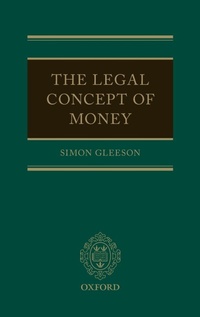
The Legal Concept of Money
What is Money and Why Does it Matter?
Published on 27. December 2018
Book
Hardback
252 pages
978-0-19-882639-2 (ISBN)
Description
This new book analyses the challenge of how money (including coins, notes, credit, and virtual currency) should be defined from both a legal and an economic perspective.
As new electronic payment mechanisms proliferate, this question of definition is likely to become an important issue in global legal, commercial, economic, macro-prudential and fiscal policymaking. The book re-examines money in this context by identifying the role it plays in various transactions and to what extent, for example, cryptocurrencies and quasi-money are interchangeable with, analogous to, or different from traditional monetary systems.
Beginning with a summary of the legal nature of money, the book explains the distinction between money and payment obligations, as well as providing an overview of the fundamental characteristics of money. It analyses how the law identifies money by pinpointing characteristics of particular transactions such as sale of goods transactions, including the position where the exchange of goods is for e-currency.
Other situations or transactions examined include the recovery of stolen money, claims for non-delivery of money, and how obligations to pay operate. The book also considers the role of money in the banking system, exploring how various currencies can be used as claims on financial institutions, examining whether the systemic stability of the industry is threatened by non-traditional currency forms. Finally, the book addresses, and seeks to develop a conceptual framework for how alternative currencies might work in place of money as a medium for saving.
As new electronic payment mechanisms proliferate, this question of definition is likely to become an important issue in global legal, commercial, economic, macro-prudential and fiscal policymaking. The book re-examines money in this context by identifying the role it plays in various transactions and to what extent, for example, cryptocurrencies and quasi-money are interchangeable with, analogous to, or different from traditional monetary systems.
Beginning with a summary of the legal nature of money, the book explains the distinction between money and payment obligations, as well as providing an overview of the fundamental characteristics of money. It analyses how the law identifies money by pinpointing characteristics of particular transactions such as sale of goods transactions, including the position where the exchange of goods is for e-currency.
Other situations or transactions examined include the recovery of stolen money, claims for non-delivery of money, and how obligations to pay operate. The book also considers the role of money in the banking system, exploring how various currencies can be used as claims on financial institutions, examining whether the systemic stability of the industry is threatened by non-traditional currency forms. Finally, the book addresses, and seeks to develop a conceptual framework for how alternative currencies might work in place of money as a medium for saving.
Reviews / Votes
It is a pleasure to review this book, chiefly because it was a pleasure to read. Whether one agrees or disagrees with the substance of Simon Gleeson's analysis, it is presented with a lightness and elegance of expression that is especially difficult in this area of law. ... The Legal Concept of Money is worthwhile reading for students, scholars, and practitioners grappling to deal with current developments and is a welcome contribution of the highest calibre to a discussion that has been characterised by much "grey" literature and expert headscratching. ... Gleeson's book is, I hope, the prologue to an exciting new chapter in scholarship. * G. Allen, Edinburgh Law Review * clear and accessible ... the book sheds light on the many intricacies of the subject the world cannot do without and is a vital contribution to the understanding money in its legal context. * Prof. Dr. Bob Wessels08/04/2019. *More details
Language
English
Place of publication
Oxford
United Kingdom
Target group
College/higher education
Professional and scholarly
Dimensions
Height: 240 mm
Width: 161 mm
Thickness: 18 mm
Weight
546 gr
ISBN-13
978-0-19-882639-2 (9780198826392)
Copyright in bibliographic data and cover images is held by Nielsen Book Services Limited or by the publishers or by their respective licensors: all rights reserved.
Schweitzer Classification
Other editions
Additional editions
Simon Gleeson
The Legal Concept of Money
E-Book
12/2018
1st Edition
OUP eBook
€71.99
Available for download
Simon Gleeson
The Legal Concept of Money
E-Book
12/2018
1st Edition
OUP eBook
€71.99
Available for download
Person
Simon Gleeson is a Partner at Clifford Chance LLP in London, specialising in banking and financial markets law and regulation, clearing, settlement and derivatives.
Simon's experience includes advising governments, regulators and public bodies as well as banks, investment firms, fund managers and other financial institutions on a wide range of regulatory issues. He is described by all of the major legal directories as one of the world's leading experts in financial services and banking regulation, capital markets and derivatives.
In addition to his private practice, Simon is heavily engaged in the development of law and policy in finance. He is generally regarded as one of the intellectual leaders in the post-crisis reform of financial regulatory and resolution law.
Simon's experience includes advising governments, regulators and public bodies as well as banks, investment firms, fund managers and other financial institutions on a wide range of regulatory issues. He is described by all of the major legal directories as one of the world's leading experts in financial services and banking regulation, capital markets and derivatives.
In addition to his private practice, Simon is heavily engaged in the development of law and policy in finance. He is generally regarded as one of the intellectual leaders in the post-crisis reform of financial regulatory and resolution law.