

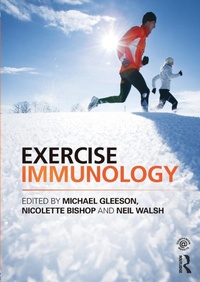
Exercise Immunology
1st Edition
Published on 20. June 2013
Book
Paperback/Softback
456 pages
978-0-415-50726-4 (ISBN)
Description
Exercise immunology is an important, emerging sub-discipline within exercise physiology, concerned with the relationship between exercise, immune function and infection risk. This book offers a comprehensive, up-to-date and evidence-based introduction to exercise immunology, including the physiological and molecular mechanisms that determine immune function and the implications for health and performance in sport and everyday life.
Written by a team of leading exercise physiologists, the book describes the characteristics of the immune system and how its components are organised to form an immune response. It explains the physiological basis of the relationship between stress, physical activity, immune function and infection risk, and identifies the ways in which exercise and nutrition interact with immune function in athletes and non-athletes. The book shows students how to evaluate the strengths and limitations of the evidence linking physical activity, immune system integrity and health, and explains why exercise is associated with anti-inflammatory effects that are potentially beneficial to long-term health.
Every chapter includes useful features, such as clear summaries, definitions of key terms, discussions of seminal research studies and practical guidelines for athletes on ways to minimise infection risk, with additional learning resources available on a companion website. This is an essential textbook for any course on exercise immunology or advanced exercise physiology.
Written by a team of leading exercise physiologists, the book describes the characteristics of the immune system and how its components are organised to form an immune response. It explains the physiological basis of the relationship between stress, physical activity, immune function and infection risk, and identifies the ways in which exercise and nutrition interact with immune function in athletes and non-athletes. The book shows students how to evaluate the strengths and limitations of the evidence linking physical activity, immune system integrity and health, and explains why exercise is associated with anti-inflammatory effects that are potentially beneficial to long-term health.
Every chapter includes useful features, such as clear summaries, definitions of key terms, discussions of seminal research studies and practical guidelines for athletes on ways to minimise infection risk, with additional learning resources available on a companion website. This is an essential textbook for any course on exercise immunology or advanced exercise physiology.
More details
Language
English
Place of publication
London
United Kingdom
Publishing group
Taylor & Francis Ltd
Target group
College/higher education
Illustrations
25 s/w Tabellen
25 Tables, black and white
Dimensions
Height: 246 mm
Width: 174 mm
Thickness: 24 mm
Weight
806 gr
ISBN-13
978-0-415-50726-4 (9780415507264)
Copyright in bibliographic data and cover images is held by Nielsen Book Services Limited or by the publishers or by their respective licensors: all rights reserved.
Schweitzer Classification
Other editions
New editions
James Turner | Guillaume Spielmann | John Campbell
Exercise Immunology
Book
10/2024
2nd Edition
Routledge
€66.00
Shipment within 10-20 days
Additional editions
Michael Gleeson | Nicolette Bishop | Neil Walsh
Exercise Immunology
Book
06/2013
1st Edition
Routledge
€231.50
Article exhausted; check for reprint
Michael Gleeson | Nicolette Bishop | Neil Walsh
Exercise Immunology
E-Book
06/2013
1st Edition
Routledge
€61.69
Available for download
Michael Gleeson | Nicolette Bishop | Neil Walsh
Exercise Immunology
E-Book
06/2013
1st Edition
Routledge
€61.69
Available for download
Persons
Michael Gleeson is Professor of Exercise Biochemistry at Loughborough University, UK. Over the past 20 years he has published over 150 papers on exercise physiology, biochemistry and immunology and sports nutrition. He is a member of several Sports Science societies in the UK and worldwide, as well as being a past president of the International Society of Exercise and Immunology. He is also an elected Fellow of the European College of Sport Science, a past editor of the Journal of Sports Sciences and is currently associate editor of Exercise Immunology Review.
Nicolette Bishop is Senior Lecturer in Exercise Physiology at Loughborough University, UK where she leads the Performance Health Research Theme within the Peter Harrison Centre for Disability Sport. She is widely published in the area of exercise immunology, is a member of the International Society for Exercise and Immunology, a Physiology Advisory Board Member for the Journal of Sports Sciences and acts as a consultant for the English Institute of Sport.
Neil Walsh is Professor, and Director of the Extremes Research Group, in the School of Sport, Health and Exercise Science at Bangor University, UK. He is physiology section editor for the Journal of Sports Sciences, and a full member of BASES, the Physiology Society, the International Society of Exercise and Immunology and the American College of Sports Medicine.
Nicolette Bishop is Senior Lecturer in Exercise Physiology at Loughborough University, UK where she leads the Performance Health Research Theme within the Peter Harrison Centre for Disability Sport. She is widely published in the area of exercise immunology, is a member of the International Society for Exercise and Immunology, a Physiology Advisory Board Member for the Journal of Sports Sciences and acts as a consultant for the English Institute of Sport.
Neil Walsh is Professor, and Director of the Extremes Research Group, in the School of Sport, Health and Exercise Science at Bangor University, UK. He is physiology section editor for the Journal of Sports Sciences, and a full member of BASES, the Physiology Society, the International Society of Exercise and Immunology and the American College of Sports Medicine.
Content
1. The influence of exercise on infection risk 2. The human immune system 3. Effects of exercise on blood leukocyte numbers 4. Effects of exercise on innate immune function 5. Effects of exercise on acquired immune function 6. Effects of exercise on mucosal immunity 7. Effect of extreme environments on immune responses to exercise 8. Immune responses to intensified periods of training 9. Exercise, nutrition and immune function 10. Practical guidelines on minimising infection risk in athletes 11. Allergy in sport 12. Exercise and the prevention of chronic diseases: the role of cytokines and the anti-inflammatory effects of exercise 13. Exercise, infection risk, immune function and inflammation in special populations Glossary of key terms