

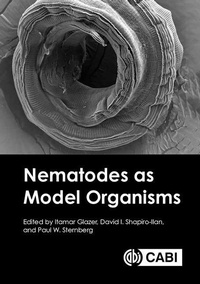
Nematodes as Model Organisms
Published on 16. May 2022
Book
Hardback
384 pages
978-1-78924-879-1 (ISBN)
Description
Nematodes are small multicellular organisms that have been used as biological models since the 1960s. For example, Caenorhabditis elegans is a free-living nematode worm, about 1mm in length, that lives in temperate soil environments. It is made up of about 1000 cells, and has a short life cycle of only two weeks. It was the first multicellular organism to have its whole genome sequenced. The book summarizes the importance of nematodes as model organisms in the fields of genetics, developmental biology, neurobiology, pharmacology, nutrition, ecology and parasitology. Of interest to a broad audience across a wide spectrum of disciplines, this book is useful for biologists working on comparative studies to investigate biological processes across organisms; medical scientists and pharmacologists for exploration of drugs and medicine (including the use of genome editing to eliminate diseases); ecologists considering nematodes as indicators for environment changes; and parasitologists for host-parasite interactions. Many other researchers can use this book as a benchmark for the broad implications of nematology research on other aspects of science.
More details
Language
English
Place of publication
Wallingford
United Kingdom
Target group
College/higher education
Professional and scholarly
Product notice
sewn/stitched
Cloth over boards
Dimensions
Height: 250 mm
Width: 175 mm
Thickness: 26 mm
Weight
1114 gr
ISBN-13
978-1-78924-879-1 (9781789248791)
Copyright in bibliographic data and cover images is held by Nielsen Book Services Limited or by the publishers or by their respective licensors: all rights reserved.
Schweitzer Classification
Other editions
Additional editions
Itamar Glazer | D. Shapiro-llan | Paul W. Sternberg
Nematodes as Model Organisms
E-Book
06/2022
CABI Publishing
€131.99
Available for download
Persons
Itamar Glazer (Edited By)
Itamar Glazer is Researcher at the Agricultural Research Organization (ARO), Volcani Center, Israel.
David I Shapiro-llan (Edited By)
David Shapiro-Ilan is a Supervisory Research Entomologist at USDA-ARS, Georgia, USA. Dr. Shapiro-Ilan's research focuses on invertebrate pathology/microbial control. Areas of interest emphasize the study of entomopathogenic nematodes and include biological control applications, production and formulation technology, and studies on nematode behavior (especially foraging dynamics). Dr. Shapiro-Ilan has published 180 peer-reviewed journal articles plus 24 book chapters and > 40 trade journal/extension articles; he has co-edited 3 books and is inventor on 7 patents. Selected awards include Fellow of the Society of Nematologists, EEO/Civil Rights, Excellence in IPM (SEB-ESA, 2012), and > $7 million as PI/co-PI on competitive grants. He is currently the Editor-in-Chief for the Journal of Nematology, and Editor for the Journal of Invertebrate Pathology.
Paul W. Sternberg (Edited By)
Paul Sternberg is Professor of Biology at Caltech, USA.
Itamar Glazer is Researcher at the Agricultural Research Organization (ARO), Volcani Center, Israel.
David I Shapiro-llan (Edited By)
David Shapiro-Ilan is a Supervisory Research Entomologist at USDA-ARS, Georgia, USA. Dr. Shapiro-Ilan's research focuses on invertebrate pathology/microbial control. Areas of interest emphasize the study of entomopathogenic nematodes and include biological control applications, production and formulation technology, and studies on nematode behavior (especially foraging dynamics). Dr. Shapiro-Ilan has published 180 peer-reviewed journal articles plus 24 book chapters and > 40 trade journal/extension articles; he has co-edited 3 books and is inventor on 7 patents. Selected awards include Fellow of the Society of Nematologists, EEO/Civil Rights, Excellence in IPM (SEB-ESA, 2012), and > $7 million as PI/co-PI on competitive grants. He is currently the Editor-in-Chief for the Journal of Nematology, and Editor for the Journal of Invertebrate Pathology.
Paul W. Sternberg (Edited By)
Paul Sternberg is Professor of Biology at Caltech, USA.
Editor
ARO, Volcani Center, Israel
USDA-ARS, Georgia, USA
Caltech, USA
Contributions
Agricultural Research Organization (ARO), Israel
University of Southampton, UK
The Institute of Vine and Wine Sciences (ICVV), Spain
The George Washington University, USA
University of Southampton, UK
University of Southampton, UK
Bielefeld University, Germany
Content
Part 1: Biological Systems Chapter 1: The genus Pristionchus: a model for phenotypic plasticity, predatory behavior, self-recognition and other complex traits Chapter 2: Aging Chapter 3: Entomopathogenic nematodes as a model for probing the insect immune system Chapter 4: The use of the root-knot nematodes, Meloidogyne spp., for studying biotrophic parasitic interactions Chapter 5: Nematodes as a model for symbiosis Chapter 6: Nematode pharmacology: neurotransmitters, receptors and experimental approaches Part 2: Ecology and Toxicology Chapter 7: Nematodes as ecological and environmental Indicators Chapter 8: Use in soil agro-ecology Chapter 9: Stress and survival mechanisms Chapter 10: Molecular toxicology in Caenorhabditis elegans Chapter 11: Nematode use for testing theoretical models of behavioral ecology Chapter 12: Entomopathogenic nematodes as models For inundative biological control Chapter 13: Parasitic nematodes and their symbiosis with bacteria: model systems for studying parasitism and pathogenesis Chapter 14: Genetic improvement of beneficial organisms