

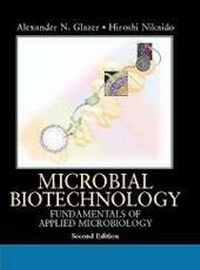
Microbial Biotechnology
Fundamentals of Applied Microbiology
2nd Edition
Published on 1. October 2007
Book
Hardback
576 pages
978-0-521-84210-5 (ISBN)
Description
Knowledge in microbiology is growing exponentially through the determination of genomic sequences of hundreds of microorganisms and the invention of new technologies such as genomics, transcriptomics, and proteomics, to deal with this avalanche of information. These genomic data are now exploited in thousands of applications, ranging from those in medicine, agriculture, organic chemistry, public health, biomass conversion, to biomining. Microbial Biotechnology. Fundamentals of Applied Microbiology focuses on uses of major societal importance, enabling an in-depth analysis of these critically important applications. Some, such as wastewater treatment, have changed only modestly over time, others, such as directed molecular evolution, or 'green' chemistry, are as current as today's headlines. This fully revised second edition provides an exciting interdisciplinary journey through the rapidly changing landscape of discovery in microbial biotechnology. An ideal text for courses in applied microbiology and biotechnology courses, this book will also serve as an invaluable overview of recent advances in this field for professional life scientists and for the diverse community of other professionals with interests in biotechnology.
Reviews / Votes
'A wonderful text for modern day study of microbes and their fantastic activities. It brings together so many aspects of microbes including their diversity, metabolism, genetics, etc., etc., etc. I wish I had such a book at my side when I was a student. The text will bring the wonders of microbiology to the student in a way that he/she will never forget.' Professor Arnold L. Demain, Research Institute for Scientists Emeriti (R.I.S.E.), Drew University 'The application of science to practical problems of humanity has at times been approached with an air of apology. No longer. Biotechnology, especially of the microbiological variety is so closely linked to its scientific roots as to make for a seamless continuum. Nowhere is this more vividly demonstrated than in the second edition of Microbial Biotechnology, written by two leading scientists who have made stellar contributions to microbiology and biochemistry. This book, based on their authoritative insights and experience, unites the 'bio' and 'technology' in a masterful way. This is what we expected from the update of a classic in its field.' Moselio Schaechter, Adjunct Professor, San Diego State University; Distinguished Professor emeritus, Tufts UniversityMore details
Edition
2nd Revised edition
Language
English
Place of publication
Cambridge
United Kingdom
Target group
College/higher education
Edition type
Revised edition
Illustrations
74 Tables, unspecified
Dimensions
Height: 260 mm
Width: 205 mm
Thickness: 35 mm
Weight
1508 gr
ISBN-13
978-0-521-84210-5 (9780521842105)
Copyright in bibliographic data and cover images is held by Nielsen Book Services Limited or by the publishers or by their respective licensors: all rights reserved.
Schweitzer Classification
Other editions
Additional editions
E-Book
01/2008
2nd Edition
Cambridge University Press
€47.49
Available for download
E-Book
10/2007
Cambridge University Press
€39.49
Available for download
Persons
Alexander N. Glazer is professor of the graduate school in the Department of Molecular and Cell Biology at the University of California, Berkeley. Hiroshi Nikaido is professor of Biochemistry & Molecular Biology in the Department of Molecular and Cell Biology at the University of California, Berkeley.
Content
Preamble; 1. Microbial diversity; 2. Microbial biotechnology, scope, techniques and examples; 3. Production of proteins in bacteria and yeast; 4. The world of 'omics' - genomics, transcriptomics, proteomics and metabolomics; 5. Recombinant and synthetic vaccines; 6. Plant-microbe interactions; 7. Microbial insecticides; 8. Microbial polysaccharides and polyesters; 9. Amino acids; 10. Antibiotics; 11. Biocatalysis in organic chemistry; 12. Biomass; 13. Ethanol; 14. Environmental applications.