

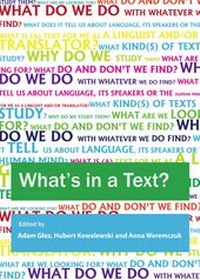
What's in a Text? Inquiries into the Textual Cornucopia
Published on 24. February 2012
Book
Hardback
295 pages
978-1-4438-3636-4 (ISBN)
Description
Numerous linguists of various orientations, translators and literary scholars share an interest in text. As students of language with very diverse interests and aims, they ask themselves, if only subconsciously, the following questions:What kind(s) of texts do we study?Why do we study them?What are we looking for?What do and don't we find?What do we do with whatever we do find?What does it tell us about language, its speakers or the human mind?Generally, what is (a) text for me as a linguist and/or translator?In the present volume, the questions are brought onto the level of the conscious and addressed by several practitioners in the fields of linguistics and translation - contributions with a literary slant also have a linguistic orientation. Although ultimate answers to these questions may not exist, the ambition of the book is to help the reader appreciate the richness of text and the variety of texts as a treasure-trove for scholars representing multifarious approaches to language.
Reviews / Votes
''The primary aim of the authors of this collection was to invite their readers to carefully consider both the richness of text as such and the diversity of text studies, performed by scholars representing various approaches to language and languages, and this goal was accomplished. The publication contains a large amount of data and ideas, satisfying the desires of linguists that may have diverse aims, methodologies and theoretical approaches. The collection is especially welcome for doctoral students of text-related phenomena. The varied geographical background of the contributors gives a reasonably good picture of the nature of text-based research in different parts of Europe.''- Elena Gheorghita, LINGUISTlist, 24.787, 13/02/13."Unusually for a scholarly work, What's In a Text? asks the right question and then goes on to provide answers along several rational dimensions. This is an impressively wide-ranging and inter-disciplinary book from an internationally significant set of contributors. The scope of textuality explored is breath-taking: from Chaucer to Dan Brown, from Beckett to Twilight, from politicians to conversations, dictionaries, ideograms, biblical prophecy and more; there is something here for everyone interested in texts, textuality, reading and rational analysis. The quality of chapters is exceptionally high, and the collision of disciplines mean that the reading is always stimulating and surprising. Even on the margins of your own field, you will find jewels of insight in every chapter."- Prof. Peter Stockwell, Chair in Literary Linguistics, University of Nottingham, UKMore details
Edition
Unabridged edition
Language
English
Place of publication
Newcastle upon Tyne
United Kingdom
Target group
Professional and scholarly
Edition type
Unabridged edition
Product notice
With dust jacket
Dimensions
Height: 212 mm
Width: 148 mm
ISBN-13
978-1-4438-3636-4 (9781443836364)
Copyright in bibliographic data and cover images is held by Nielsen Book Services Limited or by the publishers or by their respective licensors: all rights reserved.
Schweitzer Classification
Other editions
Additional editions
Anna Weremczuk Hubert Kowalewski Adam Glaz
What's in a Text? Inquiries into the Textual Cornucopia
E-Book
03/2012
1st Edition
Cambridge Scholars Publishing
€106.79
Available for download
Persons
Adam Glaz, PhD, has been affiliated with the English Department, Maria Curie-Sklodowska University, Lublin, Poland, since 1993. His interests include cognitive semantics, linguistic categorization, viewpoints in language and linguistics, cognitive ethnolinguistics and linguistic applications of Vantage Theory. He has also worked as a translator and lexicographer.Hubert Kowalewski is a doctoral student at Maria Curie-Sklodowska University, Lublin, Poland. His interests include cognitive semantics, motivation in language, and general semiotics, as well as linguistics and Buddhism.Anna Weremczuk is a doctoral student at Maria Curie-Sklodowska University, Lublin, Poland. She has researched and written on cognitive pragmatics and Cognitive Grammar.