

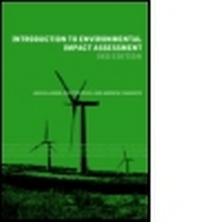
Introduction To Environmental Impact Assessment
3rd Edition
Published on 12. May 2005
Book
Paperback/Softback
448 pages
978-0-415-33837-0 (ISBN)
Description
A clearly structured overview of a key subject, this work provides the student with not only a complete introductory text but also a book to support further studies. Written by three authors with extensive research and practical experience in Environmental Impact Assessment (EIA), the treatment is up to date and brings together currently fragmented information from many sources.
EIA is now firmly on the agenda as a result of the introduction of legislation at both national and international levels, and is very much in tune with widespread and growing concern about environmental issues and the impact of development on the environment. First introduced in the USA in the 1970s, the application of EIA has been accelerated in Europe by the 1985 EC directive, which led to its introduction in the UK in 1988, since when it has been a major growth area in planning practice. The originally anticipated 20 environmental impact statements per annum have now grown to well over 300, for projects such as power stations, roads, new settlements, mineral extraction schemes, waste-disposal installations and toursism developments, and this is but the tip of the iceberg.
Based on highly successful courses at one of the leading schools of planning, this book should serve the need for an introduction to EIA that goes beyond first principles and is informed by a wealth of teaching, research and practical experience.
Students on undergraduate and postgraduate planning programmes should find it useful as a course text, as will students of environmental management/policy, environmental sciences/studies, geography and the built environment. Planners, developers and decision makers in government and business should also welcome the book as a very effective means of getting to grips with a key new subject which they must fully integrate with their other activities.
EIA is now firmly on the agenda as a result of the introduction of legislation at both national and international levels, and is very much in tune with widespread and growing concern about environmental issues and the impact of development on the environment. First introduced in the USA in the 1970s, the application of EIA has been accelerated in Europe by the 1985 EC directive, which led to its introduction in the UK in 1988, since when it has been a major growth area in planning practice. The originally anticipated 20 environmental impact statements per annum have now grown to well over 300, for projects such as power stations, roads, new settlements, mineral extraction schemes, waste-disposal installations and toursism developments, and this is but the tip of the iceberg.
Based on highly successful courses at one of the leading schools of planning, this book should serve the need for an introduction to EIA that goes beyond first principles and is informed by a wealth of teaching, research and practical experience.
Students on undergraduate and postgraduate planning programmes should find it useful as a course text, as will students of environmental management/policy, environmental sciences/studies, geography and the built environment. Planners, developers and decision makers in government and business should also welcome the book as a very effective means of getting to grips with a key new subject which they must fully integrate with their other activities.
Reviews / Votes
'This book should join a limited number of publications that provide the essential first stages on a rapid EIA learning curve ... Well written and referenced and should provide an invaluable introduction to EIA for a wide range of people, including students, practitioners, developers and decision makers.' - Environmental Assessment'The book gives the student a good introduction to the history and evolution of environmental impact assessment. It covers the existing legislation well and provides interesting case studies and examples along the way to keep the reader interested ... Many local authorities when faced with their first EIA would welcome such a review.' - Built Environment
More details
Series
Edition
3rd New edition
Language
English
Place of publication
London
United Kingdom
Publishing group
Taylor & Francis Ltd
Target group
College/higher education
Professional and scholarly
Edition type
New edition
Illustrations
1 s/w Abbildung, 70 s/w Zeichnungen, 30 s/w Tabellen
70 Line drawings, black and white; 30 Tables, black and white; 1 Illustrations, black and white
Dimensions
Height: 235 mm
Width: 156 mm
Weight
748 gr
ISBN-13
978-0-415-33837-0 (9780415338370)
Copyright in bibliographic data and cover images is held by Nielsen Book Services Limited or by the publishers or by their respective licensors: all rights reserved.
Schweitzer Classification
Other editions
New editions
John Glasson | Riki Therivel
Introduction To Environmental Impact Assessment
Book
12/2011
4th Edition
Routledge
€76.94
Article exhausted; check for reprint
Additional editions
John Glasson | Riki Therivel | Andrew Chadwick
Introduction To Environmental Impact Assessment
Book
04/2005
3rd Edition
Routledge
€148.56
Article exhausted; check for reprint
Previous edition
John Glasson | Riki Therivel | Andrew Chadwick
Introduction To Environmental Impact Assessment
Book
11/1998
2nd Edition
Routledge
€59.60
Article exhausted; check for reprint
Persons
Content
Part 1: Principles and Procedures 1. Introduction and Principles 2. Origins and Development 3. UK Agency and Legislation Context Part 2: Process 4. Starting Up; Early Stages 5. Impact Prediction, Evaluation and Mitigation 6. Participation, Presentation and Review 7. Monitoring and Auditing: After the Decision Part 3: Practice 8. An Overview of UK Practice to Date 9. Case Studies of EIA in Practice 10. Comparative Practice Part 4: Prospects 11. Improving the Effectiveness of Project Assessment 12. Widening the Scope: Strategic Environmental Assessment