

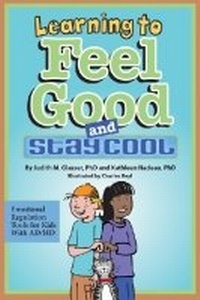
Learning to Feel Good and Stay Cool
Emotional Regulation Tools for Kids with AD/HD
Published on 15. August 2013
Book
Hardback
128 pages
978-1-4338-1342-9 (ISBN)
Description
Honors, 2 4 NAPPA AwardsDid you know that there are things you can do every day to help you feel better more often? It's true!
Packed with practical advice and fun activities, this book will show you how to:
Understand your emotions
Practice healthy habits to stay in your Feel Good Zone
Know the warning signs that you are heading into your Upset Zone
Feel better when you get upset
Problem-solve so upsets come less often
And much more!
Get ready to take charge of your emotions and start feeling better!
Everybody likes to feel good but it's normal to be sad, angry, or frustrated when things don't go the way you want them to. Many kids with AD/HD have really strong feelings that make it hard for them to control their behavior. While others may think they are amp quot over-reacting, amp quot children with AD/HD are often less self-observant and more reactive, meaning it is harder for them to understand and control their feelings.
Learning to Feel Good and Stay Cool offers practical tools to help kids with AD/HD manage and reduce unwanted feelings and to develop daily habits that can help them feel good and function well. Illustrated with cartoons that will hold children's interest, the book is divided into sections that can be read in smaller portions. Also includes a note and resources for parents.
Packed with practical advice and fun activities, this book will show you how to:
Understand your emotions
Practice healthy habits to stay in your Feel Good Zone
Know the warning signs that you are heading into your Upset Zone
Feel better when you get upset
Problem-solve so upsets come less often
And much more!
Get ready to take charge of your emotions and start feeling better!
Everybody likes to feel good but it's normal to be sad, angry, or frustrated when things don't go the way you want them to. Many kids with AD/HD have really strong feelings that make it hard for them to control their behavior. While others may think they are amp quot over-reacting, amp quot children with AD/HD are often less self-observant and more reactive, meaning it is harder for them to understand and control their feelings.
Learning to Feel Good and Stay Cool offers practical tools to help kids with AD/HD manage and reduce unwanted feelings and to develop daily habits that can help them feel good and function well. Illustrated with cartoons that will hold children's interest, the book is divided into sections that can be read in smaller portions. Also includes a note and resources for parents.
Reviews / Votes
Honors, 2 4 NAPPA Awardsamp quot This book is a practical guide for parents, clinicians, school counselors who are trying to help children with AD/HD learn how to feel good, how to problem-solve, and how to take charge of their feelings while minimizing their upsets. Why we like it: This book has some wonderful ideas for elementary school aged children to use when they are feeling overwhelmed by their emotions. There is also a nice section in the back for parents to assist their children with their emotional regulation. Illustrations are friendly. amp quot -National Parenting Publication Awards, 2 4 Honor Title
amp quot In Learning to Feel Good and Stay Cool, Judith Glasser and Kathleen Nadeau have written an amazingly clear, helpful and non-judgmental resource for kids (and their parents) who have any difficulty managing or regulating their emotions. Glasser and Nadeau have found a very effective way to describe and explain to kids, in a way that they can relate to and understand, what emotions are, how different emotions feel and what causes them. They then provide specific strategies that kids can use to feel good, recognize times when they are becoming upset and find ways to calm down. In simple, clear, understandable and sensitive language, they provide guidelines for kids to use amp ldquo feel good tools amp rdquo to manage difficult emotional experiences, again enabling kids to understand how to help themselves and use guidance from others as necessary. The illustrations, charts, fill-in exercises, reminders and summary games further enhance this remarkable book. Reading this remarkable book provided me with new insights and ideas that I can use when working with parents. I highly recommend it for kids, their parents and any professionals who are helping them. amp quot -Pat Harvey, LCSW-C, DBT Parent Coach, Consultant and Trainer, Co-author, Parenting a Child who Has Intense Emotions
amp quot This book is directed at children, but parents who want to help their youngsters with AD/HD build up self-esteem while learning to keep their temper might want to read it with them. The accessible text opens with a discussion of various feelings, including happy, bored, angry, calm, ashamed, followed by suggestions for amp quot staying in your feel good zone, amp quot amp quot feel good tools for specific upset feelings, amp quot and more. Illustrations are sprinkled throughout, and there are a few charts with fill-in blanks. Back matter has tips and resources for parents the further reading for kids lists mostly other titles from the publisher of this book. Suitable for self-help and parenting collections. amp quot -School Library Journal
amp ldquo Glasser and Nadeau have written this book for children using language they easily understand. But, it is an excellent book for parents to read with their children amp hellip .It is an upbeat book with a lot of practical information and tools that kids with ADHD can use to understand their feelings, learn tools to manage and regulate their emotions and behavior and become more emotionally independent. amp rdquo -Children amp rsquo s Books Heal
amp ldquo Presented in bite-sized pieces, clear and encouraging, this handy guide to emotional regulation is packed with good ideas. From recognizing the slippery slope to the aptly named Upset Zone to figuring out what to do once there, children with AD/HD (and their non-AD/HD siblings and peers) will benefit from the many strategies presented by Dr. Glasser and Dr. Nadeau. For both children and the adults in their lives, working through this readable book will be time well spent. amp rdquo -Dawn Huebner, bestselling author of What To Do When You Worry Too Much
amp quot These strategies have a lot to do with teaching resilience as well - aren't all strategies geared towards teaching this? Great to know your book is out there. amp quot -Michelle Garcia Winner, Founder and CEO of Social Thinking amp reg
amp quot I amp rsquo m stashing the book to read with my son when he gets older (he amp rsquo s now). I ripped out the part about triggers and taped it to my refrigerator - for myself. The tactics are equally effective for adults. And that amp rsquo s the authors amp rsquo goal: creating lifelong habits for dealing productively with negative feelings. amp quot -ADDitude Magazine
amp quot Cartoons proliferate throughout the entire book, as do interactive exercises and super-short chapters, making the book itself an ADHD-friendly read amp hellip The toolboxes are stocked with a collection of useful tools children with ADHD can use to better process and deal with emotions. amp quot -AnxietyFreeChild.com
amp quot Learning to Feel Good and Stay Cool provides the tools that kids need when they are upset. By offering concrete examples, Glasser and Nadeau not only help kids react when situation arise, but also teach them how to design an action plan to recognize triggers and avoid problems in the future. Written in language kids can understand, this book offers the reassurance that life can get better. amp quot -Patricia O. Quinn, MD, Developmental Pediatrician, Washington, DC
amp ldquo The authors, both clinical psychologists who study AD/HD, have done well to present their advice in kid-friendly language and presentation. amp rdquo -Portland Book Review
More details
Language
English
Place of publication
Washington DC
United States
Target group
Children/juvenile
US School Grade: From Preschool to Second Grade, Interest Age: From 8 to 12 years
Illustrations
Black & white illustrations
Dimensions
Height: 229 mm
Width: 152 mm
ISBN-13
978-1-4338-1342-9 (9781433813429)
Copyright in bibliographic data and cover images is held by Nielsen Book Services Limited or by the publishers or by their respective licensors: all rights reserved.
Schweitzer Classification
Persons
Judith M. Glasser, PhD, is a clinical psychologist who has worked with children and their families for over 3 years. She specializes in the assessment and treatment of AD/HD in children. For many years Dr. Glasser has been interested in the different kinds of difficulties children experience when they have AD/HD. Dr. Glasser is also the author, with Kathleen Nadeau, PhD, of Learning to Feel Good and Stay Cool (Magination Press, 2 4). Visit Dr. Glasser at www.judithglasser.com.
Kathleen G. Nadeau, PhD, is a clinical psychologist who has specialized in working with kids and adults with AD/HD for many years. She is the founder and director of the Chesapeake ADHD Center in Silver Spring, MD, and the author of many books on AD/HD for kids, teens, adults, and professionals.
Charles Beyl creates humorous illustrations for books, magazines, and newspapers in his suburban Texas ranch house. Visit him at www.charlesbeyl.com and follow him on Instagram: ChuckBeyl
Kathleen G. Nadeau, PhD, is a clinical psychologist who has specialized in working with kids and adults with AD/HD for many years. She is the founder and director of the Chesapeake ADHD Center in Silver Spring, MD, and the author of many books on AD/HD for kids, teens, adults, and professionals.
Charles Beyl creates humorous illustrations for books, magazines, and newspapers in his suburban Texas ranch house. Visit him at www.charlesbeyl.com and follow him on Instagram: ChuckBeyl