

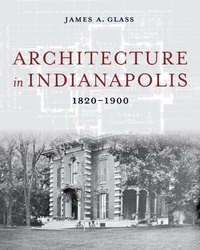
Architecture in Indianapolis
1820-1900
Published on 30. October 2024
Book
Hardback
656 pages
978-0-253-07093-7 (ISBN)
Description
As a planned community, Indianapolis boasted finished frame and brick buildings from its beginning. Architects and builders drew on Federal, Greek Revival, Italianate, French Second Empire, Gothic, Romanesque, and Italian Renaissance styles for commercial, industrial, public, and religious buildings and for residences.
In Architecture in Indianapolis: 1820-1900, preservationist and architectural historian Dr. James Glass explores the rich variety of architecture that appeared during the city's first 80 years, to 1900. Glass explains how economic forces shaped building cycles, such as the Canal Era, the advent of railroads, the natural gas boom, and repeated recessions and recoveries. He describes 243 buildings that illustrate the styles that architects and builders incorporated into the designs that they devised in each era between 1820 and 1900. This book also documents the loss of distinctive 19th century architecture that has occurred in Indianapolis. It includes 373 photographs and drawings that depict the buildings described and locator maps that show where concentrations of buildings were constructed.
Architecture in Indianapolis: 1820-1900 provides the first history of 19th-century architecture in the city and will serve as an indispensable reference for decades to come.
In Architecture in Indianapolis: 1820-1900, preservationist and architectural historian Dr. James Glass explores the rich variety of architecture that appeared during the city's first 80 years, to 1900. Glass explains how economic forces shaped building cycles, such as the Canal Era, the advent of railroads, the natural gas boom, and repeated recessions and recoveries. He describes 243 buildings that illustrate the styles that architects and builders incorporated into the designs that they devised in each era between 1820 and 1900. This book also documents the loss of distinctive 19th century architecture that has occurred in Indianapolis. It includes 373 photographs and drawings that depict the buildings described and locator maps that show where concentrations of buildings were constructed.
Architecture in Indianapolis: 1820-1900 provides the first history of 19th-century architecture in the city and will serve as an indispensable reference for decades to come.
Reviews / Votes
"Architecture in Indianapolis fills a long-standing void in the history of the city's buildings and the architectural profession. It reflects the perspective of the author, who has dedicated his career to scholarship in the fields of history, architecture, and historic preservation. His thoroughly researched, generously illustrated, definitive treatise on the capital city's buildings is a major achievement and a valued addition to the understanding of our heritage."-Marsh Davis, President, Indiana LandmarksMore details
Language
English
Place of publication
Bloomington, IN
United States
Product notice
sewn/stitched
Cloth over boards
Illustrations
149 color photos, 224 b&w photos, 22 maps
Dimensions
Height: 257 mm
Width: 203 mm
Thickness: 36 mm
Weight
1950 gr
ISBN-13
978-0-253-07093-7 (9780253070937)
Copyright in bibliographic data and cover images is held by Nielsen Book Services Limited or by the publishers or by their respective licensors: all rights reserved.
Schweitzer Classification
Other editions
Additional editions
E-Book
10/2024
Indiana University Press
€58.99
Available for download
Person
James A. Glass is an Indianapolis-based historic preservation and heritage consultant with over 45 years' experience as a historian, Deputy State Historic Preservation Officer, and professor in the preservation field. He holds a PhD in the history of architecture and historic preservation planning from Cornell University and lectures regularly on the architectural history of other countries and of Indianapolis.
Content
Foreword
Preface
Acknowledgments
Introduction
Part I: Pre-Civil War
1. Building in a Frontier Capital, 1820-36
2. Stimulus by Internal Improvements, 1836-47
3. The Railroad Era, 1847-60
Part II: Civil War Growth and Post-War Boom
4. Commercial, Public, and Charitable Architecture, 1860-77
5. Buildings of Worship, 1860-77
6. Residential Architecture, 1860-77
Part III: Depressions, Railroads, and the Gas Boom
7. Commercial and Industrial Architecture, 1877-1900
8. Public and Charitable Architecture, 1877-1900
9. Buildings of Worship, 1877-1900
10. Residential Architecture, 1877-1900
Appendix A: Architectural Glossary
Appendix B: Architectural Style Guide
Notes
Bibliography
Index
Preface
Acknowledgments
Introduction
Part I: Pre-Civil War
1. Building in a Frontier Capital, 1820-36
2. Stimulus by Internal Improvements, 1836-47
3. The Railroad Era, 1847-60
Part II: Civil War Growth and Post-War Boom
4. Commercial, Public, and Charitable Architecture, 1860-77
5. Buildings of Worship, 1860-77
6. Residential Architecture, 1860-77
Part III: Depressions, Railroads, and the Gas Boom
7. Commercial and Industrial Architecture, 1877-1900
8. Public and Charitable Architecture, 1877-1900
9. Buildings of Worship, 1877-1900
10. Residential Architecture, 1877-1900
Appendix A: Architectural Glossary
Appendix B: Architectural Style Guide
Notes
Bibliography
Index