

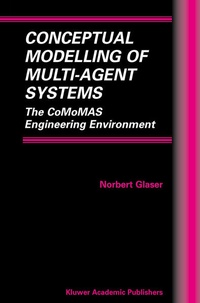
Conceptual Modelling of Multi-Agent Systems
The CoMoMAS Engineering Environment
Published on 31. October 2012
Book
Paperback/Softback
XVIII, 265 pages
978-1-4613-5331-7 (ISBN)
Description
Conceptual Modelling of Multi-Agent Systems
proposes the methodology and engineering environment CoMoMAS for the development of multi-agent systems. CoMoMAS is among the most elaborated and most often cited multi-agent development approaches available in the field. Its originality is to address the issue of the development of multi-agent systems (MAS) from a knowledge engineering perspective, which means that agents are seen as interacting entities having different kinds of knowledge, which is to be identified during development. Knowledge has played an important role for MAS development in the past, but CoMoMAS makes a step further in proposing a complete set of conceptual models and a solid methodology to guide the overall development process of a MAS-from design to validation.
Conceptual Modelling of Multi-Agent Systems is an excellent reference for both researchers and practitioners in the broad area of distributed systems development. This book is of particular value from the point of view of computer science, including knowledge engineering, artificial intelligence, agent and multi-agent technology, and software engineering.
Conceptual Modelling of Multi-Agent Systems is an excellent reference for both researchers and practitioners in the broad area of distributed systems development. This book is of particular value from the point of view of computer science, including knowledge engineering, artificial intelligence, agent and multi-agent technology, and software engineering.
More details
Series
Edition
Softcover reprint of the original 1st ed. 2002
Language
English
Place of publication
New York
United States
Target group
Professional and scholarly
Research
Illustrations
XVIII, 265 p.
Dimensions
Height: 235 mm
Width: 155 mm
Thickness: 16 mm
Weight
441 gr
ISBN-13
978-1-4613-5331-7 (9781461353317)
DOI
10.1007/978-1-4615-0973-8
Schweitzer Classification
Other editions
Additional editions
E-Book
12/2012
Springer
€96.29
Available for download
Book
05/2002
Kluwer Academic Publishers
€106.99
Shipment within 15-20 days
Content
1. Introduction.- 2. State of the Art : Agent Models and Architectures.- 1 Introduction.- 2 Characterisation of a Multi-Agent System (MAS).- 3 Hierarchical and Layered Architectures.- 4 Reactive and Real-Time Architectures.- 5 Heterogeneous, Cooperative and Social Architectures.- 6 Template-based and Generic Development Tools.- 7 Conclusion.- 3. State of the Art : Knowledge Acquisition and Modelling.- 1 Introduction.- 2 Historic Milestones.- 3 ComMet: Compositional Modelling.- 4 The KADS, CommonKADS and REFLECT project.- 5 COPILOTE: Flexible Control.- 6 ACKnowledge : Using General Directive Models.- 7 VITAL : Structured Model Development.- 8 CERISE : Two Acquisition Cycles.- 9 MACAO: Data-Driven and Model-Driven KA Approach.- 10 MIKE: Model-based and Incremental KE.- 11 The PROTÉGÉ Framework : Generation of KA-Tools.- 12 Conclusion.- 4. The Comomas Methodology.- 1 Introduction and Motivation.- 2 MAS Development: A Model-Based Approach.- 3 Reusing Knowledge during Development.- 4 Model-Driven Knowledge Acquisition.- 5 Tasks, Strategies and Methods at Run-Time.- 6 Comparison to MAS Engineering Methodologies.- 7 Conclusion.- 5. The Comomas Agent Engineering Toolkit.- 1 Introduction and Motivation.- 2 The CoMoMAS Architecture.- 3 The CoMoMAS Acquire and Modeller.- 4 The CoMoMAS Constructor and Coder.- 5 The GUI for Constructor and Coder.- 6 An Example.- 7 Comparison to KBS Engineering Environments.- 8 Conclusion.- 6. The Comomas Agent Validation Testbed.- 1 Introduction and Motivation.- 2 MICE: The Original Version.- 3 MICE 2.0: The Extended Version.- 4 Adaptation of MICE for Mobile Robot Simulation.- 5 Conclusion.- 7. A Case Study.- 1 Introduction and Motivation.- 2 The Nomad200 Robot.- 3 The Adaptive Intelligent Systems Model.- 4 The CoNomad Agent Architecture.- 5Reverse Engineering of the Agent Architectures.- 6 Conclusion.- 8. Conclusion and Perspectives.- Appendices.- Model Operators.- BNF specification of CML.- BNF specification of CML-M.