

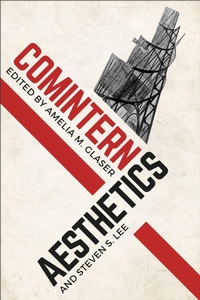
Comintern Aesthetics
Published on 11. March 2020
Book
Hardback
592 pages
978-1-4875-0465-6 (ISBN)
Description
Founded by Vladimir Lenin in 1919 to instigate a world revolution, the Comintern sought to advance not only the proletarian struggle but also a wide variety of radical causes, including fighting against imperialism and racism in settings as varied as Ireland, India, the United States, and China. Notoriously, and from the organization's outset, these causes grew ever more subservient to Soviet state interest and Stalinist centralization.
Comintern Aesthetics shows how the cultural and political networks emerging from the Comintern have persisted, even after the Comintern's demise in 1943. Tracing these networks through a multiplicity of artistic forms geared towards advancing a common, liberated humanity, this volume captures both the failure and the enduring allure of a Soviet-centred world revolution.
The sixteen chapters in this edited volume examine cultural and revolutionary circuits that once connected Moscow to China, Southeast Asia, India, the Near East, Eastern Europe, Germany, Spain, and the Americas. The Soviet Union of the interwar years provided a template for the convergence of party politics and cultural history, but the volume traces how this template was adapted and reworked around the world. By emphasizing the shared Soviet routes of these far-flung circuits, Comintern Aesthetics recaptures a long-lost moment in which cultures could not only transform perception but also highlight alternatives to capitalism - namely, an anti-colonial world imaginary foregrounding race, class, and gender equality.
Comintern Aesthetics shows how the cultural and political networks emerging from the Comintern have persisted, even after the Comintern's demise in 1943. Tracing these networks through a multiplicity of artistic forms geared towards advancing a common, liberated humanity, this volume captures both the failure and the enduring allure of a Soviet-centred world revolution.
The sixteen chapters in this edited volume examine cultural and revolutionary circuits that once connected Moscow to China, Southeast Asia, India, the Near East, Eastern Europe, Germany, Spain, and the Americas. The Soviet Union of the interwar years provided a template for the convergence of party politics and cultural history, but the volume traces how this template was adapted and reworked around the world. By emphasizing the shared Soviet routes of these far-flung circuits, Comintern Aesthetics recaptures a long-lost moment in which cultures could not only transform perception but also highlight alternatives to capitalism - namely, an anti-colonial world imaginary foregrounding race, class, and gender equality.
Reviews / Votes
"This is the best collection of essays this reviewer has read in recent years. It has been doomed to success by its very conception-an account of the body of cultural production, and especially literature, inspired and in some cases enabled, by the international communist movement."- Rossen Djagalov (The Russian Review, Vol. 80, No. 3) "I would highly recommend this volume not only to specialists in aesthetics and poetics but also to a wider audience interested in deepening its knowledge about international communism in the twentieth century. In broader Comintern literature, I would argue that this volume is positioned well within the connections between the Soviet central machine and the geographically widespread writers, artists, communists, and activists who plugged into Comintern aesthetics."
- Vsevolod Kritskiy, University of Amsterdam (H-Russia)
More details
Language
English
Place of publication
Toronto
Canada
Target group
College/higher education
Professional and scholarly
Product notice
sewn/stitched
Cloth over boards
With dust jacket
Illustrations
100 b&w illustrations
Dimensions
Height: 221 mm
Width: 152 mm
Thickness: 41 mm
Weight
930 gr
ISBN-13
978-1-4875-0465-6 (9781487504656)
Copyright in bibliographic data and cover images is held by Nielsen Book Services Limited or by the publishers or by their respective licensors: all rights reserved.
Schweitzer Classification
Persons
Amelia M. Glaser is Associate Professor of Russian and Comparative Literature at the University of California, San Diego.
Steven S. Lee is Associate Professor of English at the University of California, Berkeley.
Steven S. Lee is Associate Professor of English at the University of California, Berkeley.
Content
List of Illustrations
Chronology: Comintern Aesthetics - Between Politics and Culture
Dominick Lawton
Editors' Note
Introduction: Comintern Aesthetics - Space, Form, History
Steven S. Lee
Part One. Space: Geopoetics, Networks, Translation
1. World Literature as World Revolution: Velimir Khlebnikov's Zangezi and the Utopian Geopoetics of the Russian Avant-Garde
Harsha Ram
2. Berlin-Moscow-Shanghai: Translating Revolution across Cultures in the Aftermath of the 1927 Shanghai Debacle
Katerina Clark
3. India-England-Russia: The Comintern Translated
Snehal Shingavi
4. Seeing the World Anew: Soviet Cinema and the Reorganization of 1930s Spanish Film Culture
Enrique Fibla-Gutierrez and Masha Salazkina
5. The Panorama and the Pilgrimage: Brazilian Modernism, the Masses, and the Soviet Union in the 1930s
Sarah Ann Wells
6. Polycentric Cosmopolitans: Writing World Literature in Indonesia and Vietnam, 1920s to 1950s and Beyond
Tony Day
Part Two. Form: Beyond Realism-versus-Modernism and Art-versus-Propaganda
7. Culture One and a Half
Nariman Skakov
8. Street Theatre and Subject Formation in Wartime China: Origins of a New Public Art
Xiaobing Tang
9. In the Shadow of the Inquisition: The Spanish Civil War in Yiddish Poetry
Amelia M. Glaser
10. "Beaten, but Unbeatable": On Langston Hughes's Black Leninism
Jonathan Flatley
11. A Comintern Aesthetics of Anti-racism in the Animated Short Film Blek end uait
Christina Kiaer
Part Three. History: Beyond the Interwar Years - Afterlives of Comintern Aesthetics
12. The Revolutionary Romanticism of Alice Childress's "Conversations from Life"
Kate Baldwin
13. When Comintern and Cominform Aesthetics Meet: Socialist Realism in Eastern Europe, 1956 and Beyond
Evgeny Dobrenko
14. Visions of the Future: Soviet Art, Architecture, and Film during and after the Comintern Years
Vladimir Paperny and Marina Khrustaleva
15. Comintern Media Experiments, Leftist Exile, and World Literature from East Berlin
Katie Trumpener
16. Workers of the World, Unite!
Bo Zheng
Coda
Steven S. Lee and Amelia M. Glaser
Contributors
Index
Chronology: Comintern Aesthetics - Between Politics and Culture
Dominick Lawton
Editors' Note
Introduction: Comintern Aesthetics - Space, Form, History
Steven S. Lee
Part One. Space: Geopoetics, Networks, Translation
1. World Literature as World Revolution: Velimir Khlebnikov's Zangezi and the Utopian Geopoetics of the Russian Avant-Garde
Harsha Ram
2. Berlin-Moscow-Shanghai: Translating Revolution across Cultures in the Aftermath of the 1927 Shanghai Debacle
Katerina Clark
3. India-England-Russia: The Comintern Translated
Snehal Shingavi
4. Seeing the World Anew: Soviet Cinema and the Reorganization of 1930s Spanish Film Culture
Enrique Fibla-Gutierrez and Masha Salazkina
5. The Panorama and the Pilgrimage: Brazilian Modernism, the Masses, and the Soviet Union in the 1930s
Sarah Ann Wells
6. Polycentric Cosmopolitans: Writing World Literature in Indonesia and Vietnam, 1920s to 1950s and Beyond
Tony Day
Part Two. Form: Beyond Realism-versus-Modernism and Art-versus-Propaganda
7. Culture One and a Half
Nariman Skakov
8. Street Theatre and Subject Formation in Wartime China: Origins of a New Public Art
Xiaobing Tang
9. In the Shadow of the Inquisition: The Spanish Civil War in Yiddish Poetry
Amelia M. Glaser
10. "Beaten, but Unbeatable": On Langston Hughes's Black Leninism
Jonathan Flatley
11. A Comintern Aesthetics of Anti-racism in the Animated Short Film Blek end uait
Christina Kiaer
Part Three. History: Beyond the Interwar Years - Afterlives of Comintern Aesthetics
12. The Revolutionary Romanticism of Alice Childress's "Conversations from Life"
Kate Baldwin
13. When Comintern and Cominform Aesthetics Meet: Socialist Realism in Eastern Europe, 1956 and Beyond
Evgeny Dobrenko
14. Visions of the Future: Soviet Art, Architecture, and Film during and after the Comintern Years
Vladimir Paperny and Marina Khrustaleva
15. Comintern Media Experiments, Leftist Exile, and World Literature from East Berlin
Katie Trumpener
16. Workers of the World, Unite!
Bo Zheng
Coda
Steven S. Lee and Amelia M. Glaser
Contributors
Index