

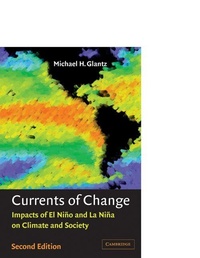
Currents of Change
Impacts of El Nino and La Nina on Climate and Society
2nd Edition
Published on 23. November 2000
Book
Paperback/Softback
268 pages
978-0-521-78672-0 (ISBN)
Description
Droughts, hurricanes and floods are generated worldwide by the periodic warming and cooling of the tropical Pacific Ocean's surface waters. El Nino's impacts are now widely known, but the equally serious consequences of its counterpart, La Nina, are only now being highlighted. Although both phenomena have generally been associated with death and destruction, there are benefits in understanding more about their occurrence, their strength and their impacts worldwide, so that their worst effects can be forecast and mitigated. This new edition of Currents of Change explains in simple terms what El Nino and La Nina are and how they can be forecast. Examining for the first time the major El Nino of 1997-1998, this book explores what we can learn from past events, what we can do to ameliorate the worst excesses of these phenomena and how climate change might affect them in future decades.
Reviews / Votes
From reviews of the first edition: '... for atmospheric scientists, the book provides a meaningful perspective of the human component of the phenomena described. For the social scientist, it is an account of El Nino that will help clear up any misrepresentations derived from popular accounts. I thoroughly enjoyed reading this book.' John Oliver, International Journal of Climatology 'This book is well written, well illustrated and manages to convey a lot of important facts without 'technospeak'. It can be recommended to anyone requiring an introduction to the complexities ... of climate.' Elmar R. Reiter, Meteorology and Atmospheric Physics '... an absorbing book.' George Philander, Nature '... Michael H. Glantz delivers more than a description of a major climatic phenomenon and its impacts: he presents a case study of science at work, and also shows how to make a book readable.' Lothar Lueken, Earthwatch 'Glantz is a passionate advocate of the value of climate research and his book should be compulsory reading for politicians and funding agency heads anywhere. It also provides background material that will be useful to geography and environmental science students and should appeal to anyone interested in the human dimension of climate'. J. C. King, Weather 'An excellent book to be recommended to anyone.' Bulletin of the British Ecological Society '... this book should be essential reading for politicians and well as ecologists.' John Feltwell, Biologist 'A mine of information for those not up to speed on the phenomena, this book should be essential reading for politicians and well as ecologists.' Biologist '... an excellent introduction to the subject for a nonscientist, or an interesting bit of entertainment for the enthusiastic scientist who just can't leave the subject alone.' Mike Meredith, Ocean ChallengeMore details
Edition
2nd Revised edition
Language
English
Place of publication
Cambridge
United Kingdom
Target group
Professional and scholarly
College/higher education
Edition type
Revised edition
Product notice
Paperback (trade)
Illustrations
19 Tables, unspecified; 10 Halftones, unspecified; 55 Line drawings, unspecified
Dimensions
Height: 229 mm
Width: 152 mm
Thickness: 16 mm
Weight
440 gr
ISBN-13
978-0-521-78672-0 (9780521786720)
Copyright in bibliographic data and cover images is held by Nielsen Book Services Limited or by the publishers or by their respective licensors: all rights reserved.
Schweitzer Classification
Other editions
Previous edition
Book
09/1996
Cambridge University Press
€20.99
Article exhausted; check for reprint
Person
Michael H. Glantz was a Senior Scientist at the National Center for Atmospheric Research (NCAR), where he researched from 1974 to 2009. Since then, he has been the director of the University of Colorado's Consortium for Capacity Building (CCB). His research publications relate to understanding how extreme climate, water and weather affect societies and how societies affect climate. Since 1976, Glantz has conducted joint research in the former Soviet Union and in the Central Asian Republics on desertification and on the disappearing of the Aral Sea. In 2013 he was recognized by China as a pioneer in
desertification studies. Glantz is a member of the Advisory Committee of the international Integrated Risk Governance Program, headquartered at Beijing Normal University. He has lectured on the Climate Affairs concept in several Chinese cities at universities and meteorological centers. He has numerous publications on climate, water and weather issues. Glantz and Professor Qian (BNU and executive
director of the IRG) co-authored Usable Thoughts: Climate, Water and Weather in the
21st Century. His current multiyear research is "El Niño Ready Nations," supported by USAID/OFDA. Many Belt and Road countries are affected by El Niño's impacts.
In 1990 he received the Global 500 Award of the UN Environment Program (UNEP) that recognizes people working in diverse ways to protect and enhance the planet's natural resources. Glantz received the 2009 Clinton Global Initiative and Rockefeller Foundation Commitment.
He has a BS in Metallurgical Engineering (1961) and an MA (1963) and PhD (1970) in Political Science/ International Relations from the University of Pennsylvania.
Content
Acknowledgements; Preface to second edition; Preface to first edition; 1. Introduction; 2. El Nino; 3. A tale of two histories; 4. The biography of El Nino; 5. The biography of La Nina; 6. The 1982-1983 El Nino: a case of an anomalous anomaly; 7. Forecasting El Nino; 8. Forecasting the 1997-1998 El Nino; 9. Teleconnections; 10. El Nino's ecological impacts: The Galapagos; 11. Methods used to identify El Nino; 12. El Nino and health; 13. The media, El Nino and La Nina: a study in media-rology; 14. Why do ENSO events continue to surprise us?; 15. What people need to know about El Nino; 16. Usable science; Appendix; References.