

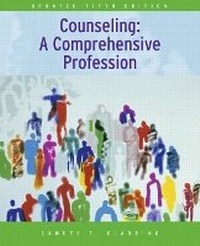
Counseling
A Comprehensive Profession, Updated Edition
5th Edition
Published on 3. November 2006
Book
Paperback/Softback
560 pages
978-0-13-232862-3 (ISBN)
Description
The leading textbook for courses in Introduction to Counseling now reflects the 2005 ACA Code of Ethics. The most comprehensive and readable text on the market for survey courses, it addresses the history of counseling and the theory behind its practice; explores the multicultural, ethical, legal environments in which counselors operate; and examines the variety of skills today's counselors are expected to exhibit. Up-to-date references to contemporary theorists, trends, and challenges in the field ensures readers learn the most current best practices and the most recently-adopted theories- preparing them to practice in today's settings, with the most recent tools and information. Incorporation of multicultural and gender issues throughout the material also broadens the scope of the book. This complete and up-to-date text encompasses all that counseling is today-a dynamic, multidimensional discipline-a comprehensive profession.
More details
Edition
5th edition
Language
English
Place of publication
United States
Publishing group
Pearson Education (US)
Target group
Professional and scholarly
Dimensions
Height: 235 mm
Width: 191 mm
Weight
830 gr
ISBN-13
978-0-13-232862-3 (9780132328623)
Copyright in bibliographic data and cover images is held by Nielsen Book Services Limited or by the publishers or by their respective licensors: all rights reserved.
Schweitzer Classification
Other editions
New editions
Book
11/2008
6th Edition
Pearson
€68.19
Article exhausted; check for reprint
Person
Samuel T. Gladding is a professor of counselor education and director of the counselor education program at Wake Forest University in Winston-Salem, North Carolina. He has been a practicing counselor in both public and private agencies since 1971. His leadership in the field of counseling includes service as president of the Association for Counselor Education and Supervision (ACES), the Association for Specialists in Group Work (ASGW), Chi Sigma Iota (counseling academic and professional honor society international) and the American Counseling Association (ACA).
Gladding is the former editor of the Journal for Specialists in Group Work and the author of over 100 professional publications. In 1999, he was cited as being in the top 1% of contributors to the Journal of Counseling and Development for the 15-year period, 1978-1993. Some of Gladding's other recent books are: Community and Agency Counseling (with Debbie Newsome) (2nd ed., 2004); Group Work: A Counseling Specialty (4th ed., 2003); Family Therapy: History, Theory, & Process (3rd ed.,2002); Becoming a Counselor. The Light, The Bright, and the Serious (2002); The Counseling Dictionary (2001); and The Creative Arts in Counseling (2nd ed., 1998).
Gladding's previous academic appointments have been at the University of Alabama at Birmingham and Fairfield University (Connecticut). He received his degrees from Wake Forest, Yale, and the University of North Carolina-Greensboro. He is a National Certified Counselor (NCC), a Certified Clinical Mental Health Counselor (CCMHC), and a Licensed Professional Counselor (North Carolina). Gladding is a former member of the Alabama Board of Examiners in Counseling and of the Research and Assessment Corporation for Counseling (RACC). He is also a Fellow in Association for Specialists in Group Work.
Dr. Gladding is married to the former Claire Tillson and is the father of three children-Ben, Nate, and Tim. Outside of counseling, he enjoys tennis, swimming, and humor.
Gladding is the former editor of the Journal for Specialists in Group Work and the author of over 100 professional publications. In 1999, he was cited as being in the top 1% of contributors to the Journal of Counseling and Development for the 15-year period, 1978-1993. Some of Gladding's other recent books are: Community and Agency Counseling (with Debbie Newsome) (2nd ed., 2004); Group Work: A Counseling Specialty (4th ed., 2003); Family Therapy: History, Theory, & Process (3rd ed.,2002); Becoming a Counselor. The Light, The Bright, and the Serious (2002); The Counseling Dictionary (2001); and The Creative Arts in Counseling (2nd ed., 1998).
Gladding's previous academic appointments have been at the University of Alabama at Birmingham and Fairfield University (Connecticut). He received his degrees from Wake Forest, Yale, and the University of North Carolina-Greensboro. He is a National Certified Counselor (NCC), a Certified Clinical Mental Health Counselor (CCMHC), and a Licensed Professional Counselor (North Carolina). Gladding is a former member of the Alabama Board of Examiners in Counseling and of the Research and Assessment Corporation for Counseling (RACC). He is also a Fellow in Association for Specialists in Group Work.
Dr. Gladding is married to the former Claire Tillson and is the father of three children-Ben, Nate, and Tim. Outside of counseling, he enjoys tennis, swimming, and humor.
Content
I. HISTORICAL AND PROFESSIONAL FOUNDATIONS OF COUNSELING.
1. History of and Trends in Counseling.
2. Personal and Professional Aspects of Counseling.
3. Ethical and Legal Aspects of Counseling.
4. Counseling in a Multicultural and Diverse Society.
II. COUNSELING PROCESS AND THEORIES.
5. Building a Counseling Relationship.
6. Working in a Counseling Relationship.
7. Termination of Counseling Relationships.
8. Psychoanalytic, Adlerian, and Humanistic Theories of Counseling.
9. Behavioral, Cognitive, Systemic, Brief, and Crisis Theories of Counseling.
III. CORE COUNSELING ACTIVITIES IN VARIOUS SETTINGS.
10. Groups in Counseling.
11. Consultation.
12. Evaluation and Research.
13. Testing, Assessment, and Diagnosis in Counseling.
IV. COUNSELING SPECIALTIES.
14. Career Counseling over the Life Span.
15. Marriage and Family Counseling.
16. Elementary, Middle, and Secondary School Counseling.
17. College Counseling and Student-Life Services.
18. Substance Abuse and Disability Counseling.
19. Mental Health and Community Counseling.
Appendixes.
A: Ethical Standards of the American Counseling Association.
B: Ethics NBCC: The Practice of Internet Counseling.
C: DSM-IV-TR Classification.
D: Counseling-Related Organizations.
Name Index.
Subject Index.
1. History of and Trends in Counseling.
2. Personal and Professional Aspects of Counseling.
3. Ethical and Legal Aspects of Counseling.
4. Counseling in a Multicultural and Diverse Society.
II. COUNSELING PROCESS AND THEORIES.
5. Building a Counseling Relationship.
6. Working in a Counseling Relationship.
7. Termination of Counseling Relationships.
8. Psychoanalytic, Adlerian, and Humanistic Theories of Counseling.
9. Behavioral, Cognitive, Systemic, Brief, and Crisis Theories of Counseling.
III. CORE COUNSELING ACTIVITIES IN VARIOUS SETTINGS.
10. Groups in Counseling.
11. Consultation.
12. Evaluation and Research.
13. Testing, Assessment, and Diagnosis in Counseling.
IV. COUNSELING SPECIALTIES.
14. Career Counseling over the Life Span.
15. Marriage and Family Counseling.
16. Elementary, Middle, and Secondary School Counseling.
17. College Counseling and Student-Life Services.
18. Substance Abuse and Disability Counseling.
19. Mental Health and Community Counseling.
Appendixes.
A: Ethical Standards of the American Counseling Association.
B: Ethics NBCC: The Practice of Internet Counseling.
C: DSM-IV-TR Classification.
D: Counseling-Related Organizations.
Name Index.
Subject Index.