

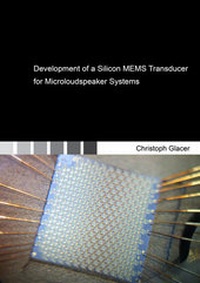
Development of a Silicon MEMS Transducer for Microloudspeaker Systems
1st Edition
Published on 9. July 2015
Book
Paperback/Softback
220 pages
978-3-8440-3763-0 (ISBN)
Description
Within this work, an attempt is made to manufacture a loudspeaker in silicon. To increase the radiated sound, an array of reversibly driven microphones was operated in parallel. The system used was a parallel plate condenser with a movable membrane and an acoustic transparent stator. The Coulomb force causes a deflection of the membrane, according to the applied audio signal voltage.
The maximum deflection of the membrane is limited by the air-gap between membrane and stator. Since the achievable sound pressure is mainly dependent on the displaced air volume, it is vital to increase the air-gap. To achieve this goal, a transducer with a stress-induced static displacement of the stator was invented. With a similar amount of process steps, compared to the Infineon silicon microphone manufacturing systems those transducers are processed flat until the release etch. After this last step, a stress layer causes the whole stator to perform a static out-of-plane deflection which increases the available air-gap. The center deflection is increased to values up to 133 µm and a volume increase by factor 25 for chips with the same area.
Parameters influencing the buckling of the stator have been determined by finite element simulations in the forefield. Novel test structures and various speaker variants are used to validate and optimize the system.
The maximum deflection of the membrane is limited by the air-gap between membrane and stator. Since the achievable sound pressure is mainly dependent on the displaced air volume, it is vital to increase the air-gap. To achieve this goal, a transducer with a stress-induced static displacement of the stator was invented. With a similar amount of process steps, compared to the Infineon silicon microphone manufacturing systems those transducers are processed flat until the release etch. After this last step, a stress layer causes the whole stator to perform a static out-of-plane deflection which increases the available air-gap. The center deflection is increased to values up to 133 µm and a volume increase by factor 25 for chips with the same area.
Parameters influencing the buckling of the stator have been determined by finite element simulations in the forefield. Novel test structures and various speaker variants are used to validate and optimize the system.
More details
Series
Thesis
Doctoral thesis
2015
Universität Bremen
Language
English
Place of publication
Aachen
Germany
Target group
Professional and scholarly
Product notice
Unsewn / adhesive bound
Illustrations
118
Dimensions
Height: 21 cm
Width: 14.8 cm
Weight
330 gr
ISBN-13
978-3-8440-3763-0 (9783844037630)
Schweitzer Classification