

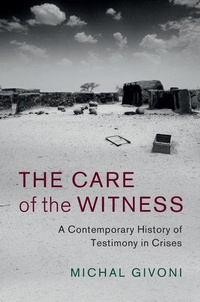
The Care of the Witness
A Contemporary History of Testimony in Crises
Published on 31. October 2016
Book
Hardback
250 pages
978-1-107-15094-2 (ISBN)
Description
During the twentieth century, witnessing grew to be not just a widespread solution for coping with political atrocities but also an intricate problem. As the personal experience of victims, soldiers, and aid workers acquired unparalleled authority as a source of moral and political truth, the capacity to generate adequate testimonies based on this experience was repeatedly called into question. Michal Givoni's book follows the trail of the problems, torments, and crises that became commingled with witnessing to genocide, disaster, and war over the course of the twentieth century. By juxtaposing episodes of reflexive witnessing to the Great War, the Jewish Holocaust, and third world emergencies, The Care of the Witness explores the shifting roles and responsibilities of witnesses in history and the contribution that the troubles of witnessing made to the ethical consolidation of the witness as the leading figure of nongovernmental politics.
Reviews / Votes
'At once thoughtful and provocative, Michal Givoni's The Care of the Witness traces the arteries of testimony that flow through twentieth-century experiences of war, humanitarian action and the Holocaust, exposing them to rigorous analysis. Anyone concerned with the political stakes of contemporary ethical speech should read this book.' Peter Redfield, University of North Carolina, Chapel Hill 'The great virtue of Michal Givoni is that she combines analytical rigor, a wide range of reference, and a deep historical understanding of witnessing with rhetorical delicacy and ethical purpose. Her book is as important for its tone and moral seriousness as it is for its very considerable academic contributions.' Thomas W. Laqueur, University of California, Berkeley 'It is nearly impossible to imagine politics today without witnesses and testimonies, writes Michal Givoni. And, they have fundamentally transformed what we mean by ethics after Auschwitz. However, her breathtaking book shows us how little we have really understood these upheavals. Virtually everything we thought we knew about them now needs to be rethought. Patiently reading her way through a rich theoretical and practical corpus, Givoni takes us from World War I through the Holocaust to Doctors without Borders and social media today, and demonstrates how we might approach witnessing and testimony in a genuinely critical manner - which is to say, to take them seriously, for ethics and for politics.' Thomas Keenan, Director of the Human Rights Project, Bard College, New YorkMore details
Series
Language
English
Place of publication
Cambridge
United Kingdom
Target group
Professional and scholarly
Dimensions
Height: 235 mm
Width: 157 mm
Thickness: 18 mm
Weight
518 gr
ISBN-13
978-1-107-15094-2 (9781107150942)
Copyright in bibliographic data and cover images is held by Nielsen Book Services Limited or by the publishers or by their respective licensors: all rights reserved.
Schweitzer Classification
Other editions
Additional editions
E-Book
11/2016
Cambridge University Press
€84.49
Available for download
E-Book
10/2016
Cambridge University Press
€71.49
Available for download
Person
Michal Givoni teaches in the Department of Politics and Government at Ben-Gurion University of the Negev, Israel. She is co-editor of The Power of Inclusive Exclusion: Anatomy of Israeli Rule in the Occupied Palestinian Territories (2009).
Content
Introduction; 1. The ethics of witnessing and the politics of the governed; 2. Witnessing beyond politics: testimony theory between Auschwitz and the crisis of representation; 3. Witnesses as a public: the authority of experience and the critique of testimonies following the Great War; 4. Empathic listeners and alarmed spectators: secondary witnessing and existential ruin in the Fortunoff Video Archive for Holocaust Testimonies; 5. Humanitarian governance and ethical cultivation: Medecins Sans Frontieres and the advent of the expert-witness; Conclusion: revisiting the ethics of witnessing.