

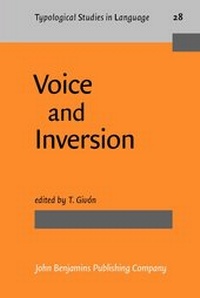
Voice and Inversion
Published on 30. May 1994
Book
Hardback
402 pages
978-90-272-2917-5 (ISBN)
Description
This collection aims first to establish a structure-independent, language-independent definition of pragmatic voice, and more specifically then a universal functional definition of "inverse". The grammar and pragmatic function of the four major voice constructions - direct-active, inverse, passive, antipassive - are surveyed using narrative texts from 14 languages: Koyukon (Athabascan), Plains Cree (Algonquian), Chepang (Tibeto-Burman), Squamish and Bella Coola (Salish), Sahaptin (Sahaptian), Kutenai (isolate), Surinam Carib (Carib), Spanish and Greek (Indo-European), Korean, Maasai (Nilotic), Cebuano and Karao (Philippine). The comparative quantified study of pragmatic voice functions tests the validity of a universal functional definition of voice and in particular of "inverse". The cross-language comparison of grammatical structures that code the various voice functions then lays down the foundation for a non-trivial cross-language typology of "inverse".
More details
Series
Language
English
Place of publication
Amsterdam
Netherlands
Target group
College/higher education
Dimensions
Height: 245 mm
Width: 164 mm
Weight
690 gr
ISBN-13
978-90-272-2917-5 (9789027229175)
Copyright in bibliographic data and cover images is held by Nielsen Book Services Limited or by the publishers or by their respective licensors: all rights reserved.
Schweitzer Classification
Other editions
Additional editions
T. Givón
Voice and Inversion
E-Book
05/1994
1st Edition
John Benjamins Publishing Company
€167.99
Available for download
Person
Content
1. Abbreviations; 2. I. Introduction; 3. The pragmatics of de-transitive voice: Functional and typological aspects of inversion (by Givon, T.); 4. II. Morphological inverses; 5. Passive and inverse constructions (by Thompson, Chad L.); 6. The discourse function of the Kutenei inverse (by Dryer, Matthew S.); 7. Direct, inverse and passive in Northwest Sahaptin (by Rude, Noel); 8. The inverse in Squamish (by Jacobs, Peter); 9. The de-transitive clauses in Bella Coola: Passive vs. Inverse (by Forrest, Linda B.); 10. The pragmatics of de-transitive voice in Spanish: From passive to inverse? (by Hidalgo Downing, Raquel); 11. Semantic and pragmatic inverse: 'Inverse alignment' and 'inverse voice' in Carib of Surinam (by Gildea, Spike); 12. III. Word-order inverses; 13. The pragmatics of Modern Greek voice: Active, inverse and passive (by Roland, Katy); 14. The pragmatics of voice in Korean (by Kwak, Inhee Lee); 15. Active, inverse and passive in Maasai (by Payne, Doris L.); 16. The pragmatics of voice in a Philippine language: Actor-focus and goal-focus in Cebuano narrative (by Payne, Thomas E.); 17. Voice and ergativity in Karao (by Brainard, Sherri)