


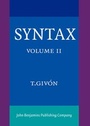
Syntax
A functional-typological introduction. Volume II
Published on 28. February 1991
Book
Hardback
554 pages
978-90-272-2069-1 (ISBN)
Description
The long-awaited second volume of the two-volume work on syntax from a functional-typological perspective. Grammar is viewed as a non-arbitrary language-processing device, to be understood in terms of the various substantive parameters relevant to language: Communicative function, cognitive processing, socio-culture and neuro-biology. Distortions in this complex yet highly iconic code are due to conflicting functional requirements, most commonly introduced into the code through the course of diachronic change. Cross-linguistic variation within each functional domain is highly constrained, and yields a coherent typology of the most natural ways the same communicative function can be performed. The volume covers the syntax of complex clauses, and is organized according to the following plan: Chapter 12: "Noun phrases" Chapter 13: "Verbal complements" Chapter 14: "Voice and de-transitivization" Chapter 15: "Relative clauses" Chapter 16: "Contrastive focus constructions" Chapter 17: "Marked topic constructions" Chapter 18: "Non-declarative speech acts" Chapter 19: "The grammar of interclausal coherence" Chapter 20: "The grammar of referential coherence as mental processing instructions" Chapter 21: "Markedness and iconicity in syntax".
More details
Language
English
Place of publication
Amsterdam
Netherlands
Target group
College/higher education
Professional and scholarly
Dimensions
Height: 245 mm
Width: 164 mm
Weight
950 gr
ISBN-13
978-90-272-2069-1 (9789027220691)
Copyright in bibliographic data is held by Nielsen Book Services Limited or its licensors: all rights reserved.
Schweitzer Classification
Other editions
New editions
Book
07/2001
John Benjamins Publishing Co
€127.20
Shipment within 10-15 days
Person
Content
Noun phrases; verbal complements; voice and de-transitivization; relative clauses; contrastive focus constructions; marked topic constructions; non-declarative speech acts; the grammar of interclausal coherence; the grammar of referential coherence as mental processing instructions; markedness and iconicity in syntax.